

Introduction
Welcome to earnfx.ng! If you are a beginner in Nigeria stepping into the world of global currency trading, there is one critical concept you must understand before placing a single trade: you need strict forex rules.
Many new traders jump into the market looking at charts and trying to guess where prices will go, but without a predefined set of personal guidelines, trading quickly becomes gambling. Forex rules are the specific, unbending limits you set for yourself regarding how much money you risk, when you enter a trade, and when you walk away. In this beginner-friendly guide,

we will explain exactly what these rules are, why they are your ultimate defense against volatile markets, and how you can build a safe foundation for your trading education.
Disclaimer: Trading involves significant risk. This content is for educational purposes only and does not constitute financial advice.
Table of Contents
Why Forex Rules Are the Foundation of Trading Education

Many beginners mistakenly believe that success in foreign exchange comes from predicting exactly where the market will go. In reality, the market is unpredictable. No one knows with absolute certainty what a currency pair like the EUR/USD or GBP/USD will do in the next hour or day. Because the market cannot be controlled, the only thing a trader can control is themselves. This is why forex rules exist.
Forex rules act as a structural boundary between logic and emotion. When the market moves rapidly—perhaps due to a global news event—human nature often triggers fear or greed. A trader without rules might panic and close a trade too early, or get greedy and risk too much money. Forex rules remove this emotional guesswork. When you have a rule for every scenario, you do not have to make stressful decisions in the heat of the moment; you simply follow the rules you established beforehand.
If you remove forex rules from your educational journey, the entire foundation of trading collapses. You are left with random decisions, inconsistent actions, and unmanaged risks.
The Core Forex Rules Every Beginner Must Learn
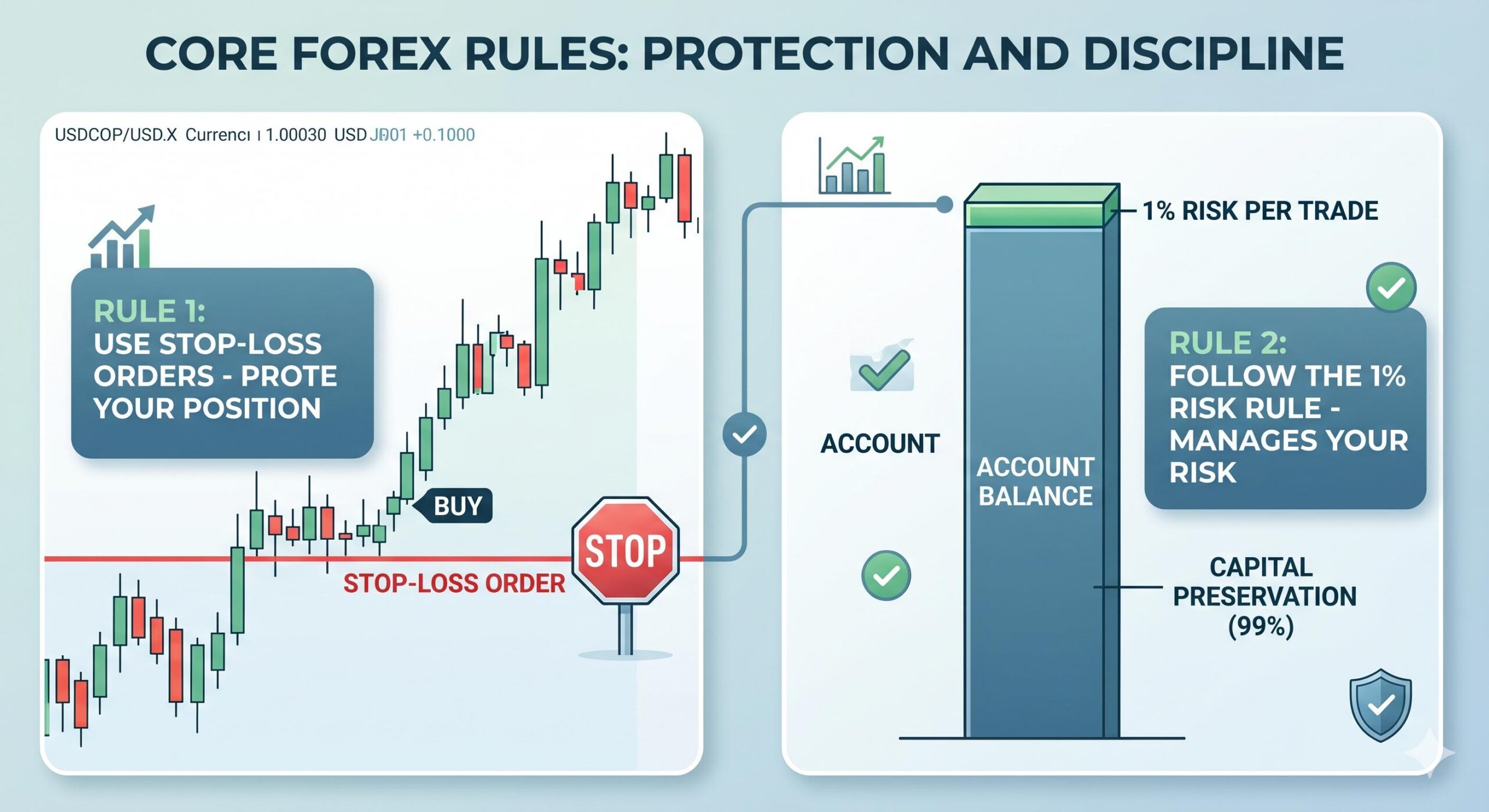
To build a solid educational foundation, a beginner must understand the universally recognized forex rules that govern risk and capital preservation. Here are the most essential rules to study:
1. The Rule of the Stop-Loss
The most non-negotiable of all forex rules is the mandatory use of a stop-loss order. A stop-loss is an automatic exit point set in your trading platform that closes your trade if the market moves against you by a specific amount. The rule is simple: never place a trade without a predetermined stop-loss. This rule ensures that a single bad decision does not wipe out your entire trading account. It acts as an emergency brake, protecting your capital from unexpected market crashes.
2. The 1% to 2% Risk Rule
Capital preservation is the ultimate goal of any educational trading strategy. One of the most vital forex rules regarding risk management states that you should never risk more than 1% to 2% of your total account balance on a single trade. For example, if your practice account has $100 (or its Naira equivalent), risking 1% means you structure your trade so that if your stop-loss is hit, you only lose $1. By following this rule, you would have to lose 100 times in a row to deplete your account, giving you ample time to learn, make mistakes, and understand market behavior without financial ruin.
3. The Rule of the Trading Plan

A trading plan is a comprehensive document that outlines your overall strategy, while your forex rules enforce that plan. The rule here is: never trade outside your plan. Your plan should specify which currency pairs you are watching, what times of day you will observe the charts (such as during the London or New York sessions, which align well with West African Time), and exactly what conditions must be met before you consider a setup valid. If the market does not meet the criteria of your plan, your forex rules dictate that you must stay out of the market entirely.
4. The Rule of Emotional Detachment
The foreign exchange market does not care about your emotions. One of the hardest forex rules for beginners to master is avoiding “revenge trading” and “FOMO” (Fear Of Missing Out). Revenge trading happens when a beginner loses a trade and immediately opens another one out of frustration to win the money back. FOMO occurs when a trader sees a massive price spike and jumps in late without a plan. Your forex rules must strictly prohibit entering the market based on anger, frustration, or excitement.
5. The Rule of Keeping a Trading Journal
Education requires review. A core rule for long-term understanding is maintaining a detailed trading journal. Every time you take a practice trade, you must record why you took it, what your risk was, how you managed the trade, and what the final outcome was. Reviewing this journal allows you to see if you are actually following your forex rules or if you are breaking them. It highlights your weaknesses and provides a factual basis for improving your market knowledge.
How Forex Rules Protect You from Inherent Market Risks
Understanding forex rules is impossible without understanding risk. The currency market involves the use of leverage, a tool that allows traders to control large positions with a small amount of money. While leverage is a standard feature of the market, it is a double-edged sword because it amplifies both potential movements and potential losses.
Without strict forex rules, leverage can be incredibly dangerous. A beginner who does not follow the 1% risk rule might misuse leverage and expose their account to massive fluctuations. Forex rules act as a barrier against the dangers of leverage. By forcing you to calculate your position size carefully and placing a hard stop-loss, your rules ensure that you are treating leverage with the respect and caution it requires. The rules keep your exposure strictly defined, shifting the focus from “how much can I make?” to “how much am I protected from losing?”
The Essential Forex Rules: A Beginner’s Survival Guide in Nigeria
Building Your Own Set of Personal Forex Rules
As you continue your education here on earnfx.ng, your goal should be to draft your own personal rulebook. Every trader in Nigeria will have slightly different rules based on their daily schedule, risk tolerance, and learning style.
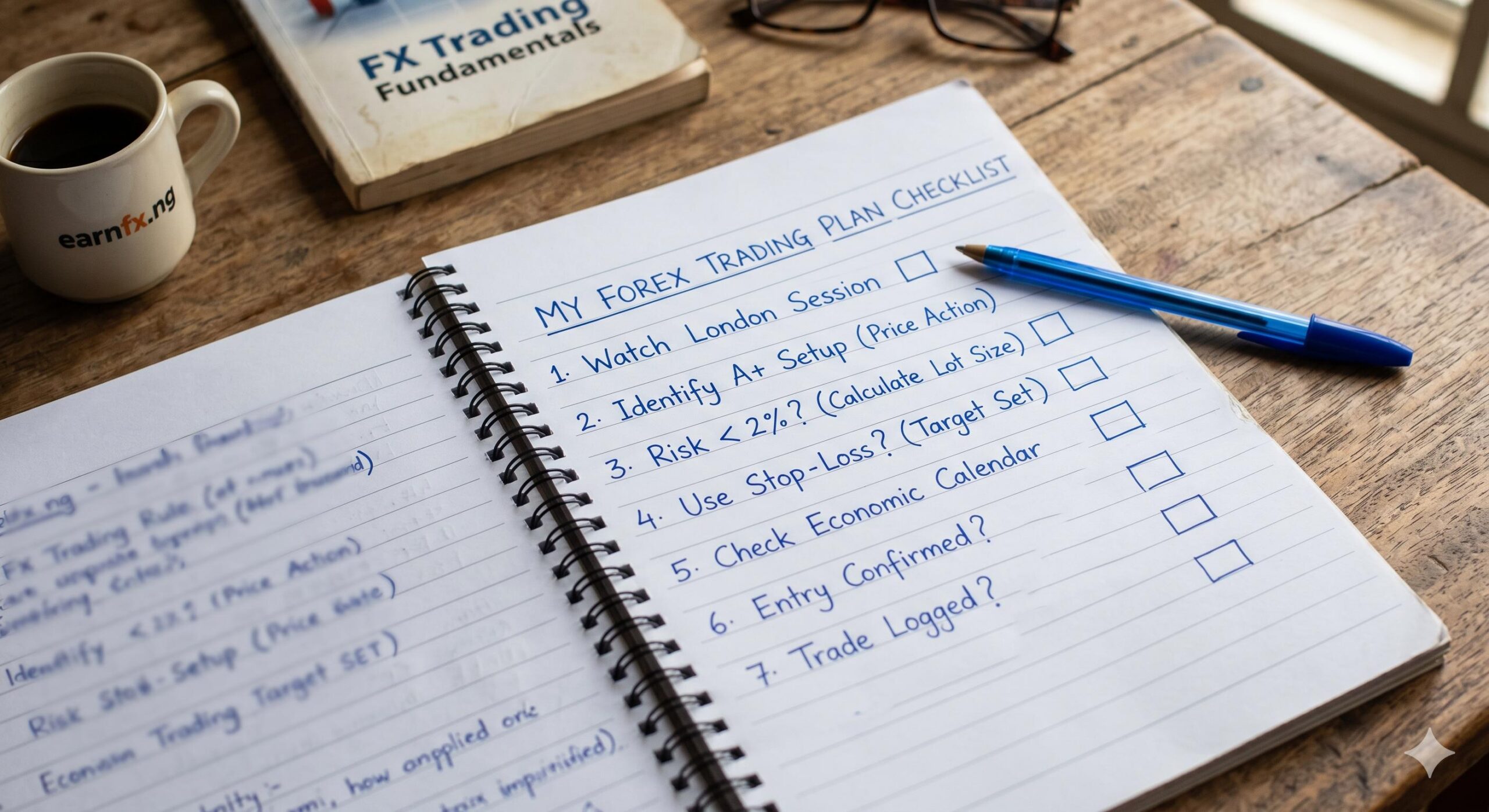
To start, write down a checklist before you open your charts. Your checklist might look like this:
- Rule 1: I will only look at the charts between 8:00 AM and 11:00 AM WAT.
- Rule 2: I will always calculate my lot size to ensure my risk does not exceed 1% of my demo account.
- Rule 3: I will physically place a stop-loss order the moment I enter the market.
- Rule 4: If I experience two consecutive losses in one day, I will shut down my computer and stop observing the market for 24 hours.
If you cannot check every single box on your rule list, you simply do not participate in the market that day. This level of discipline is what separates those who approach trading as a serious educational endeavor from those who treat it irresponsibly.
Frequently Asked Questions (FAQs)
1. What are the most important forex rules for beginners? The most critical forex rules include always using a stop-loss order to cap your potential losses, never risking more than 1% to 2% of your account balance on a single trade, and strictly following a pre-written trading plan instead of trading based on emotions.
2. Can I trade successfully without having forex rules? No. Trading without defined rules is highly discouraged and extremely risky. Without rules, traders rely on emotions like fear and greed, which almost always leads to poor decision-making and rapid depletion of their trading account. Rules provide the logical structure needed to navigate an unpredictable market safely.
3. Do forex rules guarantee that I will not lose money? No, there are absolutely no guarantees in trading, as the market involves inherent risk. However, forex rules are designed to manage and minimize your risk. While you will still experience losing trades, strict rules ensure that those losses are kept small and manageable, preventing total account ruin.
4. How do I create my own set of forex rules? You can create your own rules by evaluating your personal schedule, your risk tolerance, and your educational goals. Start by writing down a simple checklist: decide exactly what times of day you will look at the charts, set a strict maximum percentage for your risk per trade, and define exactly what conditions must be met before you enter the market.
5. Why is emotional control considered a forex rule? The market is highly volatile and can easily trigger panic or over-excitement. Establishing a rule to step away from the computer after consecutive losses—or refusing to trade when you are upset—protects you from “revenge trading” and making impulsive decisions outside of your logical trading plan.
Conclusion: Discipline is the Ultimate Rule
In summary, grasping the concept of forex rules is the most valuable step a beginner can take. The mechanics of the market—understanding pips, charts, and trends—mean very little if you do not have the discipline to protect yourself.
Your forex rules are your safety harness in an unpredictable environment. They keep you grounded, protect your educational capital, and ensure that your journey into the foreign exchange market is safe, measured, and responsible. Take the time to write down your rules, study them daily, and commit to following them without exception. Remember, the goal of a beginner is not to seek profits, but to learn how the market works while managing risk flawlessly. Stick to your forex rules, prioritize your education, and always trade responsibly.