


Introduction
If you want to know the 10 golden rules of forex trading, they are the ultimate survival principles for navigating the foreign exchange market safely. Here is the direct answer: 1) Always use a stop-loss order, 2) Risk only 1% to 2% of your capital per trade, 3) Follow a strict written trading plan, 4) Detach your emotions from the market, 5) Do not over-leverage your account, 6) Avoid revenge trading after a loss, 7) Monitor fundamental economic news, 8) Trade with the overarching trend, 9) Keep a detailed trading journal, and 10) Accept that losses are inevitable.

Welcome to earnfx.ng. Applying these exact guidelines is the foundation of market education for any beginner in Nigeria. Before we break down why each principle matters, please note: trading involves risk, this guide is for educational purposes only, and does not constitute financial advice.
Table of Contents
Why the 10 Golden Rules of Forex Trading Matter
The foreign exchange market is incredibly volatile. Without a strict framework of rules, beginners rely on guesswork, which inevitably leads to the total loss of their trading capital. The 10 golden rules of forex trading are not about making money; they are entirely focused on capital preservation and risk management. If you remove these rules from your strategy, your entire trading structure will collapse. Let’s explore each rule in detail.
1. Always Use a Stop-Loss Order

The very first of the 10 golden rules of forex trading is to protect your downside. A stop-loss is an automatic order placed with your broker to close a trade once it hits a specific negative price point. The market can move unpredictably due to sudden global events. If you are a beginner in Nigeria trading without a stop-loss, a sudden spike against your position can wipe out your entire account balance before you even have the chance to react. Using a stop-loss ensures that your risk is strictly capped on every single trade you take.
2. Risk Only 1% to 2% of Your Capital Per Trade
Capital preservation is the core of forex education. This rule dictates that you should never risk more than a tiny fraction of your total account balance on one single market movement. For example, if you fund your account with the Naira equivalent of $100, risking 1% means you stand to lose only $1 if the trade hits your stop-loss. By adhering to this mathematical rule, you would have to lose 100 consecutive trades to drain your account. This principle prevents catastrophic financial loss and keeps you in the game long enough to learn.
3. Follow a Strict Written Trading Plan
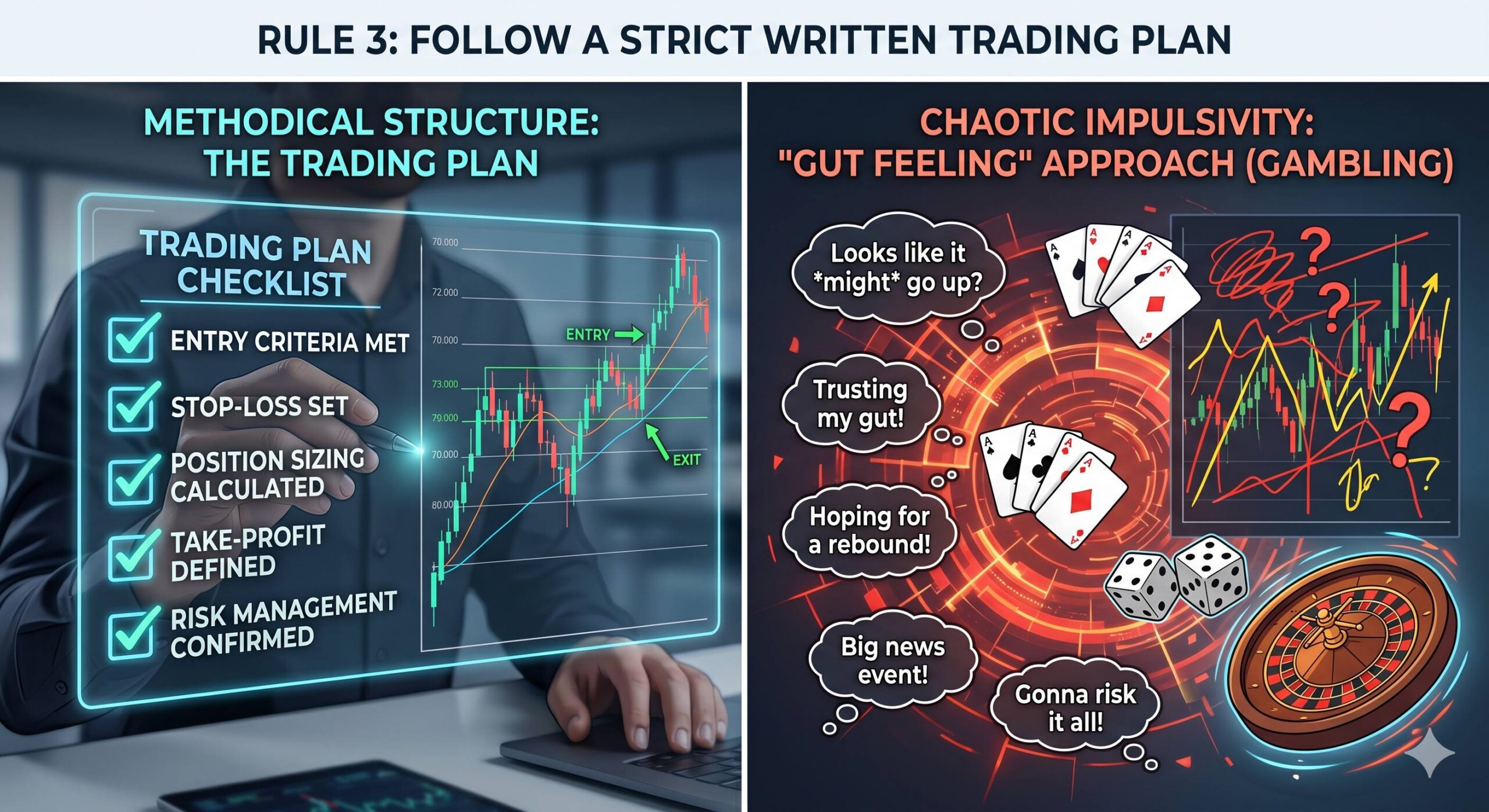
Entering the market without a plan is just gambling. A trading plan is a written document that defines exactly what currency pairs you will trade, what time of day you will analyze the charts, what specific technical setups you are looking for, and exactly when you will exit a trade. The 10 golden rules of forex trading require you to treat this as a serious educational discipline. If a potential trade does not meet every single checklist item on your written plan, you simply do not execute it.
4. Detach Your Emotions from the Market
Fear and greed are the two primary reasons beginners fail. When you see a trade moving in your favor, greed might convince you to remove your take-profit order, hoping for more. When a trade moves against you, fear might cause you to close it prematurely, or worse, move your stop-loss further away. Emotional trading breaks all the rules of risk management. You must learn to view the charts neutrally, accepting the outcome of the probabilities you have calculated without emotional attachment.
5. Do Not Over-Leverage Your Account

Leverage is essentially a tool provided by your broker that allows you to control a large position size with a small initial deposit. While it can magnify market movements, it equally magnifies your risk exposure. One of the most critical of the 10 golden rules of forex trading is to keep your leverage low, especially as a beginner. High leverage means that even a minor fluctuation in the exchange rate can result in a margin call, where the broker forcefully closes your trades because your account can no longer sustain the floating loss.
6. Avoid Revenge Trading After a Loss
Revenge trading happens when a trader suffers a loss and immediately jumps back into the market with a larger lot size, desperately trying to win the lost capital back. This is an emotional reaction that abandons all logic, risk management, and planning. If you lose a trade, the absolute best action is to step away from the computer, review what happened in your journal, and wait for the next calm, planned opportunity.
7. Monitor Fundamental Economic News
Even if you only study technical analysis (chart patterns), you must respect fundamental news. Economic announcements—such as inflation reports, interest rate decisions by central banks, or employment data—inject massive volatility into the forex market. The 10 golden rules of forex trading dictate that beginners should ideally avoid executing new trades right before major news releases, as the resulting price spikes can easily trigger stop-losses unpredictably.
8. Trade With the Overarching Trend
There is an old saying in market education: “The trend is your friend.” The forex market generally moves in established directions over time. If the US Dollar is consistently gaining strength against the Japanese Yen over several weeks, it is an uptrend. Beginners should look for opportunities that align with this dominant direction rather than trying to constantly predict when the market will suddenly reverse. Trading with the trend puts the broader market momentum on your side.
9. Keep a Detailed Trading Journal

You cannot improve what you do not measure. A trading journal is a log where you record the date, time, currency pair, entry price, exit price, and the exact reason why you took the trade based on your plan. More importantly, it is where you record your emotional state and any mistakes you made. Reviewing this journal weekly is how Nigerian beginners transition from guessing to understanding their own psychological weaknesses and structural errors in the market.
10. Accept That Losses Are Inevitable
The final entry in the 10 golden rules of forex trading is a harsh reality check: you will lose trades. No strategy in the world wins 100% of the time. Professional risk management is about ensuring your winning trades are larger than your losing trades, or that you win frequently enough that the small, controlled 1% losses do not damage your overall account health. You must learn to view a lost trade not as a personal failure, but as a standard business expense required to operate in the forex market.
The Essential Forex Rules: A Beginner’s Survival Guide in Nigeria
Frequently Asked Questions (FAQ)
What is the most important rule in forex trading for beginners?
While all the 10 golden rules of forex trading are crucial, capital preservation is the absolute foundation. This is primarily achieved through Rule #1 (Always use a stop-loss) and Rule #2 (Risking only 1% to 2% per trade). If you do not protect your trading capital first, you will not survive in the market long enough to learn how to trade effectively.
Can I trade forex without using a stop-loss order?
Trading without a stop-loss is highly dangerous and strictly goes against beginner risk management principles. The forex market can experience sudden, violent price spikes due to unexpected global news. Without a stop-loss, a single bad trade can completely wipe out your entire account balance in minutes.
Why do I need a written trading plan?
A written trading plan removes emotion and guesswork from your decisions. It acts as a strict business framework that tells you exactly when to enter a trade, when to exit, and how much to risk. If you trade based on “gut feeling” rather than a written plan, you are gambling, not trading.
How much money should a beginner risk on a single trade?
The golden mathematical rule for risk management is to never risk more than 1% to 2% of your total account equity on a single trade. If you have a $100 account (or its Naira equivalent), your stop-loss should be calculated so that you lose no more than $1 to $2 if the trade goes against you.
Do these golden rules guarantee that I will not lose money?
No. There are absolutely no guarantees in forex trading. Losses are an unavoidable part of participating in the financial markets (as stated in Rule #10). These rules are designed strictly for risk management—to ensure that when you do lose, the losses are small, controlled, and do not destroy your overall account equity.
Conclusion
Mastering the 10 golden rules of forex trading is not something that happens overnight. It requires immense patience, discipline, and a commitment to continuous education. By implementing strict stop-losses, managing your leverage, removing emotion from your decisions, and keeping a diligent journal, you protect yourself from the severe risks inherent in the global currency markets.
At earnfx.ng, we encourage all beginners in Nigeria to practice these ten rules extensively on a free demo account using virtual funds. Only when you have proven you can follow these rules without fail should you ever consider exposing real capital to the live market. Stay focused on your education, respect the risks, and prioritize the safety of your capital above all else.