

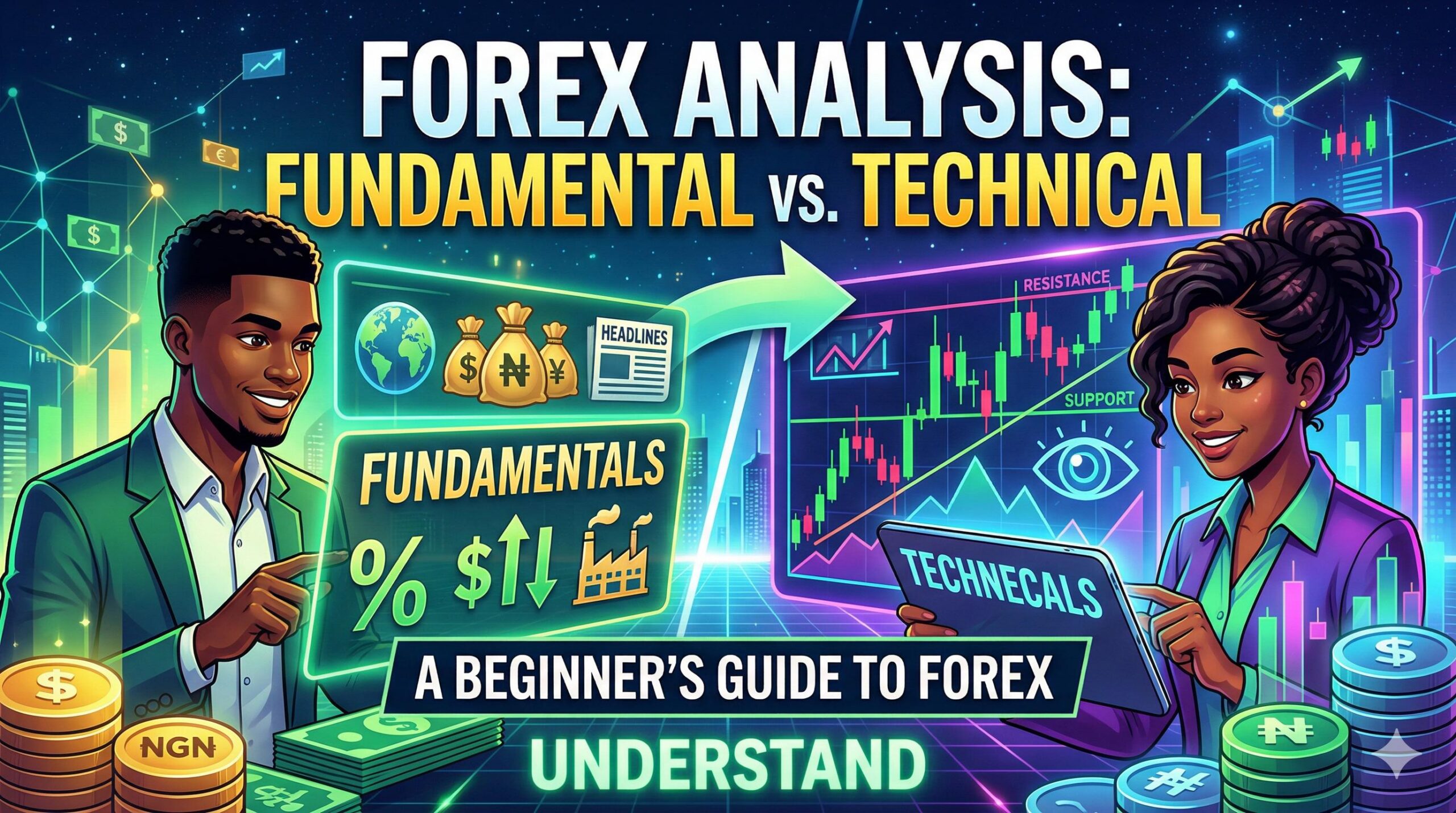
Introduction: The Two Pillars of Market Research
When new traders in Nigeria start exploring the foreign exchange market, they quickly encounter the phrase fundamental & technical analysis.
To answer simply: fundamental & technical analysis are the two primary methods traders use to evaluate currencies and predict future price movements. Fundamental analysis looks at the real-world economic health of a country (like interest rates or inflation) to understand why a currency has value. Technical analysis ignores the news and focuses strictly on studying historical price charts and mathematical indicators to determine when a price might move next based on past patterns.
Together, they form the complete toolkit for making educated market decisions rather than relying on guesswork.

Disclaimer: Trading involves a high level of risk and may not be suitable for all individuals. This article is strictly for educational purposes only and does not constitute financial advice. It is entirely possible to lose your capital. Always prioritize risk awareness.
Table of Contents
What is Fundamental Analysis in Forex?
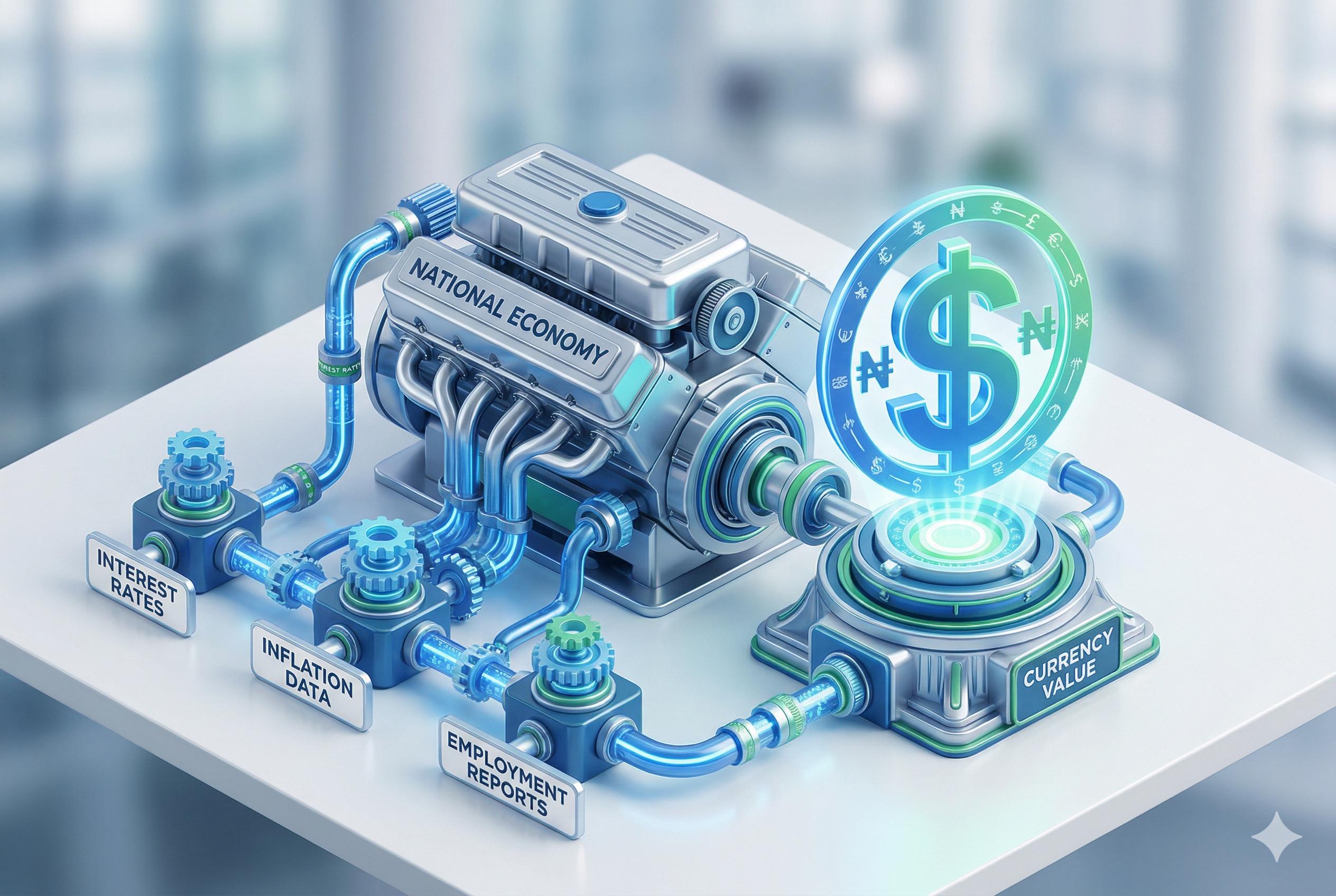
Within the framework of fundamental & technical analysis, the fundamental side is all about the “big picture.” It is the study of the underlying economic health of a country and how that health affects the value of its currency.
Think of it like buying a physical business in Lagos. Before buying, you would look at the company’s revenue, its debts, the overall Nigerian economy, and consumer demand. In forex, fundamental analysis applies this same logic to entire nations. If a country’s economy is strong and growing, foreign investors will want to invest there. To do so, they must buy that country’s currency, which drives the currency’s value up.
Key Factors in Fundamental Analysis
When applying this method, traders monitor official economic reports and global news. Some of the most important factors include:
- Interest Rates: This is the most significant driver of currency value. Central banks, like the Central Bank of Nigeria (CBN) or the US Federal Reserve, set interest rates. Generally, higher interest rates attract foreign investment, increasing the demand for the currency.
- Inflation Data: High inflation erodes the purchasing power of a currency. Traders watch consumer price indexes tightly, as severe inflation usually leads to currency depreciation.
- Employment Reports: If a country is creating jobs and unemployment is low, consumer spending typically rises, leading to a stronger economy and a stronger currency.
- Geopolitical Events: Elections, trade agreements, or global crises can cause massive shifts in currency demand. For example, during times of global economic uncertainty, traders often buy the US Dollar as a “safe haven.”
By understanding these macroeconomic factors, a trader can form a long-term bias on whether a currency pair is likely to rise or fall over weeks or months.
What is Technical Analysis in Forex?
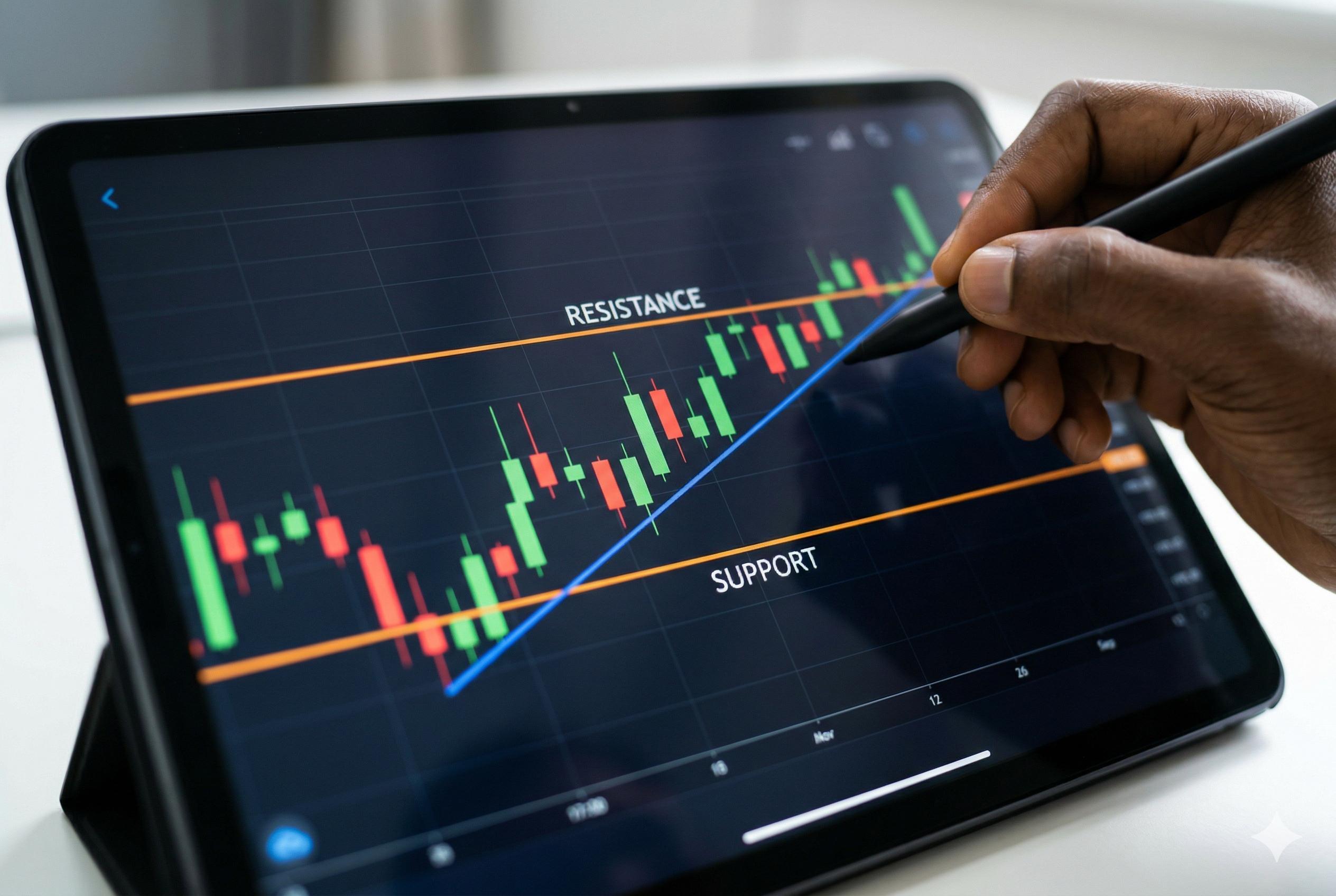
While fundamental analysis tells you why a market should move, the second half of fundamental & technical analysis focuses entirely on the price itself. Technical analysis is the study of historical market data, primarily using visual charts, to identify trends and predict future price movements.
Technical analysts believe that all fundamental news—every interest rate change, every employment report—is already reflected in the current market price on the screen. Therefore, instead of reading economic reports, they focus entirely on the charts in front of them.
The core philosophy of technical analysis is that market psychology repeats itself. Human emotions like fear and greed cause prices to move in recognizable visual patterns. If a specific pattern preceded a drop in price five times in the past, a technical analyst assumes it will likely cause a drop the sixth time.
Key Tools in Technical Analysis
The technical side relies heavily on platform tools rather than news websites:
- Price Charts: The most common tool is the Japanese Candlestick chart. These charts show the open, high, low, and close prices for a specific time period, giving traders a visual representation of the battle between buyers and sellers.
- Support and Resistance: These are invisible “floors” and “ceilings” on a chart. Support is a price level where a falling currency repeatedly stops falling and bounces back up. Resistance is a level where a rising currency repeatedly stops rising and falls back down.
- Trendlines: Traders draw lines on their charts to visualize the general direction of the market—whether it is an uptrend, a downtrend, or a ranging (sideways) market.
- Indicators: These are mathematical calculations applied to the price, such as Moving Averages or the Relative Strength Index (RSI), which help confirm trends or signal potential reversals.
Fundamental & Technical Analysis: The Key Differences
To fully grasp fundamental & technical analysis, beginners must understand how they contrast. They are two entirely different lenses through which to view the exact same market.
| Feature | Fundamental Analysis | Technical Analysis |
| Primary Focus | Economic data, news, and political events. | Historical price charts, patterns, and indicators. |
| The Main Question | Why is the price moving? | When and where will the price move next? |
| Time Horizon | Usually long-term (weeks, months, years). | Usually short-term (minutes, hours, days). |
| Data Source | Economic calendars, government reports, central bank speeches. | Trading platforms (like MetaTrader 4), raw price data. |
| Core Belief | A currency will eventually gravitate toward its true economic value. | History repeats itself; price action reflects all available information. |
Combining Both: The Balanced Approach
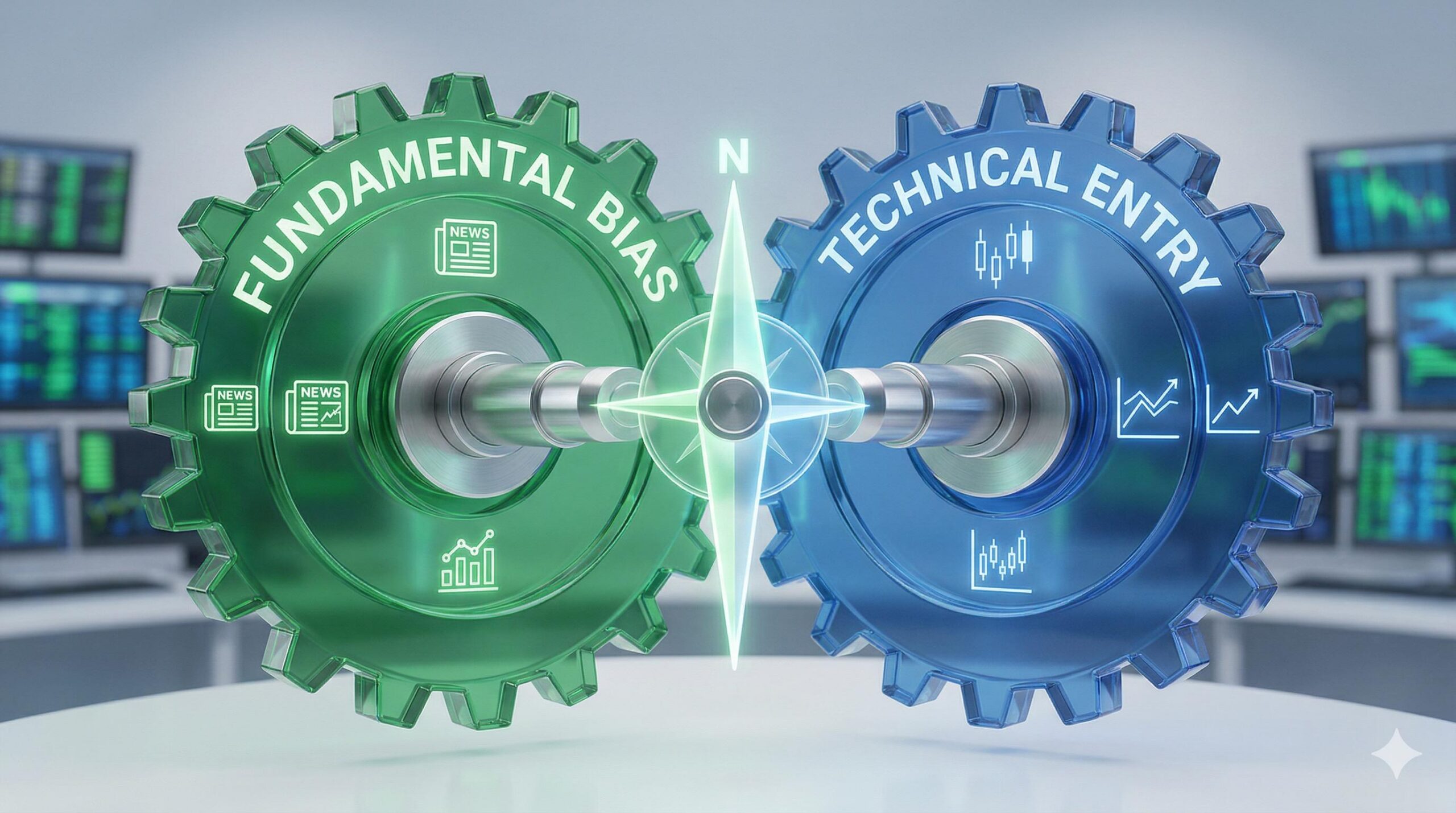
One of the most common debates among beginners is deciding which method is “better.” The truth is, the most educated approach to the markets involves combining fundamental & technical analysis. Relying strictly on one while ignoring the other can leave you blind to major market risks.
Here is an example of how a balanced trader uses fundamental & technical analysis together:
- Finding the Direction (Fundamental): A trader reads that the US Federal Reserve is planning to raise interest rates to combat inflation. Based on fundamental analysis, the trader determines that the US Dollar (USD) will likely strengthen against the Euro (EUR). Their fundamental bias is to look for opportunities to “buy” the USD.
- Finding the Entry Point (Technical): Even if the USD is fundamentally strong, the trader does not buy blindly. They open their charting platform and use technical analysis. They look at the EUR/USD chart to find a strong area of “support.” They wait patiently until the price hits that specific technical level before entering the trade, ensuring they execute at a logical point to manage their risk.
In this scenario, fundamentals dictate what to trade, while technicals dictate exactly when to execute the trade.
Price Action Trading vs Indicator Trading : A Beginner’s Guide
Frequently Asked Questions (FAQs)
To further your forex education, here are the most common questions beginners in Nigeria ask when learning about market analysis.
1. Which is easier for a beginner to learn first?
Most beginners find technical analysis slightly easier to start with because it is highly visual. You can open a free demo account and immediately start looking at charts, drawing lines, and identifying support and resistance. Fundamental analysis requires a deeper understanding of global economics and a commitment to reading daily financial news.
2. Can I trade successfully using only one method?
While some professional traders rely almost entirely on one method, it is highly recommended for beginners to understand both. A pure technical trader might have a perfect chart setup, but if a massive, unexpected fundamental news report (like an emergency interest rate cut) is released, it can destroy the technical pattern in seconds. Knowing the fundamentals helps you avoid trading during highly volatile news events.
3. What tools do I need to perform fundamental & technical analysis?
For fundamental analysis, you need an Economic Calendar (available for free on many financial websites) to track when major global reports are released. For technical analysis, you need a Trading Platform (such as MetaTrader 4 or MetaTrader 5), which your broker provides, giving you access to live charts and technical indicators.
4. Does mastering fundamental & technical analysis guarantee I will make money?
Absolutely not. This is a critical point of education. No form of analysis guarantees a profitable trade. The forex market is largely unpredictable. Analysis simply gives you a logical framework to make educated decisions rather than gambling. True longevity in trading comes from strict risk management, not just perfect analysis.
Conclusion: Education Over Expectation
Learning fundamental & technical analysis is a required step for anyone looking to navigate the foreign exchange market responsibly. Fundamental analysis grounds you in the economic reality of why currencies fluctuate, while technical analysis provides the practical tools to read price action on a screen.
However, always remember that analysis is not a crystal ball. Because both methods can and will fail frequently, risk management must remain your top priority. Responsible traders never risk money they cannot afford to lose, and they always utilize tools like “Stop-Loss” orders to protect their account balances when the market moves against their predictions.

As you continue your education here on EarnFX Nigeria, focus on understanding the mechanics of these analytical methods on a risk-free demo account before ever considering live trading.