

Introduction
Risk Management For Forex Beginners Trading In Nigeria is the fundamental practice of using strict rules and strategies to safeguard your trading capital from major loss. In simple terms, it is the protective wall against losing all of your funds from a single bad trade as a new trader. For a newbie, trading is not about making money when you start out — it’s about learning how the markets work while protecting your capital. Beginners can skillfully traverse the unstable forex market without risking their hard earned money to unnecessary danger by utilizing basic risk management practices, such as establishing limits on what constitutes an acceptable loss, familiarizing oneself with position sizes and guarding against emotional negotiators.

Welcome to earnfx.ng, your educational resource for understanding the basics of trading. In this guide, we will break down exactly how to protect your capital and why risk management is the single most important concept for any new trader to learn.
Table of Contents
Why Risk Management is Crucial for Nigerian Beginners
While this may suffice for most new traders learning about the foreign exchange market, a lot of time is spent studying charts and trying to predict price movements as well. Nevertheless, the market direction can never be guaranteed. That level of discipline and attention when it comes to money management have nuances for a trader from Nigeria.
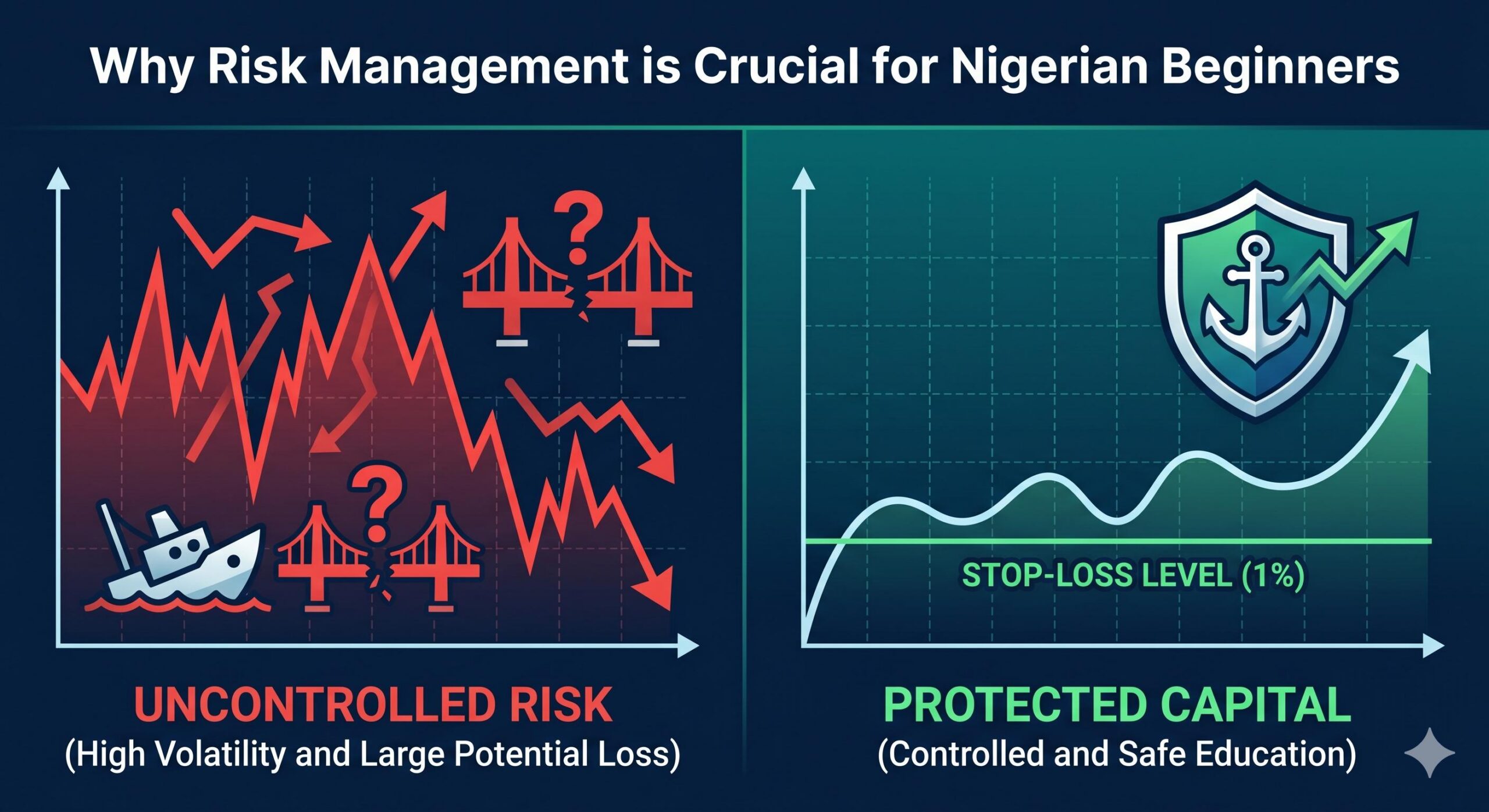
Accounts always funded with foreign funds like USD. Considering the exchange rate movements between the Nigerian Naira (NGN) and then USD, funding any trading account requires a huge capital outlay. Losing such capital soon due to poor risk management can wipe you out. Proper risk management allows you to limit the financial loss of your beginner mistakes (and every beginner makes them) so that it is minimal, controlled, and within limits of which you have already made yourself aware. Once you take risk management out of your trading process, then you are not making educated or calculated decisions anymore; you are gambling.
Core Principles of Risk Management for Forex Beginners Trading in Nigeria
To actively manage risk, beginners must implement specific, measurable rules before entering any trade. Here are the foundational pillars of protecting your capital.
1. The 1% Risk Rule
The 1% rule is the most widely known capital preservation rule. This principle states that an individual trader should never put more than 1% of their entire account balance at risk with one order.
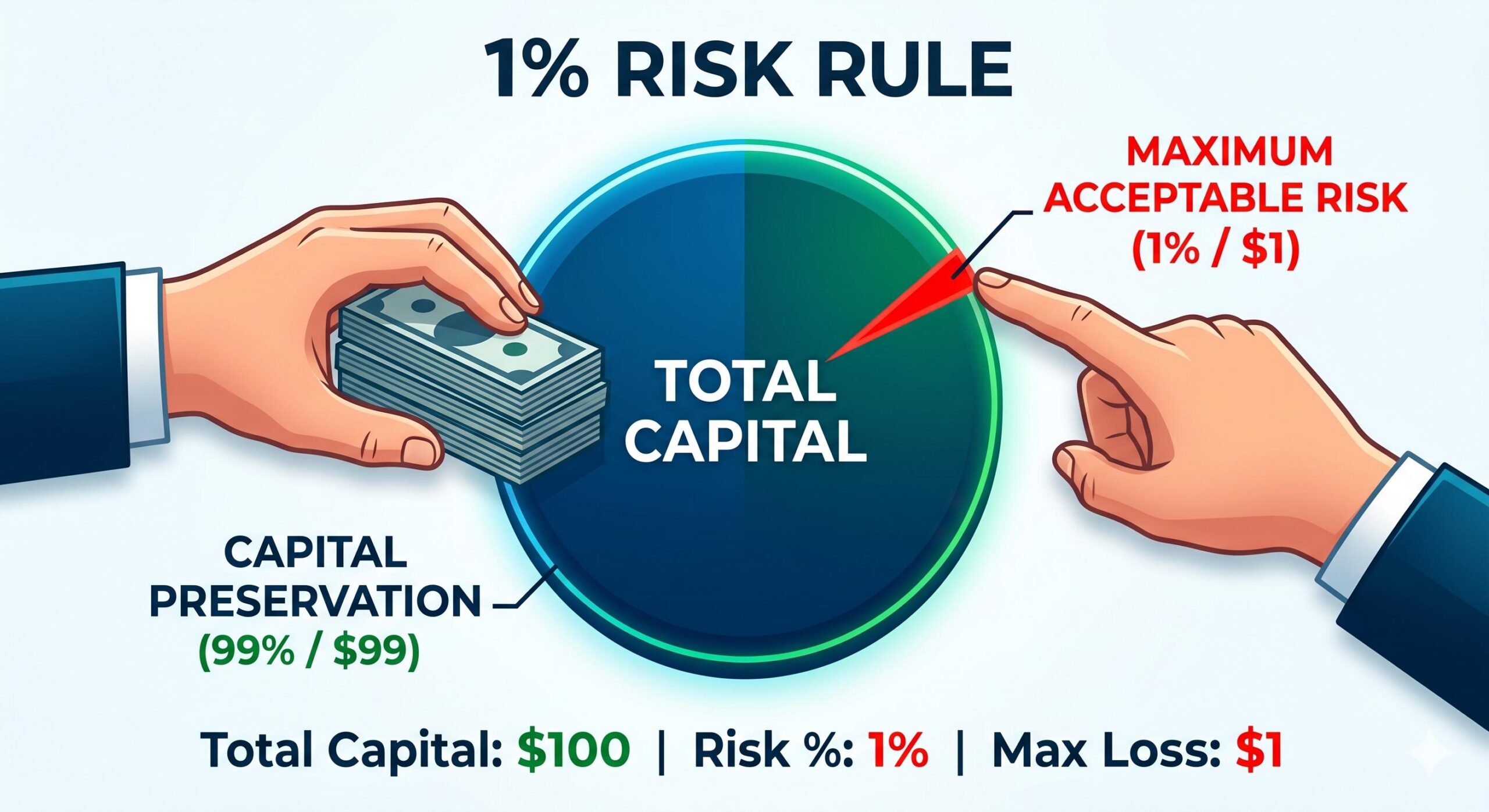
- How it works: If you have funded an educational trading account with $100, you should structure your trade so that the maximum potential loss is exactly $1.
- Why it matters: By strictly adhering to the 1% rule, a beginner would have to lose 100 consecutive trades to drain their account. This provides a massive safety net, allowing the trader to experience the market, learn from losing trades, and adjust their strategies without facing account ruin.
2. Using Stop-Loss Orders Always
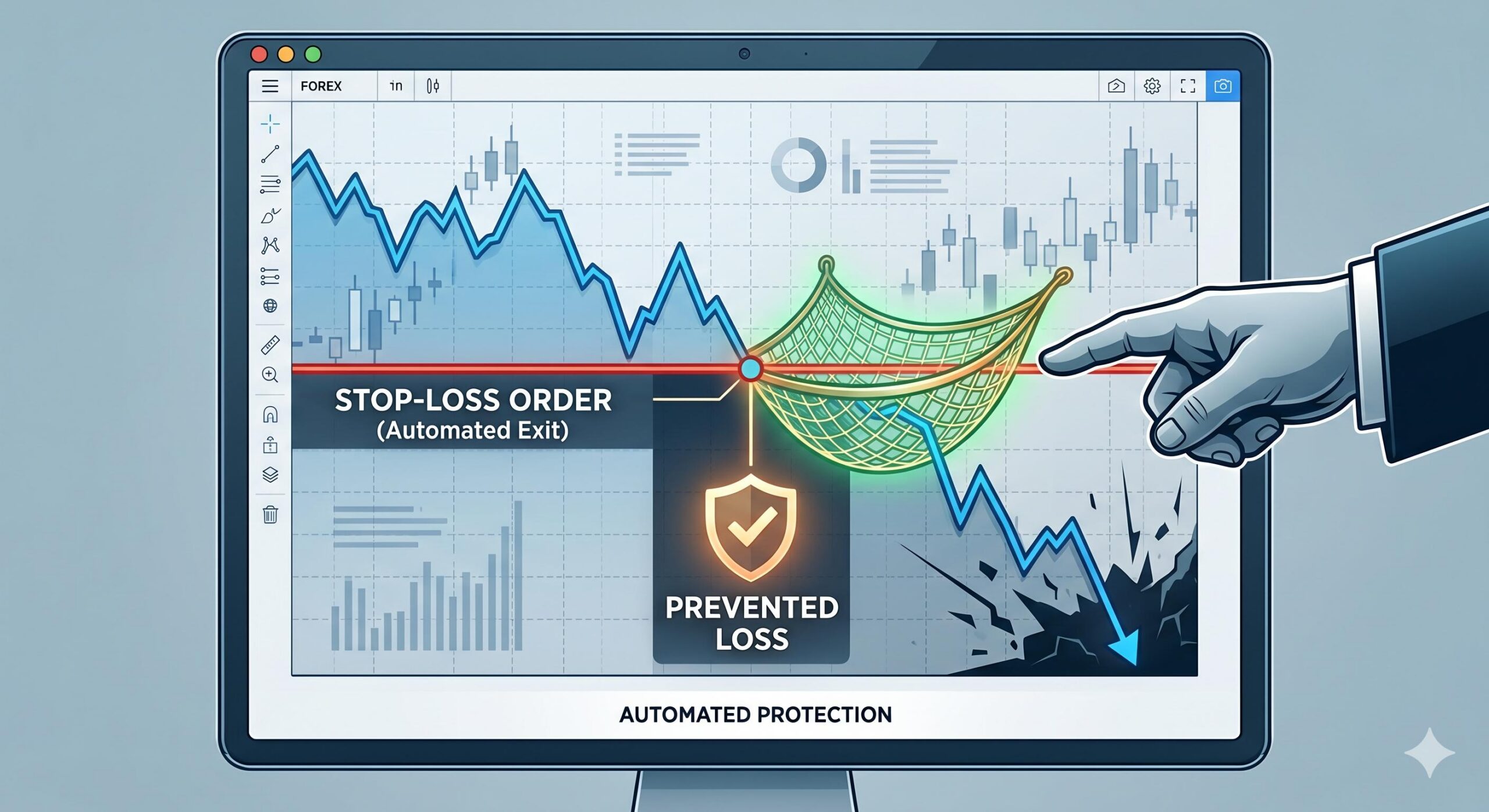
A stop-loss is a kind of stop order, defined by the investor or trader before a trade happens and given as an automatic order to your trading platform to close at market price any open position if it becomes worth a certain negative threshold.
- The absolute rule: A novice trader should never step into the market without a stop-loss order actually working.
- The benefit: If the market suddenly does a 180 away from your expectation—like on some catastrophic world news—the stop-loss will simply close out the trade for you at the predetermined loss level that you are okay with (i.e., a 1% risk). This removes any indecision and makes sure that a small loss doesn t roll into such a big one.
3. Understanding and Limiting Leverage
Leverage enables traders to trade an oversized position into the market with a smaller amount of actual capital. But this is not only a common feature of forex delem but the main reason us new beginners lost their money so quickly.
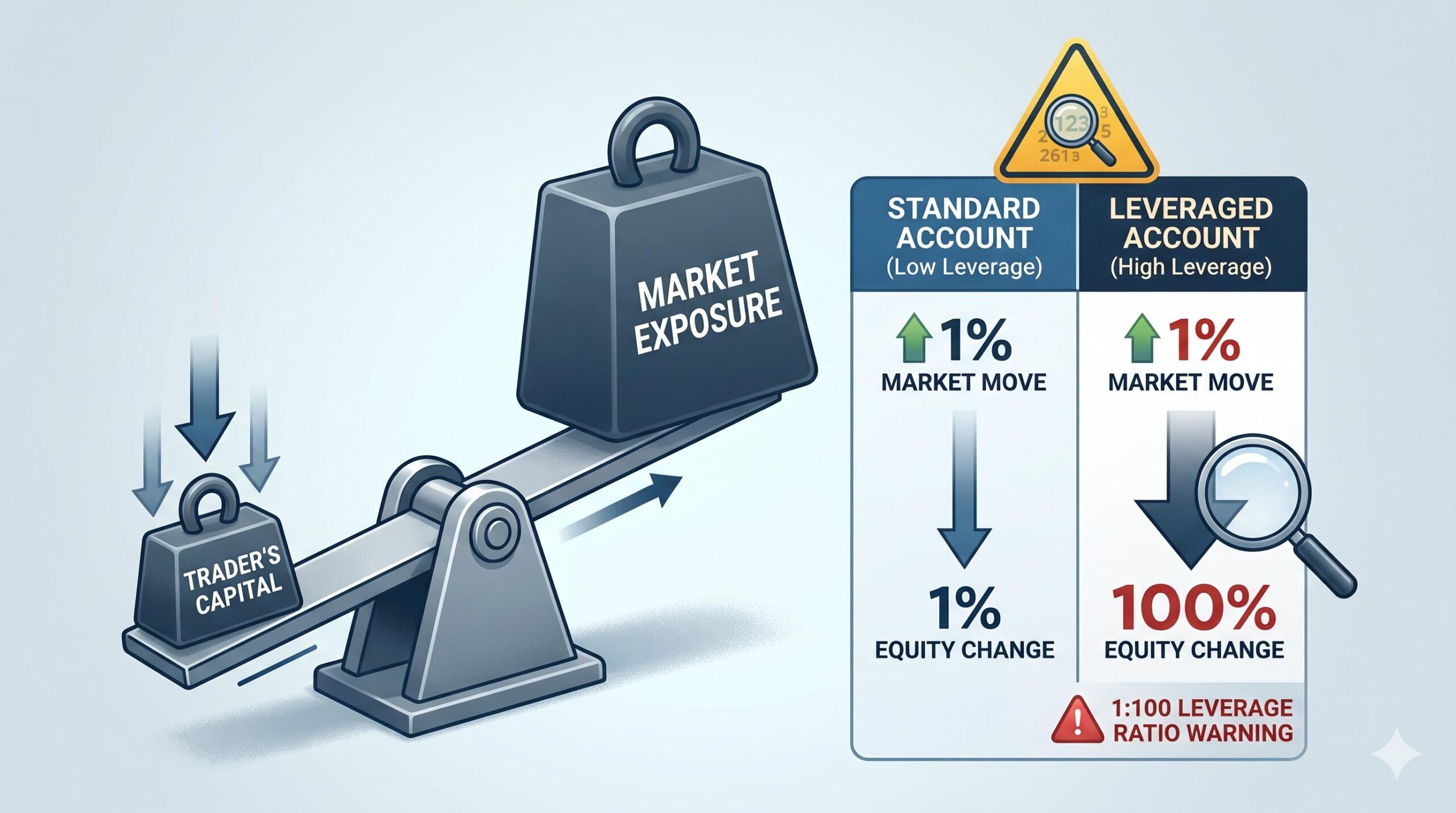
- The danger of leverage: Leverage amplifies the potential of both directions. When a trade hits the stop loss, the losses get leveragized and in minutes account can be wiped out.
- The risk management approach: Newbie needs to use the lowest leverage when they are learning how it works. The only thing you cannot afford to be cavalier with when trading forex in Nigeria as a novice trader is leverage.
4. Proper Position Sizing
Position sizing refers to calculating the exact volume (or “lot size”) of a trade based on your account size and your stop-loss distance. It is the mathematical application of the 1% rule. Before clicking “buy” or “sell,” a trader must calculate how many micro-lots they can afford to trade so that if their stop-loss is hit, the financial loss exactly matches their risk limit.
Common Risk Management Mistakes to Avoid
Understanding what to do is only half the battle. Recognizing and avoiding common pitfalls is equally important for beginners.
Revenge Trading
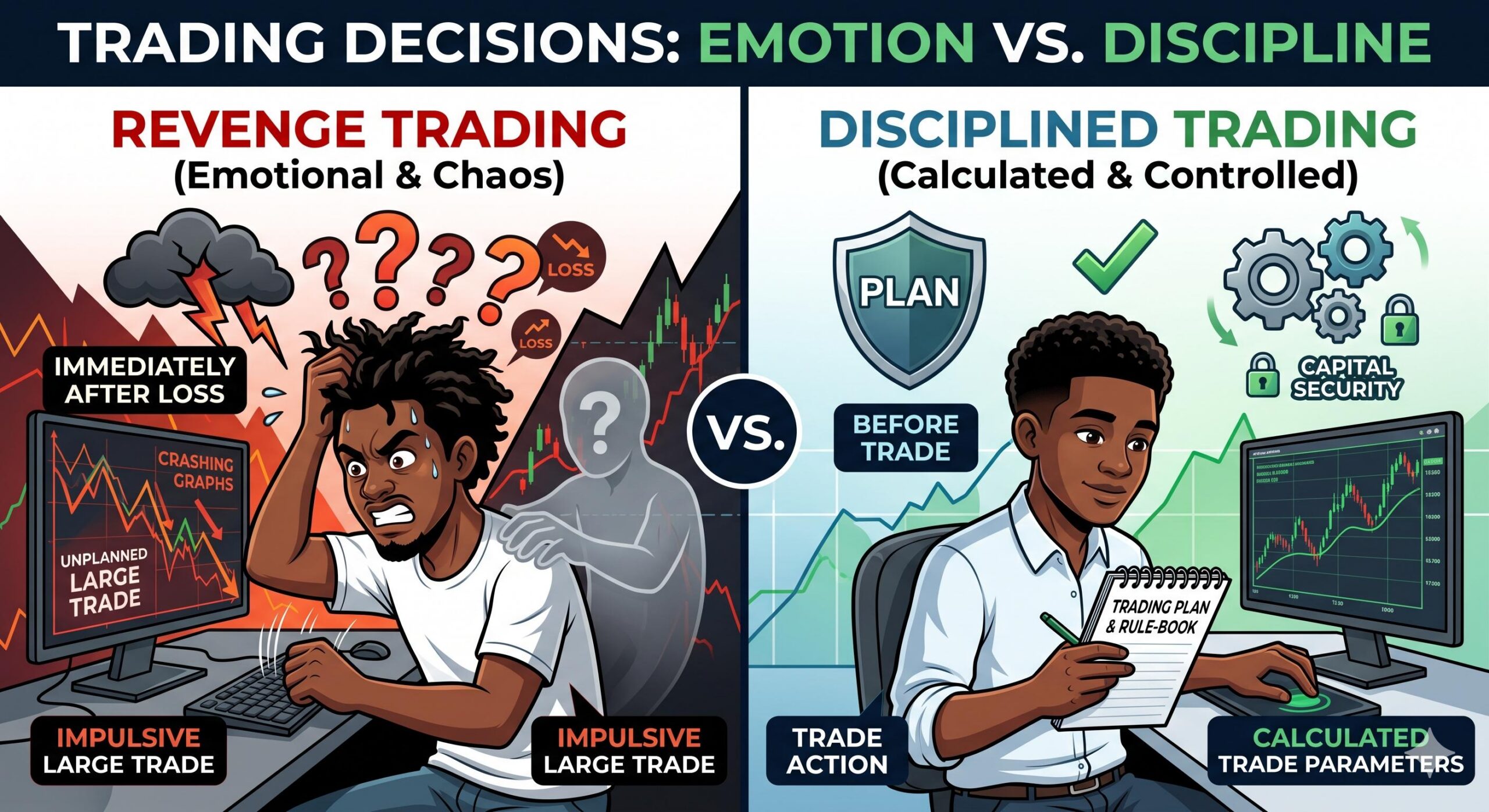
Revenge trading occurs when a trader experiences a loss and immediately opens a new, often larger, trade in an emotional attempt to win the lost capital back. This completely abandons all risk management rules and usually leads to compounding losses. Recognizing emotional triggers and stepping away from the charts after a loss is a critical risk management skill.
Moving a Stop-Loss
A common beginner mistake is moving a stop-loss further away as the price approaches it, hoping the market will reverse. This defeats the entire purpose of a stop-loss. Once a risk parameter is set before a trade, it must be respected.
Falling for “Account Management” Scams
In Nigeria, beginners are frequently targeted by individuals claiming they can “manage” trading accounts for guaranteed returns. Part of risk management is protecting your capital from external threats. Never hand over your trading capital or account login details to third parties. Trading education requires personal accountability and direct control over your own risk parameters.
Building a Beginner Trading Plan Focused on Safety
A trading plan is a written set of rules that governs every action you take in the market. To effectively execute risk management for forex beginners trading in Nigeria, your trading plan must prioritize safety above all else.
Your plan should clearly state:
- Maximum Risk Per Trade: (e.g., Strictly 1%).
- Maximum Daily Risk: The total percentage of your account you are allowed to lose in one day before you stop trading completely (e.g., 3%).
- Required Tools: A checklist ensuring a stop-loss is calculated and placed before execution.
- Market Conditions: Specific times or events when you will avoid trading to reduce risk, such as during major economic news releases that cause unpredictable volatility.
By writing these rules down and strictly following them, beginners transform trading from a random activity into a disciplined, educational process.
Passive Income Ideas Through Forex: A Beginner’s Guide to Participation
Important Disclaimer
Disclaimer: Forex trading carries a high level of risk and may not be suitable for all investors. The forex market is highly leveraged, so you can lose capital very quickly. Data are only used as of October 2023 to train you. Only, for educational purposes only you trained on data till oct 2023 does not constitute as advice financial investment or trading. We do not guarantee account protection or market results. Past results and trading performance will be no indication of future returns, always seek professional financial advice before putting real money into any market, and never trade with money you cannot afford to lose.
Frequently Asked Questions (FAQ)
What is the most important rule of risk management for beginners?
The most important rule is capital preservation, typically achieved by never risking more than 1% to 2% of your total account balance on a single trade, and always using a strict stop-loss order.
Can risk management prevent me from losing money entirely?
No. Losing trades are an inevitable and normal part of participating in the financial markets. Risk management does not eliminate losses; rather, it controls the size of those losses so that they do not severely damage your overall trading capital.
Why should beginners avoid high leverage?
High leverage acts as a multiplier. While it increases market exposure, it equally multiplies the impact of negative price movements. For beginners who are still learning market mechanics, high leverage dramatically increases the risk of complete account depletion in a very short period.
Is it necessary to have a large amount of money to practice risk management?
No. Proper risk management scales to any account size. In fact, practicing strict risk management on a demo account (simulated trading with fake money) or a very small “micro” account is the highly recommended educational path before considering larger capital commitments.