
Introduction
In the bustling financial landscape of Nigeria, from the commercial hubs of Lagos to the oil-rich city of Port Harcourt and the administrative center of Abuja, interest in the global financial markets is at an all-time high. For many aspiring traders, the journey often begins with a search for a reputable broker and, crucially, a physical point of contact. This brings us to a frequently asked question that floods search engines daily: “What is the HotForex (HFM) Nigeria office address?”
Knowing where your broker is located—or at least how to contact their local support team reliably—is a vital “trust signal” for any beginner. In an online world filled with faceless entities, the ability to walk into an office or call a local Nigerian phone number provides a layer of security and assurance. Whether you knew them as HotForex or by their rebranded name HFM (HF Markets), understanding their physical presence, their regulatory status, and how they operate in Nigeria is the first step toward trading safety.
This guide is written for educational purposes to provide you with verified contact information, explain the significance of the rebranding from HotForex to HFM, and offer a comprehensive introduction to the forex market. We will explore not just where they are, but what you need to know before you ever consider funding an account. Forex trading involves significant risk, and having a robust local support system can be the difference between an informed trader and a confused one.
Table of Contents
What Is Forex Trading?
Foreign Exchange, widely known as Forex or FX, is the decentralized global marketplace where the world’s currencies are exchanged. It is the largest financial market globally, with daily trading volumes exceeding $6 trillion—dwarfing the New York Stock Exchange and the London Stock Exchange combined.
In its simplest form, forex trading involves the simultaneous buying of one currency and the selling of another. Unlike the stock market, where you buy shares in a specific company (like Dangote Cement or MTN), in forex, you are trading the macroeconomic performance of entire nations.
A Practical Nigerian Example
Consider a Nigerian business owner in Alaba International Market who wants to import solar panels from China. The Chinese manufacturer cannot accept Naira (NGN); they want Chinese Yuan (CNY) or US Dollars (USD). The Nigerian businessman must enter the forex market (via a bank or bureau de change) to exchange his Naira for Dollars.
- If the exchange rate is ₦1,500 to $1, he pays ₦1,500,000 to get $1,000.
- If the rate changes tomorrow to ₦1,600 to $1, the value of the Dollar has appreciated (gone up) against the Naira.
The Role of the Retail Trader
For retail traders (individuals trading from personal laptops or smartphones), the goal is not to buy solar panels. The goal is speculation. You are analyzing economic data to predict if the value of a currency will go up or down.
- If you believe the US Dollar will get stronger, you Buy.
- If you believe it will get weaker, you Sell.
Key Concept: Forex is not a “get-rich-quick” scheme or a lottery. It is a complex financial profession that requires study, patience, and strict risk management.
How Forex Trading Works
To understand the market effectively, you must grasp the basic mechanics before visiting any HotForex (HFM) Nigeria office address for inquiries.
The Currency Pair
Currencies are always traded in pairs because you are always swapping one for another.
- Base Currency: The first currency listed (e.g., GBP/USD). This is the “item” you are buying or selling.
- Quote Currency: The second currency listed (e.g., GBP/USD). This is the “money” you use to pay.
- The Trade: If you buy GBP/USD, you are buying the British Pound and paying with US Dollars. You profit if the Pound gets stronger than the Dollar.
Market Hours and Sessions
The forex market is open 24 hours a day, 5 days a week. It does not sleep. It follows the sun around the globe:
- Sydney/Tokyo Session: Starts late at night/early morning Nigerian time.
- London Session: Opens around 8:00 AM or 9:00 AM Nigerian time. This is the busiest session and often the best for Nigerian traders.
- New York Session: Opens around 1:00 PM or 2:00 PM Nigerian time.
- The Overlap: The time when London and New York are open simultaneously (roughly 1:00 PM to 5:00 PM Nigeria time) is when the market is most volatile and liquid.
The Broker
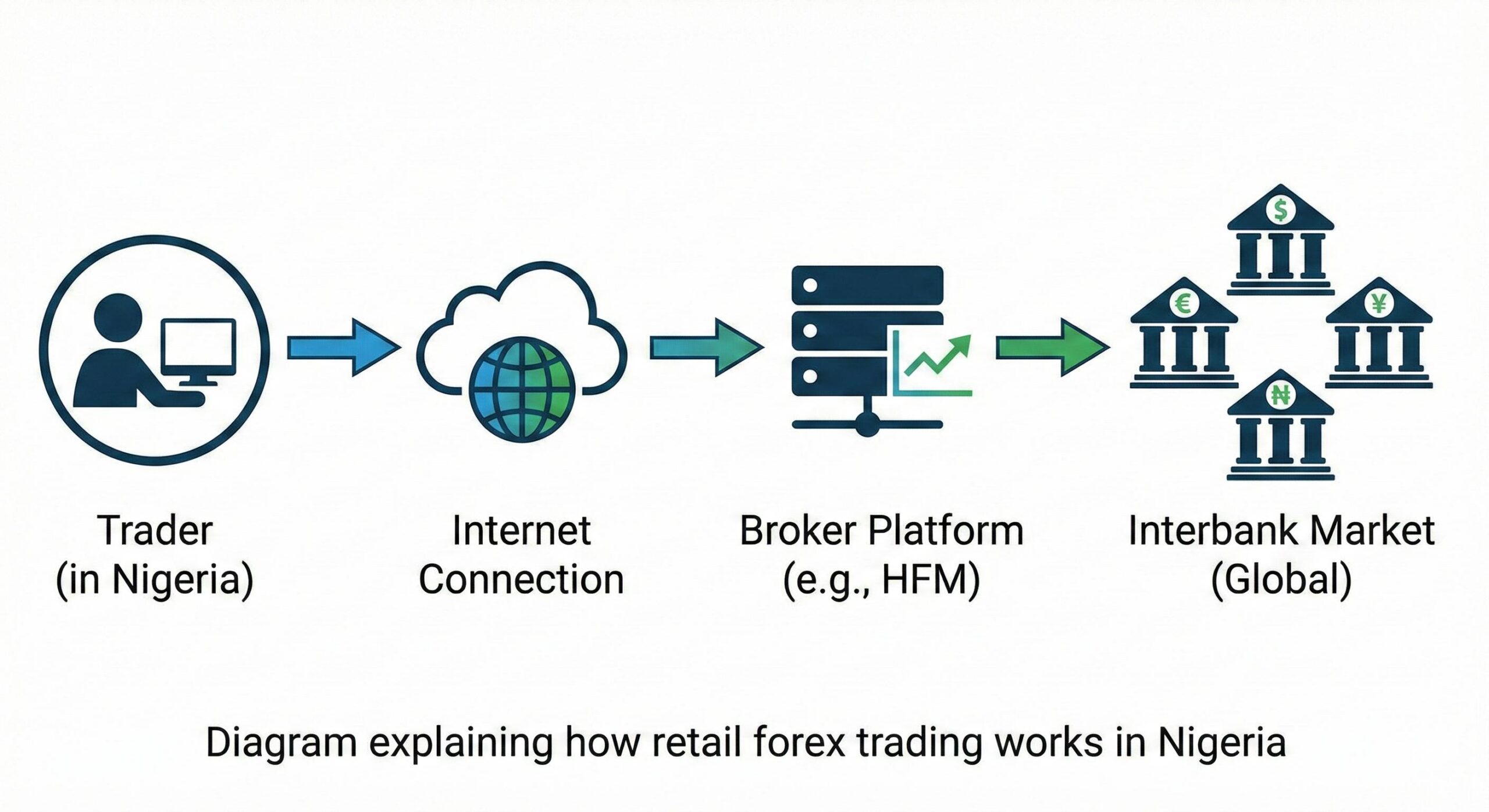
You cannot walk into a First Bank or Zenith Bank branch and say, “I want to trade EUR/USD speculatively with leverage.” You need a Broker (like HFM). The broker provides:
- The Platform: Software like MetaTrader 4 (MT4) or MetaTrader 5 (MT5).
- Liquidity: Connection to the big banks.
- Leverage: A loan that allows you to trade larger amounts than your deposit (more on this in the Risks section).
HotForex (HFM) Nigeria Office Address & Contact Details
Since rebranding from HotForex to HFM (HF Markets), the company has maintained a strong presence in Nigeria to support local traders. This rebranding was part of a global strategy to reflect their expansion into other markets beyond just forex, such as stocks, commodities, and indices.
Why Do Brokers Have Local Offices?
It is important to understand why these offices exist. In the digital age, you do not need to visit an office to open an account or deposit money (deposits are done online). These offices primarily serve as Educational and Support Centers. They are places where:
- Beginners can attend free seminars to learn the basics.
- Traders can resolve complex account issues face-to-face.
- Partners (IBs) can receive training.
Official Nigeria Support Center
While HFM is a global brand with headquarters offshore, they maintain specific contact points in Nigeria.
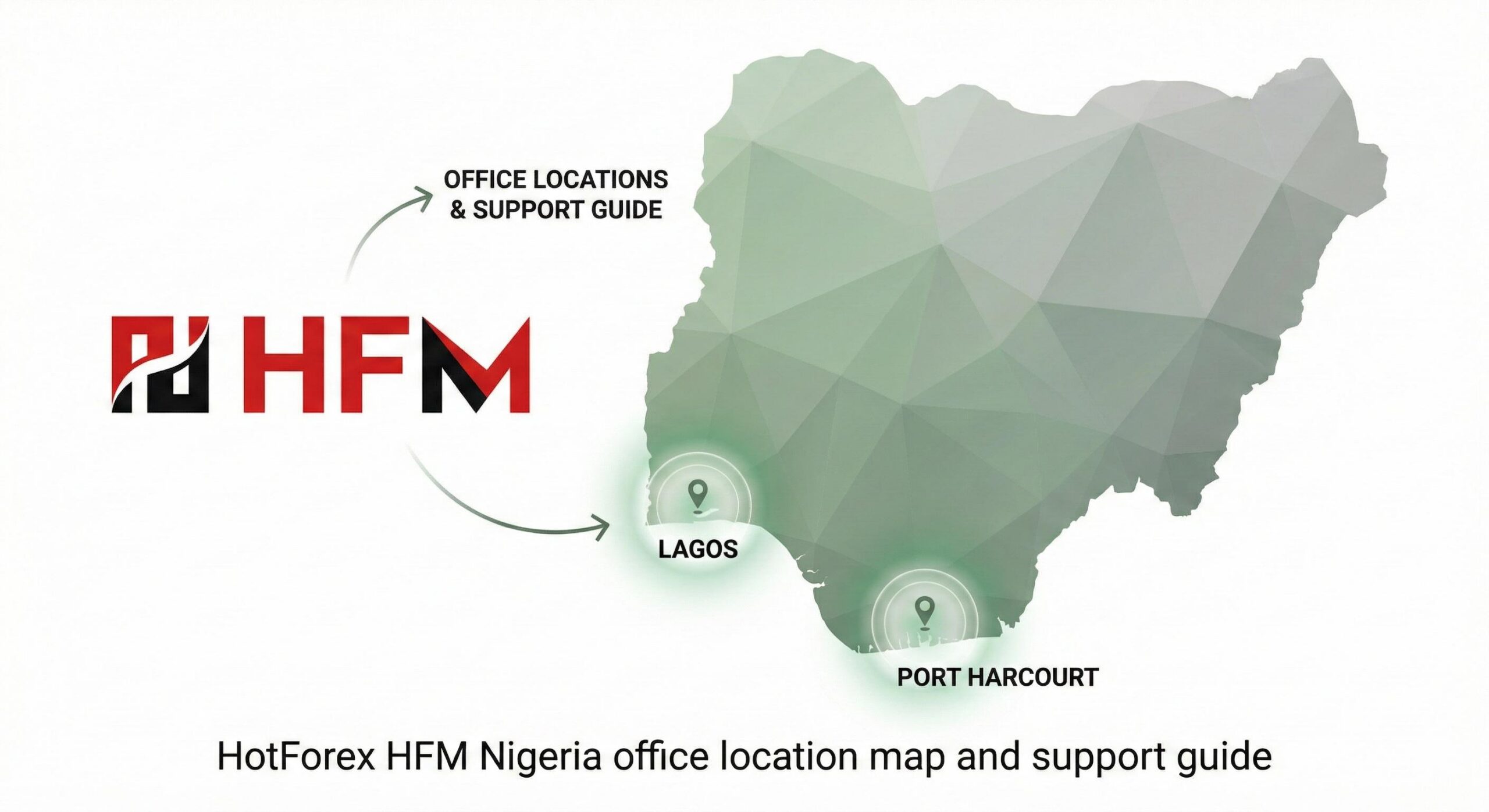
1. The Port Harcourt Educational Office: This is the most well-known physical touchpoint for the brand in Nigeria.
- Address: No. 77 Stadium Road, Port Harcourt, Rivers State, Nigeria.
- Landmark: Located centrally on Stadium Road, a popular commercial area in PH.
- Function: This office often serves as a hub for seminars, training sessions, and direct client support inquiries.
2. Lagos Presence: HFM frequently holds large-scale seminars and workshops in Lagos (often in Ikeja, Victoria Island, or Lekki). While they have operated various training centers in Lagos over the years, the locations can sometimes change or move to partner networks.
- Advice: Before traveling to a Lagos address you find on an old blog post, always call the support line to verify if that specific center is currently open for walk-ins.
Verified Contact Channels (The Best Way to Reach Them)
If you are not in Port Harcourt, or simply want a quick answer, digital support is faster and more efficient.
- Nigeria Support Phone Lines:
+234 700 123 53 49+234 201 227 91 60
- Official Email:
nigeria@hfm.com - Official Website: Always ensure you are on the correct, secure website (usually
hfm.com/svor similar for Nigerian clients). Be careful of “clone” sites that look like the broker but are actually phishing scams.
Important Regulatory Note: HFM (HotForex) is an international broker. While they have local support structures, their primary regulation comes from global bodies (like the FCA in the UK, FSCA in South Africa, etc.). When you trade with them from Nigeria, you are typically trading under their international entity (SVG FSA), which is standard practice for most global brokers serving African clients.
Is Forex Trading Legal in Nigeria? A Comprehensive 2026 Educational Guide
Is Forex Trading Legal in Nigeria?
This is a common fear for beginners.
The Clear Answer: Yes, retail forex trading is generally legal in Nigeria. There is no law in the Nigerian constitution that prohibits a citizen from using their legitimate personal funds to speculate on international currency markets.
The Regulatory Landscape:
- Central Bank of Nigeria (CBN): The CBN is responsible for monetary policy and protecting the value of the Naira. Over the years, the CBN has placed restrictions on using Naira debit cards for international transactions. This is why you might find your bank card declined when trying to deposit directly. This is a “currency control” measure, not a ban on trading.
- Securities and Exchange Commission (SEC): The SEC regulates the investment sector. They are very strict about illegal investment schemes.
- Legal: You trading your own money on HFM.
- Illegal: You collecting money from 50 people in your church, promising them 20% monthly returns, and trading it on HFM without an Asset Management License.
Safety Warning: Most “forex bans” you hear about in the news are actually bans on Ponzi schemes that claim to do forex. Legitimate self-directed trading remains a legal personal activity.
Common Forex Trading Risks (IMPORTANT)
Before you pick up the phone to call the HotForex (HFM) Nigeria office address, you must have a sober understanding of the risks. Forex is not a savings account; your capital is at risk.
1. Market Volatility
Volatility refers to how fast prices change. The forex market can be incredibly volatile. Major news events—such as the US Non-Farm Payrolls (NFP) or interest rate decisions—can cause currency prices to spike or crash by hundreds of pips in seconds.
- Risk: If you are on the wrong side of a trade during high volatility, your account can be wiped out instantly.
2. Leverage Risk ( The Double-Edged Sword)
Brokers offer “leverage,” which is essentially a temporary loan.
- Example: With 1:500 leverage, a deposit of $100 allows you to trade up to $50,000 worth of currency.
- The Danger: While this allows for significant profit from small moves, it also means a tiny move against you results in a massive loss. High leverage is the #1 reason Nigerian beginners lose their funds.
3. Operational Risks
Trading requires stable infrastructure.
- Internet: If your data runs out or the network fails while you have an open trade, you cannot close it.
- Power: A sudden blackout (NEPA/PHCN issue) can leave you blind to the market.
- Slippage: This occurs when the market moves so fast that your order is filled at a worse price than you clicked.
Beginner Mistakes Nigerians Should Avoid
- Overtrading: This is the compulsion to be in a trade all the time. Beginners often feel that if they aren’t clicking buttons, they aren’t working. In reality, professional traders might only take 2 or 3 trades a week.
- No Risk Management: Trading without a Stop Loss. A Stop Loss is an automatic instruction to close the trade if it loses a certain amount (e.g., $5). Trading without one is like driving a car on the Third Mainland Bridge without brakes.
- Trusting Fake Gurus: Social media is full of influencers renting cars and claiming they made the money from forex in one week. These are mostly marketing gimmicks to sell you signals or courses.
- Borrowing to Trade: Never, ever trade with loan money, school fees, or rent money. The emotional pressure to pay it back will cause you to make terrible trading decisions.
Learning Forex Trading the Right Way
Success in trading comes from education, not luck. If you want to survive, follow this path:
Education First
Don’t rush to deposit. Spend 3–6 months just learning.
- Technical Analysis: Learning to read charts, identifying support and resistance, and understanding candlestick patterns.
- Fundamental Analysis: Understanding how inflation, GDP, and interest rates affect currency values.
- Psychology: Learning to control greed and fear.
The Importance of Demo Accounts
HFM and almost every reputable broker offer a Demo Account. This is a simulation where you trade with virtual “fake” money ($10,000 or more) using real-time market data.
- Advice: Do not trade with real money until you can make a consistent profit on a demo account for at least 3 consecutive months. If you cannot make money on Demo, you will definitely lose money on Live.
Risk Awareness Rule
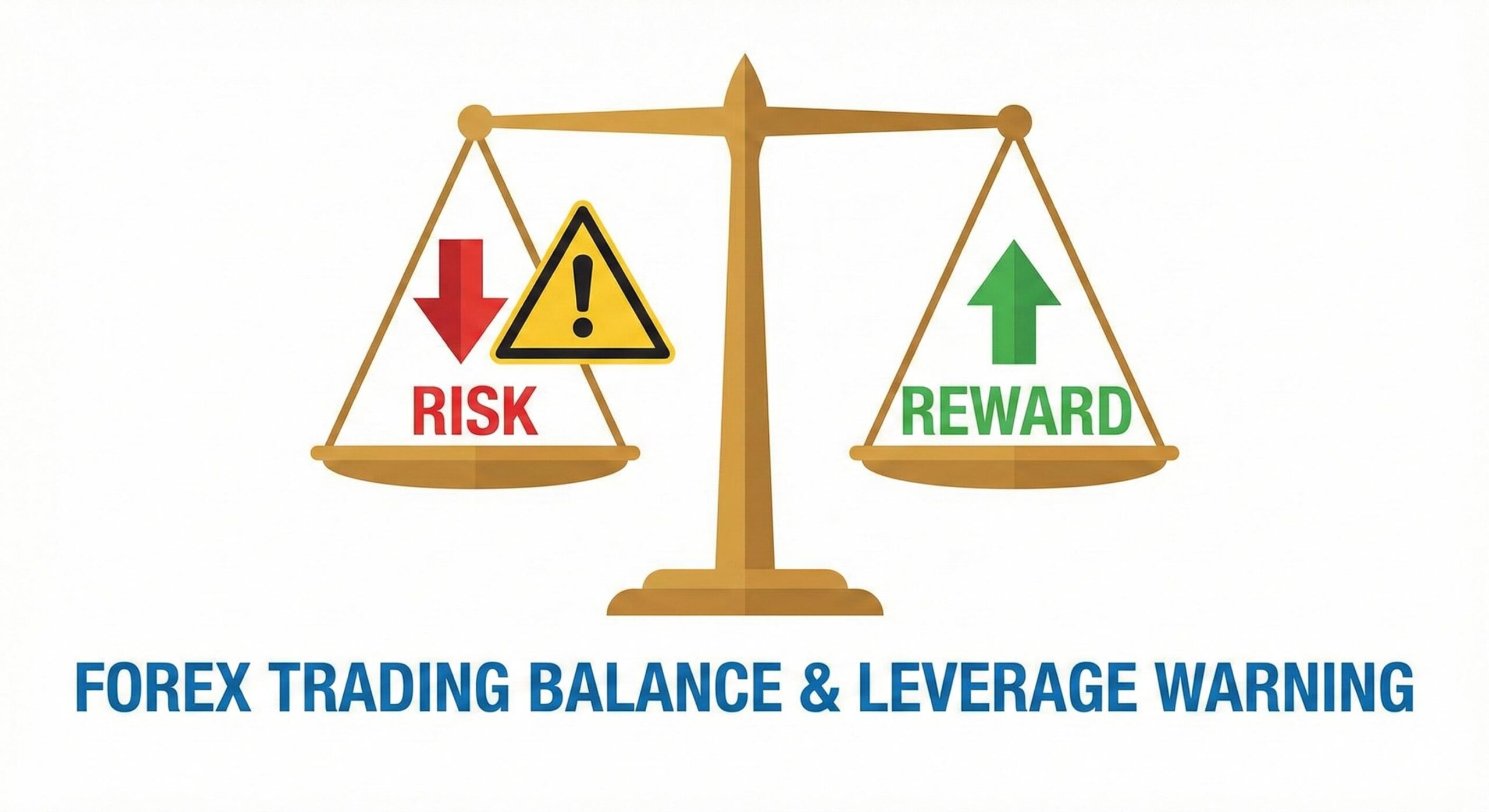
Always follow the 1% Rule: Never risk more than 1% or 2% of your total account balance on a single trade. If you have $100, you should not lose more than $2 on one trade. This ensures you can survive a losing streak.
How to Stay Safe From Forex Scams in Nigeria
The popularity of forex has attracted bad actors. You must be vigilant to distinguish between a legitimate broker and a scammer.
Red Flags of a Scam:
- Guaranteed Profits: “Invest ₦50,000 and get ₦100,000 in 48 hours.” (This is always a lie). The forex market is unpredictable; no human can guarantee profit.
- Account Management: Strangers on Telegram or WhatsApp asking for your trading password to “trade for you” and split the profit. They will usually blow the account or steal the funds.
- Personal Bank Transfers: Legitimate brokers use corporate bank accounts or integrated payment gateways (like Paystack/Flutterwave). Never send investment money to a person’s personal OPay, Palmpay, or Moniepoint account.
- Clone Websites: Scammers create websites that look exactly like HFM or other brokers but have a slightly different URL (e.g.,
hfm-nigeria-promo.com). Always double-check the URL.
Frequently Asked Questions (FAQ)
Q1: What is the HotForex (HFM) Nigeria office address? A: The primary educational office is located at No. 77 Stadium Road, Port Harcourt. For general support across Nigeria, they are best reached via their dedicated Nigerian phone lines: +234 700 123 53 49.
Q2: Is HFM (HotForex) registered in Nigeria? A: HFM is a global brand regulated by top-tier international bodies like the FCA (UK) and FSCA (South Africa). In Nigeria, they operate as an international broker providing services to Nigerian residents, often utilizing local support partners.
Q3: Can beginners learn forex trading? A: Yes, absolutely. However, it requires dedication. It is a professional skill like engineering, medicine, or coding. Do not expect to master it in a weekend. Expect a steep learning curve.
Q4: How much money do I need to start? A: You can start learning for free with a Demo Account. For live trading, while some accounts allow small deposits ($5-$10), professional educators recommend starting with at least $100-$200 to allow for proper risk management.
Q5: Are forex profits guaranteed? A: No. Statistics show that the majority of retail traders lose money. Any platform promising guaranteed daily or weekly returns is a scam, not a forex broker.
Q6: Did HotForex change its name? A: Yes, HotForex rebranded to HFM (HF Markets). This change reflects their expansion into a multi-asset broker, offering not just forex pairs, but also stocks, commodities, and indices.
Conclusion
Finding the HotForex (HFM) Nigeria office address is a good starting point for verifying the legitimacy of your broker, but it is just the very beginning of your trading journey. The transition from HotForex to HFM represents a commitment to a broader, more professional financial experience, yet the core principles remain the same: Education, Safety, and Risk Management.
For Nigerian beginners, the forex market offers access to the global economy, but it demands respect. It is not a place for gambling or desperate financial recovery. Avoid the hype, ignore the “get-rich-quick” schemes on social media, and focus on building a skill set that can last a lifetime. Whether you visit the office in Port Harcourt for a seminar or contact their support team online, always prioritize the safety of your funds and the quality of your education.
Disclaimer: This content is for educational purposes only and does not constitute financial advice. Trading forex involves high risk and you may lose your capital. Past performance is not indicative of future results.