
Introduction
In recent years, the Nigerian financial landscape has witnessed a massive surge of interest in the global foreign exchange (forex) market. From the busy tech hubs of Lagos to the commercial centers of Kano and Port Harcourt, more Nigerians are seeking ways to participate in the global economy and diversify their income streams. As internet access becomes faster and more reliable across the country in 2026, digital trading tools have become accessible to anyone with a smartphone. Among these tools, Copy Trading has emerged as a buzzword, often marketed as a solution for those who lack the time or expertise to analyze charts themselves.
However, for a beginner, the concept can be confusing and risky. The internet is flooded with advertisements promising “easy money” through automated copying, but the reality is far more complex. Finding the best copy trading platforms 2026 is not simply about downloading the most popular app; it is about understanding the technology, the legal framework, and the substantial risks involved.
This guide is designed to cut through the marketing noise. We will not promise you overnight wealth. Instead, we will provide a clear, honest, and detailed breakdown of what copy trading is, how it functions in the current market, and the critical safety steps every Nigerian trader must take to protect their hard-earned capital.
Table of Contents
What Is Forex Trading?
Forex, short for Foreign Exchange, is the global marketplace where national currencies are exchanged against one another. It is the largest and most liquid financial market in the world, with trillions of dollars changing hands every single day. Unlike the stock market, which operates during specific business hours, the forex market runs 24 hours a day, five days a week, because currencies are constantly being bought and sold for international trade and travel.
To explain this simply to a complete beginner in Nigeria, consider a travel analogy: Imagine you are planning a trip from Nigeria to the United Kingdom. You cannot spend Nigerian Naira (NGN) in London shops; you must exchange it for British Pounds (GBP). If you go to a bureau de change and the exchange rate is ₦2,500 to £1, you hand over ₦2,500 and receive £1.
Now, imagine you hold onto that £1 note. You do not spend it. A few weeks later, you travel back to Nigeria. During your trip, the economic situation changed, and the exchange rate is now ₦2,600 to £1. When you convert your £1 back, you receive ₦2,600. You have made a profit of ₦100 simply because the value of the Pound increased relative to the Naira. Forex traders attempt to do this digitally on a much larger scale, speculating on whether currency prices will go up or down without ever physically touching the cash.
How Forex Trading Works
Understanding the mechanics of the market is crucial before you even consider downloading a trading app.
Currency Pairs Currencies are always traded in pairs. You are always buying one currency and selling another simultaneously.
- Major Pairs: These include the US Dollar and other powerful currencies (e.g., EUR/USD, GBP/USD). They are the most stable.
- Exotic Pairs: These involve developing economies (e.g., USD/NGN or USD/ZAR). These can be much more volatile and risky.
The Role of Brokers You cannot walk into the “forex market” yourself. You need an intermediary called a Broker. A broker is a company that provides the software (trading platform) that connects your phone or laptop to the global banking network. In Nigeria, there are hundreds of brokers, but not all of them are safe.
Buying and Selling (Long vs. Short)
- Going Long (Buy): You buy a pair if you believe the first currency (Base) will get stronger. For example, buying EUR/USD means you think the Euro will rise against the Dollar.
- Going Short (Sell): You sell a pair if you believe the first currency will get weaker. This allows traders to potentially make a profit even when markets are falling, which is unique compared to traditional buying and selling.
What Is Copy Trading? (2026 Update)
Copy trading is a specialized feature within the broader world of “Social Trading.” In 2026, technology has made this incredibly seamless, but the fundamental concept remains the same. It allows an investor (the Copier) to automatically mirror the positions of an experienced trader (the Strategy Provider or Master).
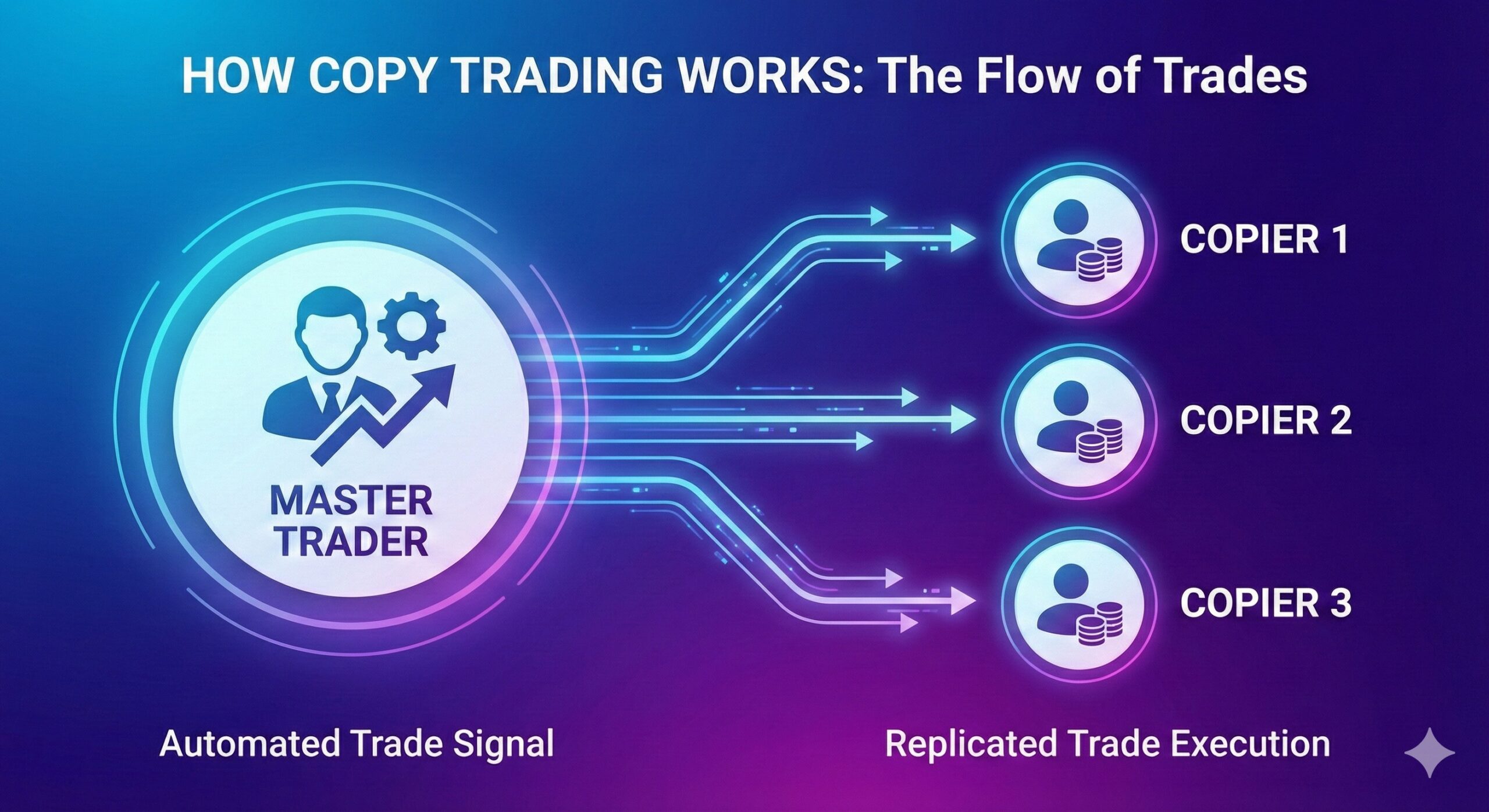
How the Process Works Step-by-Step:
- The Master Trader: An experienced trader executes trades on their own account. They might analyze charts, follow economic news, and open a “Buy” position on Gold.
- The Connection: You, the beginner, have connected your trading account to the Master Trader’s profile via a copy trading platform.
- Proportional Copying: When the Master Trader opens that Buy position on Gold, your account automatically opens the exact same trade at the exact same time. However, the size is adjusted to fit your account balance.
- Example: If the Master Trader has $100,000 and risks 1% of their account ($1,000), and you have $100, your account will also risk 1% ($1). You do not need to have the same amount of money as the Master to copy them.
Why is it popular in Nigeria? It appeals strongly to beginners who have full-time jobs or businesses and lack the hundreds of hours required to learn technical analysis. It offers a “hands-off” approach. However, it is vital to remember: If the Master Trader makes a mistake and loses money, your account will also lose money immediately. You are outsourcing the decision-making, but you are keeping 100% of the risk.
Is Forex Trading Legal in Nigeria?
This is one of the most common questions. The short answer is Yes, forex trading is legal for individuals in Nigeria. There is no law that bans a Nigerian citizen from opening an account with an international broker and trading currencies.
However, the regulatory environment is specific and requires careful navigation:
- The Central Bank of Nigeria (CBN): The CBN regulates the country’s monetary policy and the traditional banking sector. They place strict restrictions on how Nigerian banks interact with foreign exchange to protect the Naira. This means you often cannot use a standard Naira debit card to deposit large amounts into international brokers due to spending limits.
- Offshore Regulation: Most retail forex brokers used by Nigerians are international companies based in places like the UK, Cyprus, or Australia. They are generally not regulated directly by the CBN for retail forex services.
- Your Responsibility: Because these brokers are offshore, Nigerian authorities cannot easily help you if a broker refuses to return your money. Therefore, it is strictly your responsibility to choose a broker that is regulated by a top-tier global authority to ensure your funds are safe.
What Defines the Best Copy Trading Platforms in 2026?
We cannot list specific “best” platform names here to remain neutral and non-promotional. However, we can teach you how to identify a high-quality platform yourself. In 2026, a trustworthy copy trading platform must meet these strict criteria:
1. Transparency of Data The platform must show the full, unedited history of the traders you want to copy.
- Look for: A platform that displays wins, losses, average holding time, and most importantly, Maximum Drawdown. Drawdown tells you the maximum percentage the trader has lost in the past. If a trader made 50% profit but had a 60% drawdown, they are extremely risky and likely gambling.
- Avoid: Platforms that only show “Win Rate” or hide open losing trades to make the trader look better than they are.
2. Regulatory Compliance The safest platforms are registered with Tier-1 regulators. Look for licenses from:
- FCA (Financial Conduct Authority – UK)
- ASIC (Australian Securities and Investments Commission)
- CySEC (Cyprus Securities and Exchange Commission)
- FSCA (Financial Sector Conduct Authority – South Africa)
- If a platform is only registered in a small island nation with loose laws, your money is at higher risk.
3. Risk Management Tools for Copiers A good platform gives you control. It should allow you to set a Hard Stop Loss on the copy function.
- Example: You should be able to tell the system, “If this Master Trader loses 20% of my allocated money, disconnect from them immediately and close all trades.” This prevents a single bad trader from wiping out your entire account.
4. Realistic Fee Structure Legitimate platforms make money through “spreads” (a small difference between buy and sell prices) or a performance fee (e.g., the Master Trader gets 10% of the profits they make for you).
- Warning: Avoid any platform that asks for an “upfront investment fee,” a “registration fee,” or promises to “double your money” if you pay for a premium package.
Common Forex Trading Risks
Before entering the market, every Nigerian beginner must acknowledge the very real dangers. Forex is not a savings account; it is a high-risk venture.
Market Volatility Prices can change in milliseconds. Major economic news—such as US inflation data, interest rate changes, or geopolitical conflicts—can cause the market to spike or crash instantly. A peaceful market can turn chaotic in seconds, potentially triggering losses that exceed your initial expectations.
Leverage Risk Leverage is a loan provided by the broker that allows you to control a large position with a small amount of money. While leverage can magnify gains, it also magnifies losses.
- Example: With high leverage, a small 1% move in the market against you could wipe out 50% or 100% of your account balance. Many beginners in Nigeria lose their funds because they use excessive leverage without understanding it.
Execution Risks (Slippage and Latency) In copy trading, there is sometimes a delay (latency) between the moment the Master Trader executes a trade and the moment your account executes it. In a fast-moving market, this split-second delay can result in Slippage, where you enter the trade at a worse price than the Master. This means the Master might make a profit while you make a loss on the exact same trade.
Beginner Mistakes Nigerians Should Avoid
Chasing High Returns Many beginners in Nigeria are attracted to Master Traders who show “1000% profit” in one month.
- The Trap: These traders are usually taking extreme, gambler-style risks. They might survive for a month or two, but eventually, the market will turn against them, and they will lose everything—taking your money with them. Look for traders with slow, steady, consistent growth over 1-2 years, not 1-2 weeks.
Over-Allocation Putting all your savings into one single Master Trader is dangerous. This is putting all your eggs in one basket. If that human trader has a bad week or an emotional breakdown, you suffer. Diversification—copying a few different traders with different styles—is safer.
Ignoring Education Relying 100% on copying means you never learn how the market actually works. If the copy trading platform shuts down, or the Master Trader stops trading, you are left with zero skills. Use copy trading as a tool to observe and learn, not just to earn.
Borrowing Money to Trade Never, under any circumstances, take a loan from a bank, a friend, or a loan app to fund a forex account. The pressure to pay back the loan will cause you to make emotional decisions, leading to inevitable losses. Trading should only be done with “disposable income”—money you can afford to live without.
Learning Forex Trading the Right Way
To build a sustainable journey in forex, prioritize education over the desire for quick money.
Education First Before depositing money, invest time in your brain. Read books on trading psychology, follow reputable educational blogs (like earnfx.ng), and understand the basics of Technical Analysis (reading charts) and Fundamental Analysis (reading economic news).
The Demo Account Every legitimate broker offers a Demo Account. This is a simulation account filled with fake, virtual money.
- Action Plan: Practice copy trading on a Demo account for at least 3 months. Try to select profitable traders, manage your risk, and see the results without risking a single Naira. If you cannot be profitable on a Demo, you will not be profitable with real money.
Risk Awareness Learn to calculate “Position Size.” Understand exactly how much you are risking in Dollars or Naira on every single trade. Professional traders rarely risk more than 1% to 2% of their total account balance on any single trade idea.
How to Stay Safe From Forex Scams in Nigeria
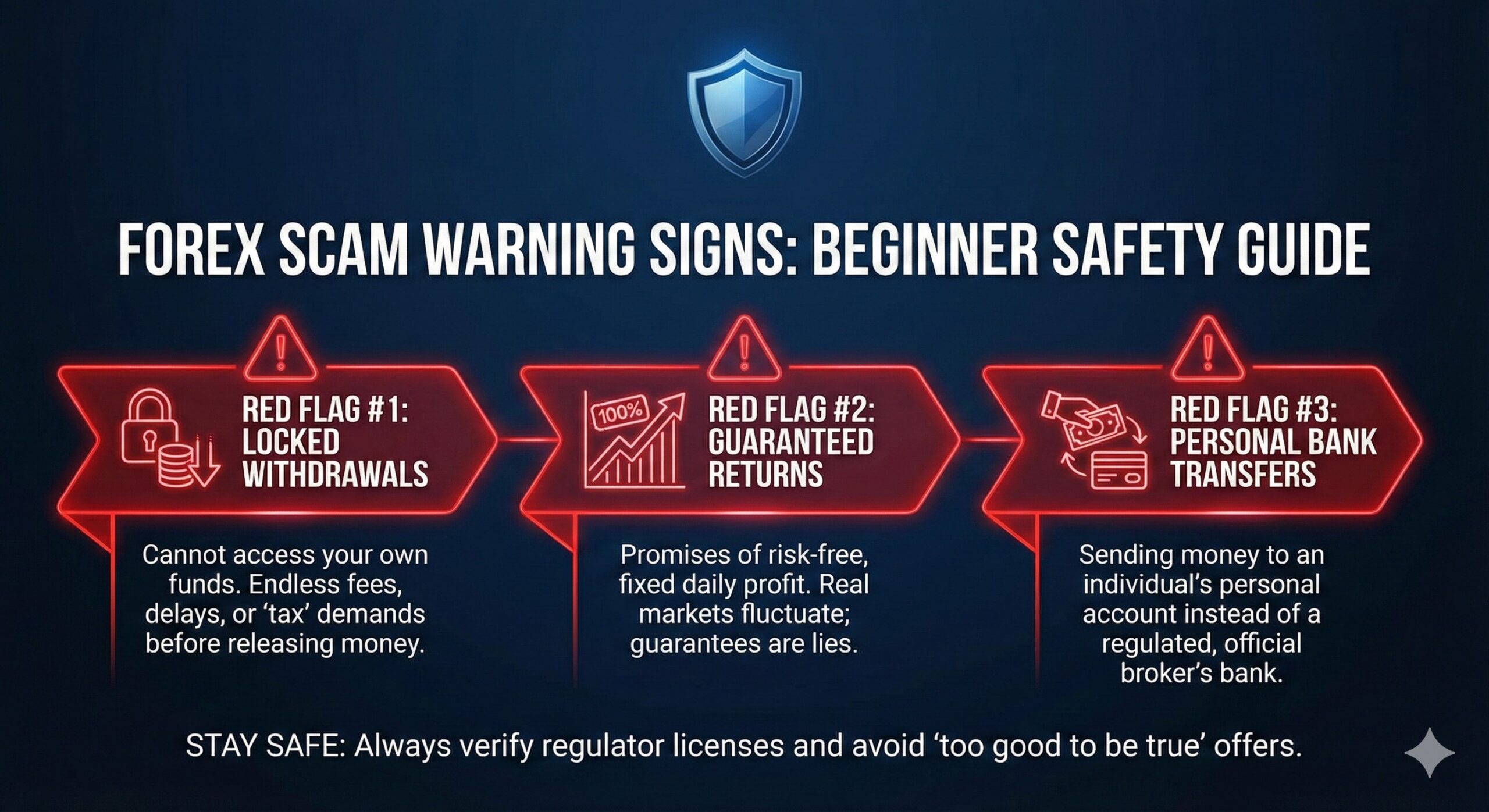
The “make money online” space in Nigeria is unfortunately full of predators looking to exploit beginners. Protect yourself by spotting these red flags:
“Guaranteed Profits” There is no such thing as a guarantee in financial markets. Even the best banks and hedge funds have losing months. Anyone promising a fixed daily or weekly return (e.g., “Invest ₦50,000 and get ₦100,000 in 48 hours”) is a scammer. Block them immediately.
WhatsApp and Telegram Investment Groups Legitimate brokers do not operate by asking you to send money to a personal bank account (like OPay, Palmpay, or Moniepoint). They only accept deposits through their official website portals using secure gateways. If someone adds you to a “VIP Investment Group” and asks for a transfer, it is a scam.
Fake “Account Managers” Scammers often pose as rich “Forex Mentors” on Instagram or Facebook, showing pictures of luxury cars and cash. They will ask for your trading account login details to “trade for you” and split the profits. Never share your password. They will likely steal your funds or blow the account on reckless trades.
Ponzi Schemes Disguised as Forex If a platform focuses more on “referring friends” and building a downline than on actual market analysis, it is likely a Ponzi scheme. A real trading platform does not require you to recruit others to make money.
FAQ Section
Is forex trading a quick way to get rich? No. Forex trading is a high-risk profession that requires patience, discipline, and skill. Most beginners lose money. It should be viewed as a long-term educational journey, similar to learning a new trade or university degree, not a get-rich-quick scheme.
How much money do I need to start? While some brokers accept deposits as low as $10 (approx. ₦15,000+), starting with such a small amount makes proper risk management very difficult. It is better to save up adequate disposable capital while practicing on a Demo account.
Is copy trading safe for beginners? It carries the same market risks as manual trading. You are trusting another human’s decisions. If they make a mistake, you lose money. It is not “safe” in the same sense as a bank savings account where your principal is guaranteed.
Can I withdraw my money anytime? On a legitimate, regulated broker, yes. You should be able to withdraw your funds whenever you wish, usually within 1-5 business days. If a platform asks for a “tax fee,” “withdrawal fee,” or “activation fee” before releasing your money, it is a scam.
Which is the best copy trading platform in Nigeria? There is no single “best” one that fits everyone. The best platform for you is one that is regulated by a major authority (like the FCA or ASIC), offers transparent fees, excellent customer support, and has a user-friendly interface. Always verify the license number on the regulator’s official website.
Do I need a laptop to trade? While a laptop offers a better, wider view of charts for analysis, most modern platforms have powerful mobile apps that work well on Android and iOS devices. This makes trading accessible for many Nigerians who primarily use smartphones.
Conclusion
Finding the best copy trading platforms 2026 is about looking past the flashy advertisements and focusing on security, regulation, and functionality. For Nigerian beginners, the forex market offers exciting opportunities to learn about the global economy, but it demands respect and caution.
Do not be in a rush to deposit your savings. Take your time to learn the basics, understand the terminology, and practice extensively on demo accounts. Your financial safety is far more important than the fear of missing out (FOMO). By choosing regulated platforms, avoiding “get-rich-quick” schemes, and managing your risk, you can navigate the forex landscape responsibly.
Important Disclaimer: Forex trading involves a significant risk of loss and is not suitable for everyone. This content is strictly for educational purposes and does not constitute financial advice. You should never trade with money you cannot afford to lose, such as rent or school fees.