
Introduction
In the rapidly evolving financial landscape of Nigeria, the foreign exchange (forex) market has transitioned from a niche interest to a subject of mainstream financial debate. From the bustling commercial hubs of Lagos to the administrative centers of Abuja, a growing number of Nigerians are seeking to understand the mechanics of global currency arbitrage. Amidst this surge in curiosity, the demand for transparent information has led many to search for a reliable Exness Nigeria review 2026.
However, forex trading is often misunderstood. It is not merely the act of buying and selling digital numbers; it is a complex, high-stakes financial activity that demands a sophisticated understanding of macroeconomics, probability theory, and strict risk management. For a Nigerian beginner, the journey must not begin with a deposit, but with rigorous education. Understanding the “counterparty risk” of brokers, the precise legal framework in Nigeria (including the implications of the 2025 FX Code), and the mathematical reality of leverage is the only foundation for a responsible trading journey.

This guide is written strictly for educational purposes. We will dissect the mechanics of the forex market, critically analyze the infrastructure of brokers like Exness without promotional bias, and emphasize safety. By the end of this article, you will possess a realistic picture of what trading entails—stripping away the hype to reveal a serious, disciplined financial endeavor.
Table of Contents
What Is Forex Trading?
Forex (Foreign Exchange) is the decentralized global marketplace where national currencies are exchanged against one another. Unlike stock markets, which have a centralized exchange (like the NGX in Nigeria), forex is an “Over-the-Counter” (OTC) market. This means trades occur directly between parties via electronic networks, making it the most liquid market in the world with volumes exceeding $6 trillion daily.
To understand the utility of forex, consider international trade. If an importer in Onitsha needs to buy heavy machinery from China, they cannot pay in Nigerian Naira (NGN). They must sell Naira and buy Chinese Yuan (CNY) or US Dollars (USD). This necessity creates a constant flow of currency exchange.
The Speculative Reality Retail traders, however, are participants who do not intend to take physical delivery of the currency. They are speculators.
- The Mechanism: Traders attempt to profit from the change in price. If you “buy” the EUR/USD pair, you are essentially betting that the Euro’s economy will outperform the US economy in the short term.
- The Critical Detail: In retail trading, you are often trading a “Contract for Difference” (CFD). You do not own the actual dollars; you own a contract with the broker that pays out if the price moves in your favor. This distinction is vital because it introduces “broker risk”—the risk that the broker itself must be solvent to pay you.
How Forex Trading Works
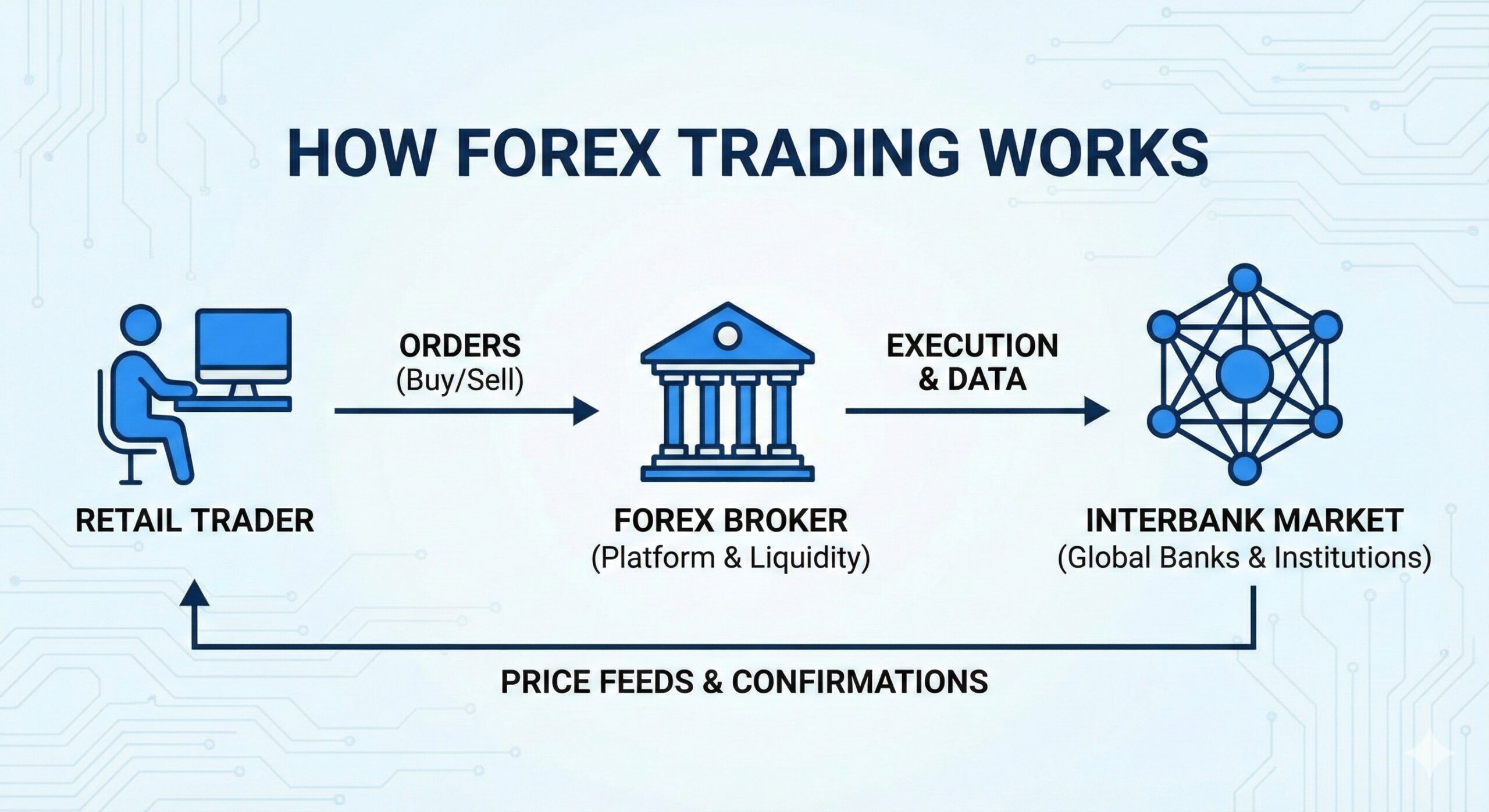
For a beginner reading this Exness Nigeria review 2026, understanding the engine of the market is more critical than the features of the car (the broker).
1. Market Hours and Sessions
The forex market operates 24 hours a day, 5 days a week, but liquidity shifts. It begins in New Zealand/Australia, moves to the Asian session (Tokyo/Singapore), then the European session (London), and finally the North American session (New York).
- Critical Note for Nigerians: The most volatile period—where price moves are largest—often occurs when the London and New York sessions overlap (roughly 1:00 PM to 5:00 PM Nigerian time). This is when liquidity is highest, but also when risk is most acute.
2. Currency Pairs and Correlation
Currencies trade in pairs (Base/Quote).
- Major Pairs (e.g., EUR/USD): These generally have the lowest “spreads” (fees) because they are heavily traded.
- Exotic Pairs (e.g., USD/NGN): Trading the Naira is incredibly difficult for retail traders due to low liquidity and massive spreads. Most Nigerian traders stick to major pairs like GBP/USD.
- Correlation Risk: Beginners often fail to realize that pairs are connected. Buying EUR/USD and buying GBP/USD is effectively doubling your risk on the US Dollar weakness.
3. The Role of the Broker (The Intermediary)
An individual cannot access the interbank market (where banks trade billions) directly. Brokers like Exness act as the bridge.
- Market Maker vs. STP/ECN: Some brokers “make the market” (take the other side of your trade), while others route it to liquidity providers. Exness operates a hybrid model, offering execution that suits different account types. Understanding how your broker executes trades is key to avoiding conflicts of interest.
Is Forex Trading Legal in Nigeria?
This is the most nuanced section for 2026.
The Legal Status Yes, forex trading is legal for individuals. There is no legislation in the Nigerian constitution or criminal code that prohibits a citizen from opening an online account to trade currencies.
The Regulatory Gap However, the sector exists in a “regulatory grey zone.”
- Central Bank of Nigeria (CBN): The CBN regulates the official foreign exchange market and traditional banks. It strictly controls how Naira can be sourced for imports. However, it does not issue licenses to online retail forex brokers.
- Securities and Exchange Commission (SEC): The SEC regulates investment schemes. They have previously warned against “unlawful online trading platforms,” largely targeting fraudulent schemes.
The Consequence: Since no online forex broker holds a license from the Nigerian government to operate on Nigerian soil, all legitimate brokers used by Nigerians (including Exness) are offshore brokers. They operate under foreign licenses (like the FCA in the UK or FSCA in South Africa).
- Critical Safety Tip: Your protection does not come from Abuja; it comes from the broker’s regulator abroad. If you trade with an unregulated broker and they vanish, there is no Nigerian authority to help you recover funds.
Exness Nigeria Review 2026: Broker Features Analysis
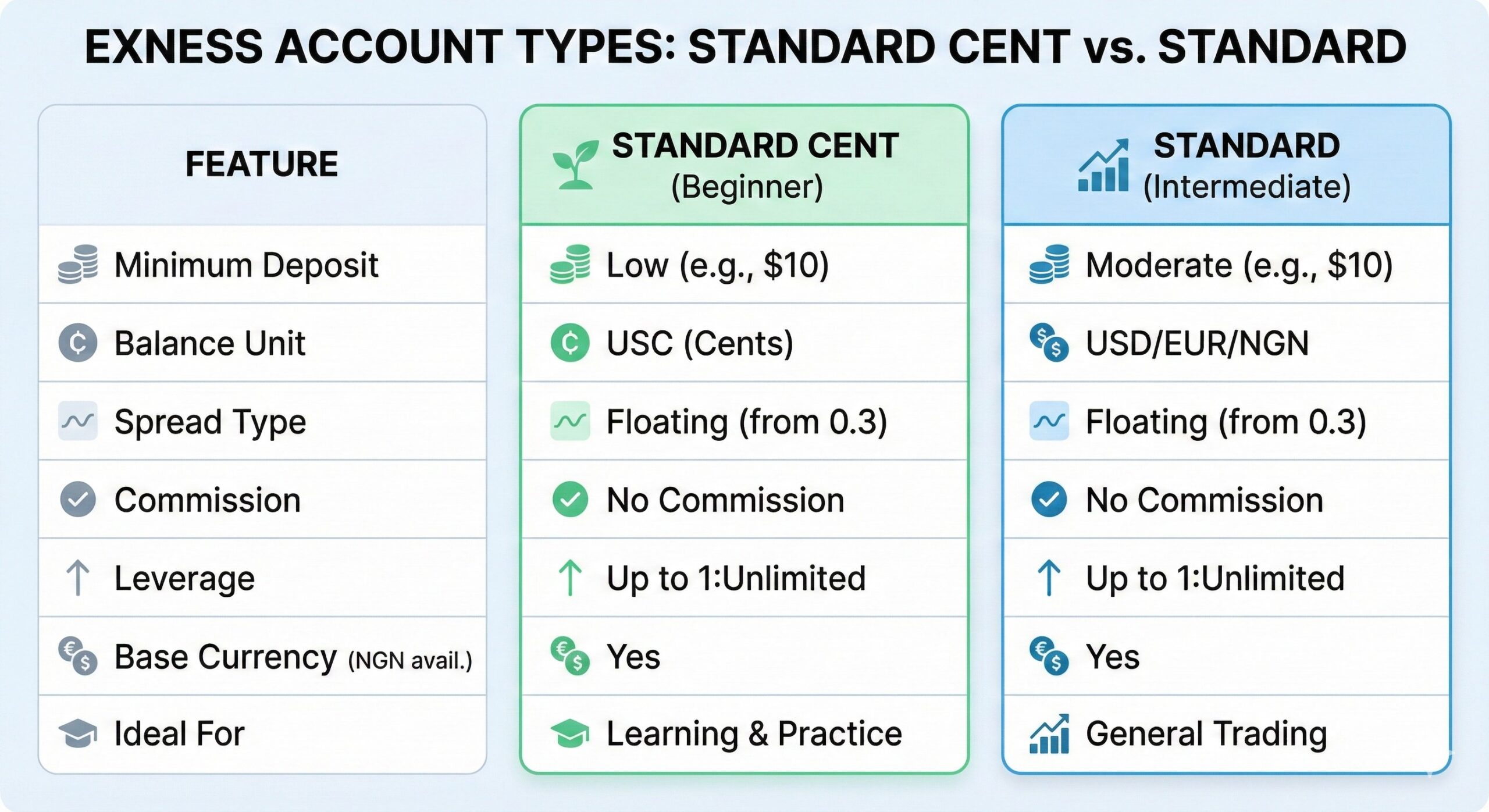
Analyzing Exness in 2026 requires looking beyond marketing to the technical specifications that affect profitability and safety.
1. Account Structure and Capital Efficiency
Exness differentiates itself through its tiered account structure.
- Standard Cent Account: This is the critical educational tool. By denominating balance in cents (1 USD = 100 USC), it allows beginners to trade standard market movements with a fraction of the financial risk. A 10-cent movement feels real psychologically but is financially survivable.
- Standard Account: Features floating spreads starting from 0.2 pips. It uses “Market Execution,” meaning no requotes, but slippage (price difference) can occur during high volatility.
- Pro/Raw Accounts: These offer near-zero spreads but charge a commission (e.g., $3.50 per lot). These are mathematically superior only for high-volume traders or scalpers (automated trading algorithms).
2. Localized Payment Gateways
The ability to move funds is often the biggest hurdle in Nigeria. Exness supports local bank transfers in Naira.
- The Mechanism: You transfer NGN to a local partner bank. The system converts it to USD at an internal exchange rate.
- Critical Check: Always check the broker’s internal exchange rate against the parallel market rate. A poor conversion rate acts as a “hidden fee” on your deposit.
3. Swap-Free (Islamic) Integrity
Exness offers Extended Swap-Free status for Muslim countries. Unlike some brokers who widen spreads to compensate for lack of interest charges, Exness maintains standard spreads for Swap-Free accounts on major pairs, aligning with ethical trading standards.
4. Regulatory Standing
Exness is not a “cowboy” broker. It holds licenses from top-tier regulators:
- FCA (UK): Highly strict protection of funds.
- CySEC (Cyprus): Compliance with European standards.
- FSCA (South Africa): Relevant for African oversight.
- FSA (Seychelles): Often the license covering global retail clients (including Nigeria). While less strict than the FCA, the parent company’s multi-jurisdictional oversight provides a layer of corporate governance.
Common Forex Trading Risks (IMPORTANT)
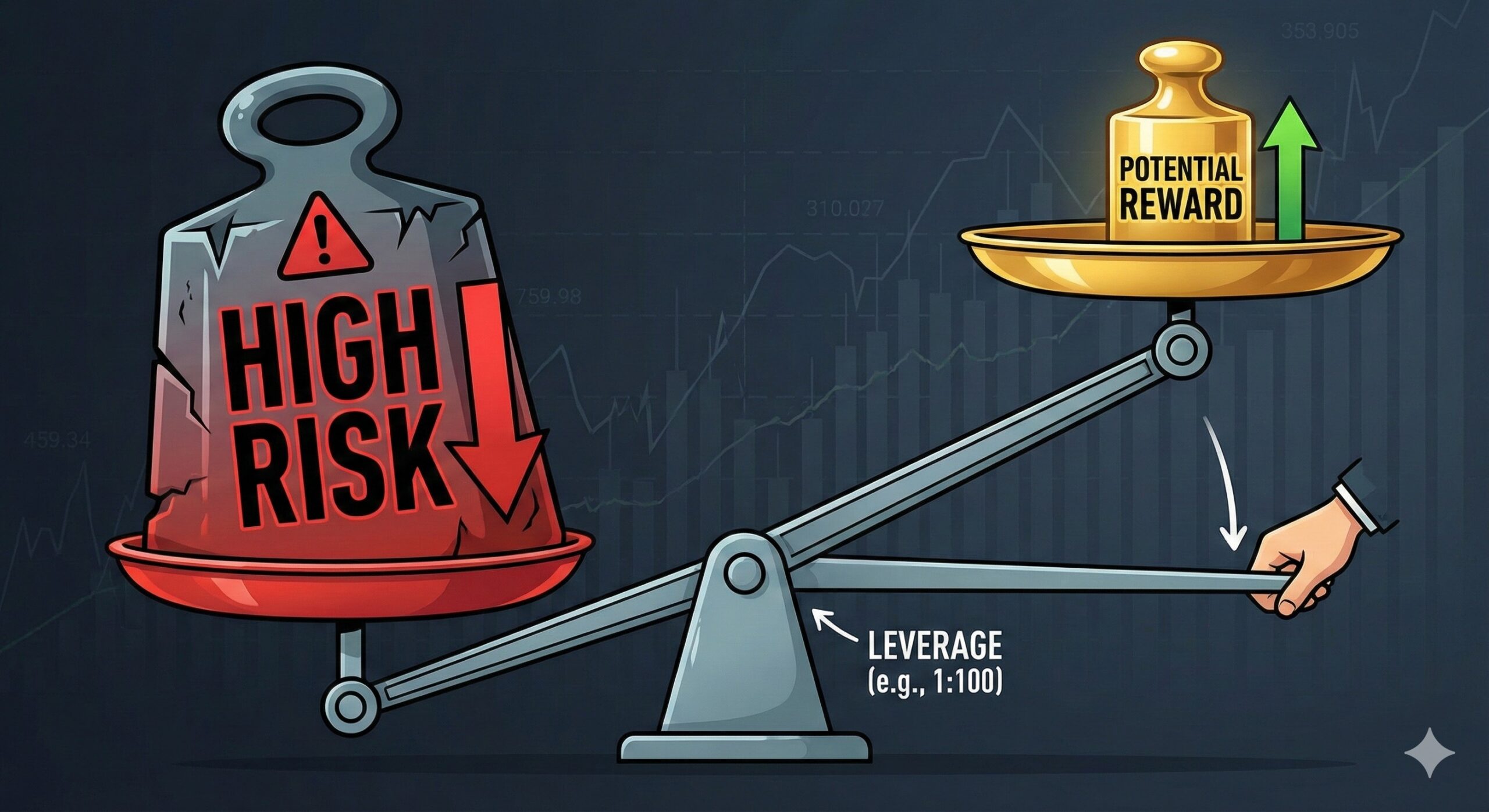
The marketing suggests “freedom”; the reality is “risk.”
1. Leverage: The Double-Edged Sword
Leverage is a loan from the broker.
- The Math: With 1:100 leverage, a 1% drop in price wipes out 100% of your equity.
- The Trap: High leverage (e.g., 1:1000) is often marketed as a benefit. In reality, it removes your “margin for error.” A tiny bit of market noise can liquidate your account before your analysis has time to play out.
2. Volatility and Slippage
During major news (like US Non-Farm Payrolls), liquidity dries up. You might try to close a trade at 1.0500, but the market “gaps” and fills you at 1.0450. This slippage is a normal market function, but it can cause losses larger than your Stop Loss intended.
3. Psychological Ruin
The market is designed to trigger dopamine. The “near-miss” effect (almost winning) encourages gambling behavior. Without strict rules, trading becomes an addiction rather than a business.
Beginner Mistakes Nigerians Should Avoid
- The “Bonuses” Trap: Avoiding brokers that offer “100% Deposit Bonus.” These often lock your withdrawal until you trade impossible volumes. (Note: Reputable regulators often ban bonuses).
- Signal Dependency: Relying on Telegram “gurus.” If their signals were perfect, they would be trading, not selling subscriptions for NGN 5,000.
- Undercapitalization: Trying to turn $10 into $1,000. The mathematical probability of this is near zero. It encourages reckless over-leveraging.
Learning Forex Trading the Right Way
- Macro-Education: Learn why currencies move (interest rates, GDP, inflation) before looking at charts.
- Micro-Education: Learn how price moves (candlestick patterns, support/resistance).
- The Demo Phase: Trade on a demo account until you have a profitable track record over 3 consecutive months. Most beginners skip this and fail.
- Risk Management: Never risk more than 1-2% of your account on a single trade.
How to Stay Safe From Forex Scams in Nigeria
- Investment Schemes: Real forex trading is active. You do the work. Any platform asking you to “invest” capital for a “guaranteed weekly return” is a Ponzi scheme, not a broker.
- Impersonation: Scammers clone legitimate broker websites. Always type
exness.com(or the official regional domain) directly into your browser. - Recovery Scams: If you lose money, beware of “agents” claiming they can recover your lost funds from a broker for a fee. This is a secondary scam.
Frequently Asked Questions (FAQs)
1. Is forex trading safe for beginners in Nigeria? No financial market is “safe.” It involves the risk of loss. However, trading with a regulated broker like Exness removes the risk of theft, leaving you to manage the risk of the market itself.
2. Can I deposit in Naira? Yes. Exness acts as a gateway, accepting Naira transfers and holding your balance in USD (or other base currencies), allowing you to trade global assets without sourcing hard currency yourself.
3. What is the spread? The spread is the cost of doing business—the difference between the Buy and Sell price. On a Standard account, this averages around 0.2 to 1.0 pips for EUR/USD.
4. Does Exness offer a Cent account? Yes, and it is the most recommended starting point for educational trading.
5. Are profits taxable in Nigeria? Currently, personal income from online trading falls under general personal income tax rules, but enforcement on offshore digital income varies. It is advisable to consult a tax professional.
6. Why do most traders lose money? Lack of risk management. Most beginners bet too big on single trades, ignoring the mathematical certainty of losing streaks.
Conclusion
In this critical Exness Nigeria review 2026, we have stripped away the allure of easy wealth to reveal the mechanical reality of forex trading. Exness stands out as a robust platform for Nigerian traders due to its regulatory footprint, local banking integration, and educational account structures.
However, the broker is merely the venue; you are the player. The market does not care about your financial goals. It rewards only discipline, education, and risk management. We strongly advise that you treat trading as a tuition-heavy profession: start with a demo account, read widely, and never trade capital you cannot afford to lose.
Risk Warning: Trading Forex and CFDs carries a high level of risk to your capital and may not be suitable for all investors. You could lose more than your initial deposit. The content on earnfx.ng is for educational purposes only and does not constitute financial or investment advice. We are not a financial institution or broker. Always do your own research or consult a certified financial advisor before trading.