
Introduction
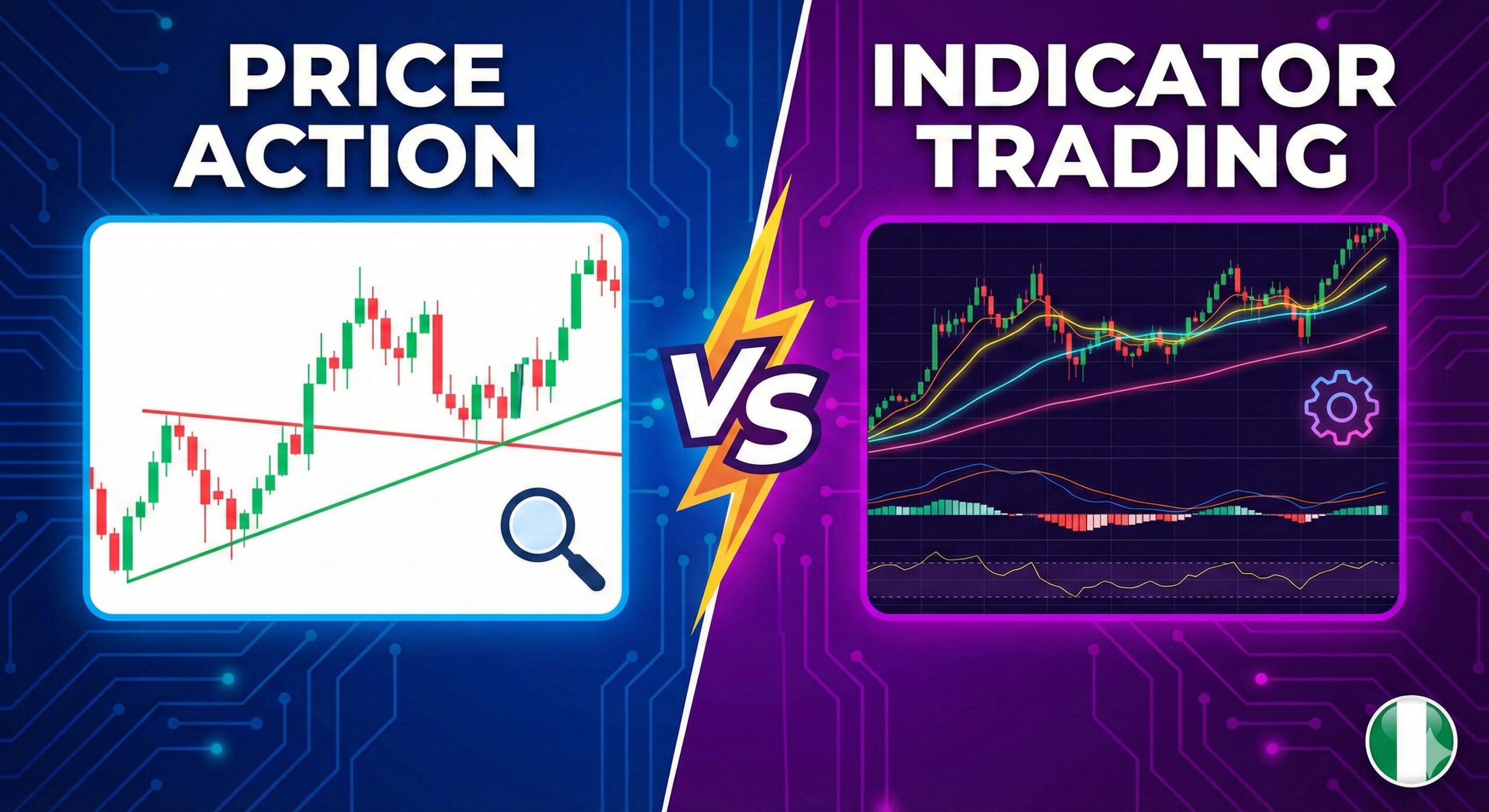
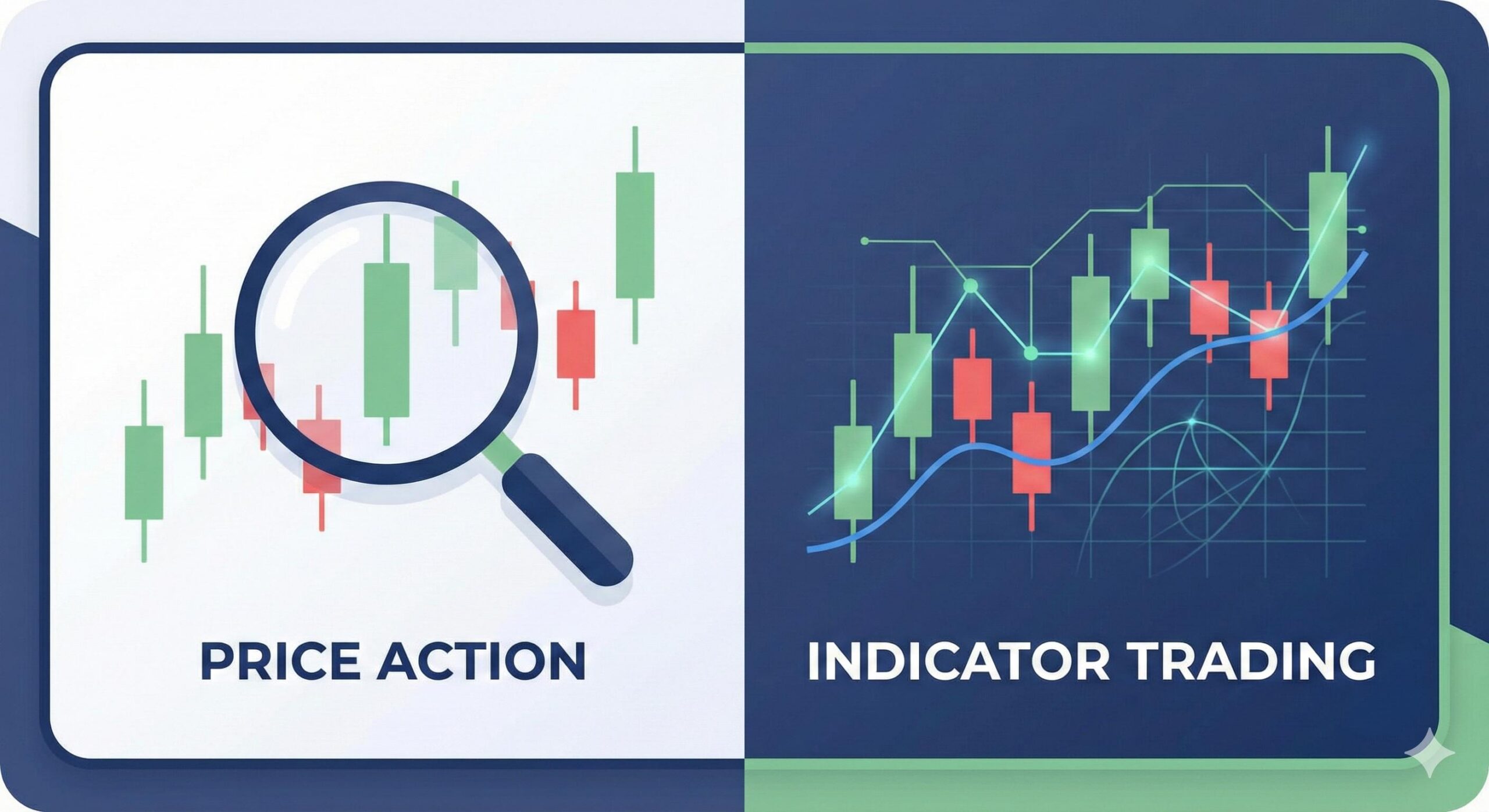
What exactly is the difference between Price Action trading vs Indicator trading? Price action trading uses chart price movement and reads candlestick colors and shapes and uses past support and resistance levels without any trading tools, while in comparison, indicator trading uses mathematical formulas such as Moving Averages and RSI and uses past market data to draw shapes and visual guide line indicators on your screen. While price action trading uses only current market activity, indicator trading captures market structure and behavior over time. Both methods are used a lot, however, they are very different.
Forex trading has a lot of competition, and learning to analyze currency pairs can be beneficial for you as a novice trader starting from Nigeria. While learning about the vast and ever-changing forex market, you will encounter many different types of global banks, news, economic data, and institutional investors that affect the market.
Once you understand the various types of market influences, you will be able to better understand and navigate the market. In this guide, we will cover the various types of analyses for you to understand which one correlates to the way you learn the best and which one fits you the best psychologically as a trader, all of which can be done before you actually invest money into the market.
Table of Contents
Deep Dive into Price Action Trading
Price action trading is universally referred to by professionals as “naked trading.” This is because the price charts are kept entirely clean, stripped of any underlying mathematical lines, formulas, or automated tools. A price action trader looks strictly at the raw data—specifically, how the price moves up and down over a chosen timeframe—to predict what the market might do next.
The philosophy behind price action is that the current price reflects all known information, fears, and expectations in the market. Therefore, the purest way to understand market sentiment is to watch the price itself. The key components of this method include:
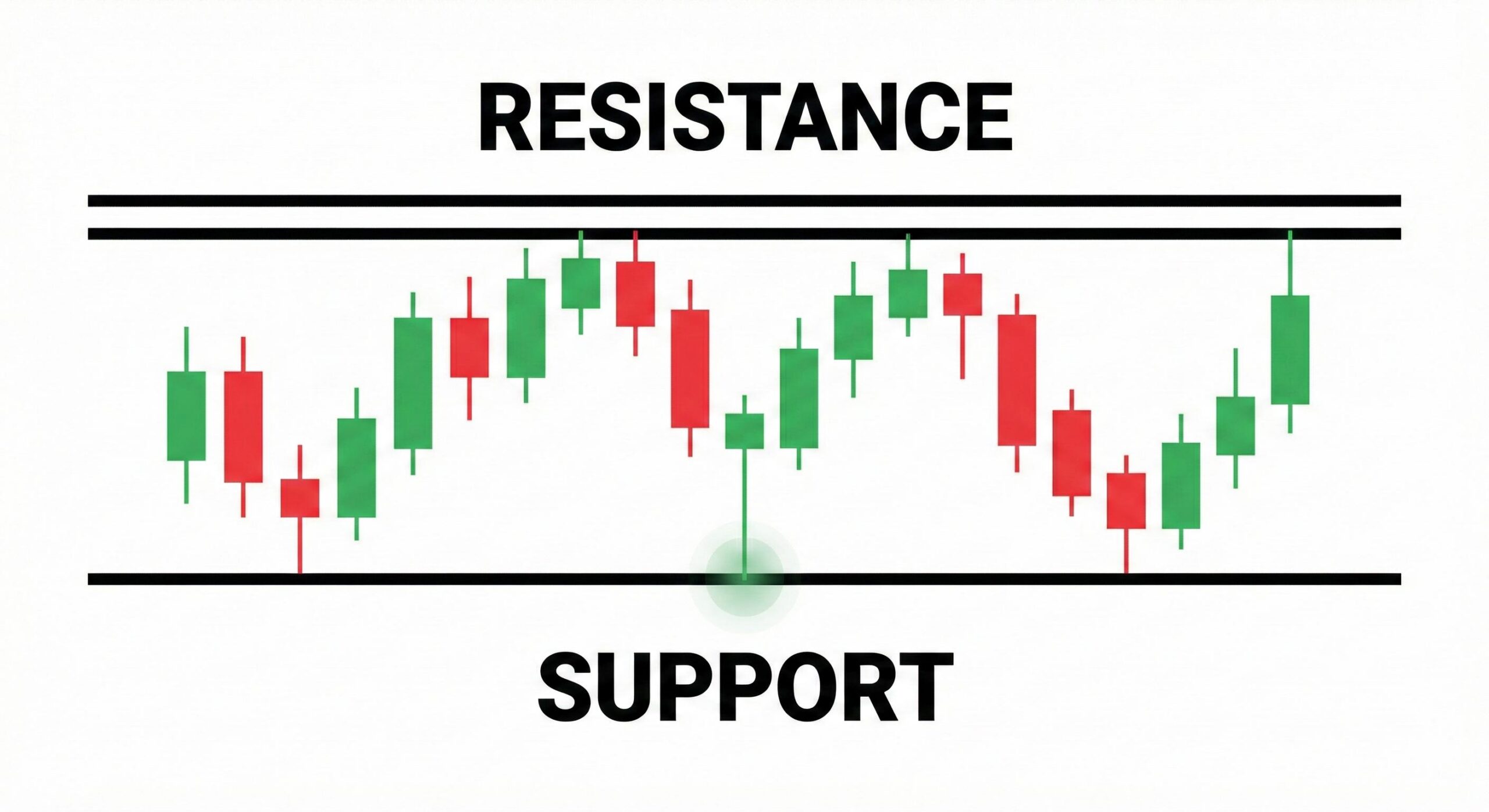
- Candlestick Patterns: Price action traders meticulously read the physical shape, size, and wicks (or shadows) of individual candlesticks. For instance, a “pin bar” with a long lower wick tells the trader that sellers tried to push the price down, but buyers aggressively rejected it, signaling a potential upward reversal.
- Support and Resistance Zones: These are historical price levels where the market has repeatedly reversed direction. Support acts as a “floor” where prices tend to bounce up, while resistance acts as a “ceiling” where prices fall back down. Price action traders manually draw these zones based on past market memory.
- Market Structure and Trendlines: By visually connecting the sequence of higher highs and higher lows, traders draw manual diagonal trendlines to identify the overall market direction without needing a computer algorithm to define the trend for them.
The primary advantage of price action is its real-time responsiveness. Because there are no formulas to process, there is absolutely no “lag” between what the market is doing and what you see on your screen. You are reacting to live, unfolding market psychology. However, the major drawback is that it is a highly subjective method. For a beginner with absolutely no trading knowledge, a naked chart can look incredibly chaotic and confusing. Accurately reading market structure requires significant screen time, patience, and visual chart-reading practice.
Deep Dive into Indicator Trading
Indicator trading creates an attempt to take away any guessing from the emotional bias an individual may take to read price charts. Since raw price charts without the help of an indicator require someone to derive psychological interpretations from each of the small embedded meaning of the individual candlestick shape, they turn to trading indicators, which are preemptive indicators that help with advancements of mathematical predictions from past data of price, volume, or time. These are instantly set to a trader’s chart when the chart is opened.
Beginning traders can spend so much time trying to parse the vast quantities of data to try to find the patterns that develop. With indicators, those patterns are turned into simple signals. In the foreign exchange market, resistance and support indicators are used, and those indicators are:
- Moving averages are used to provide a visual representation of price loss/gain, which are performed as average prices over the specified period of time. For example, an average price may be calculated as a historical price in the average time period of the last 50 or 200 days.
- Relative Strength indicators, which essentially have the same purpose as momentum indicators, help determine whether a currency pair is in an “oversold” or “overbought” condition. An oversold condition means the price is too low and is likely to rise.
- MACD is an indicator meant to show or help determine the strength of the trend as well as the trend in the opposite direction, which often develop into a solid trend, and provide the potential for openings to enter the trend.
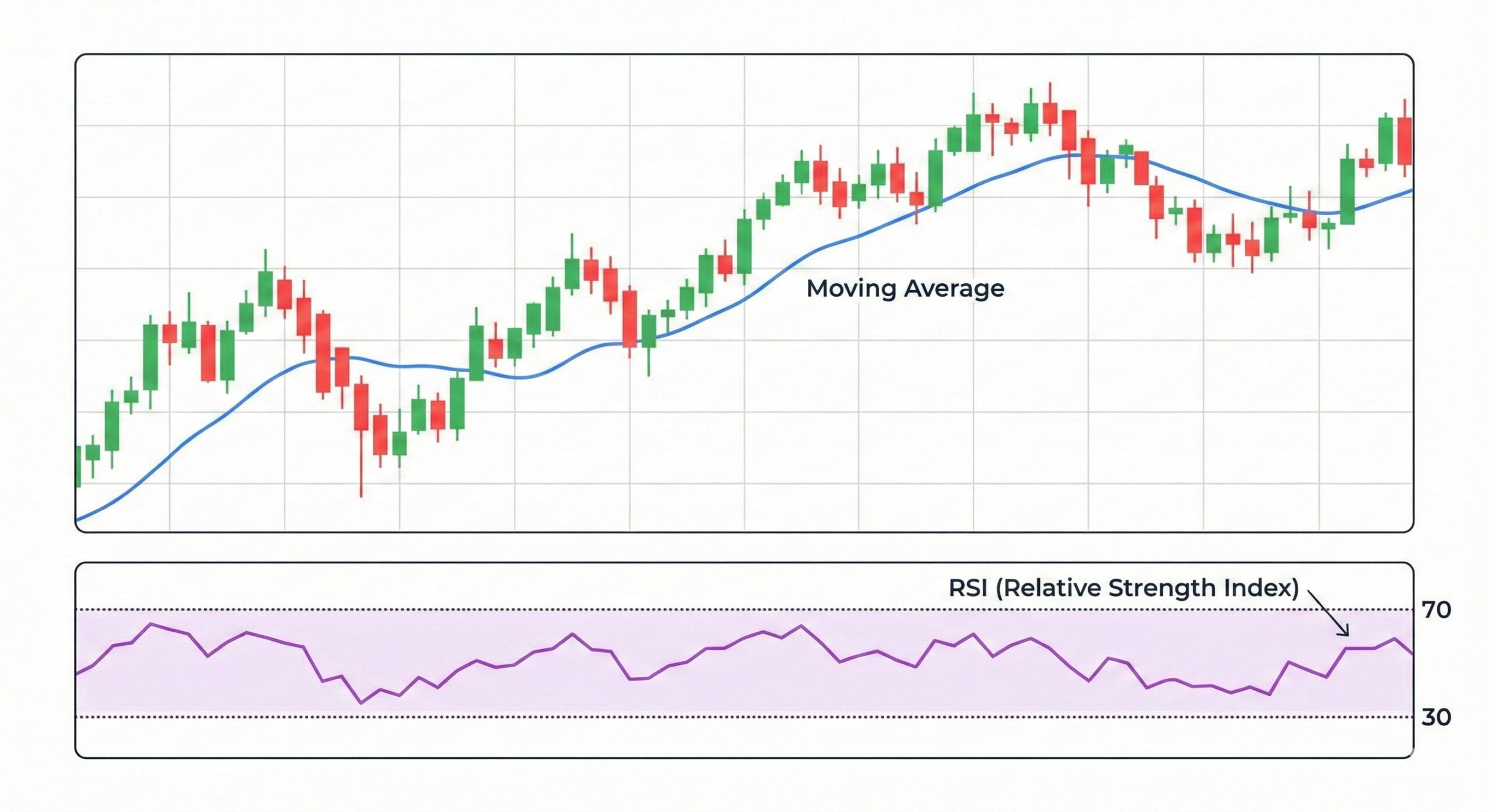
With indicator trading, trading and investing can be broken down into simple and understandable rules. For example, one clear rule could be, “Buy when the RSI indicator is above 30 AND the Moving Average indicator is below the price.” For beginners, this is helpful because it will reduce emotional decisions like fear and greed.
On the other hand, one big drawback of this type of trading is that indicator trading is often based on “lagging” data. This means that indicator calculations will often show price movements that have already begun to move. Additionally, one of the most common mistakes beginners make is adding a ton of indicators to one chart. This is often referred to as “analysis paralysis” and it makes the chart much more cluttered and difficult to understand.
Price Action Trading vs Indicator Trading: Which is Best for Beginners?
It’s important to remember that comparing Price Action trading and Indicator trading means that there is no definitive better option. The option that works better for you depends on your preference for how you learn, how much time you have to put towards studying trading, and how you prefer to emotionally feel when you trade.
If you feel better trading with rules and structure, and prefer objective systems, you are likely to feel better starting with trading using indicators. They give you a concrete structure to learn under before you know how the currency pairs move on their own.
On the other hand, if you prefer to learn about trading from the underlying fundamentals and trader psychology, and you are okay with a harder, more intensive start, then price action trading is for you. It is a skill that teaches you to interpret market moods without external indicators, and lets you know the reasoning behind the price movement rather than just waiting for a trade signal from a computer.
The Hybrid Approach
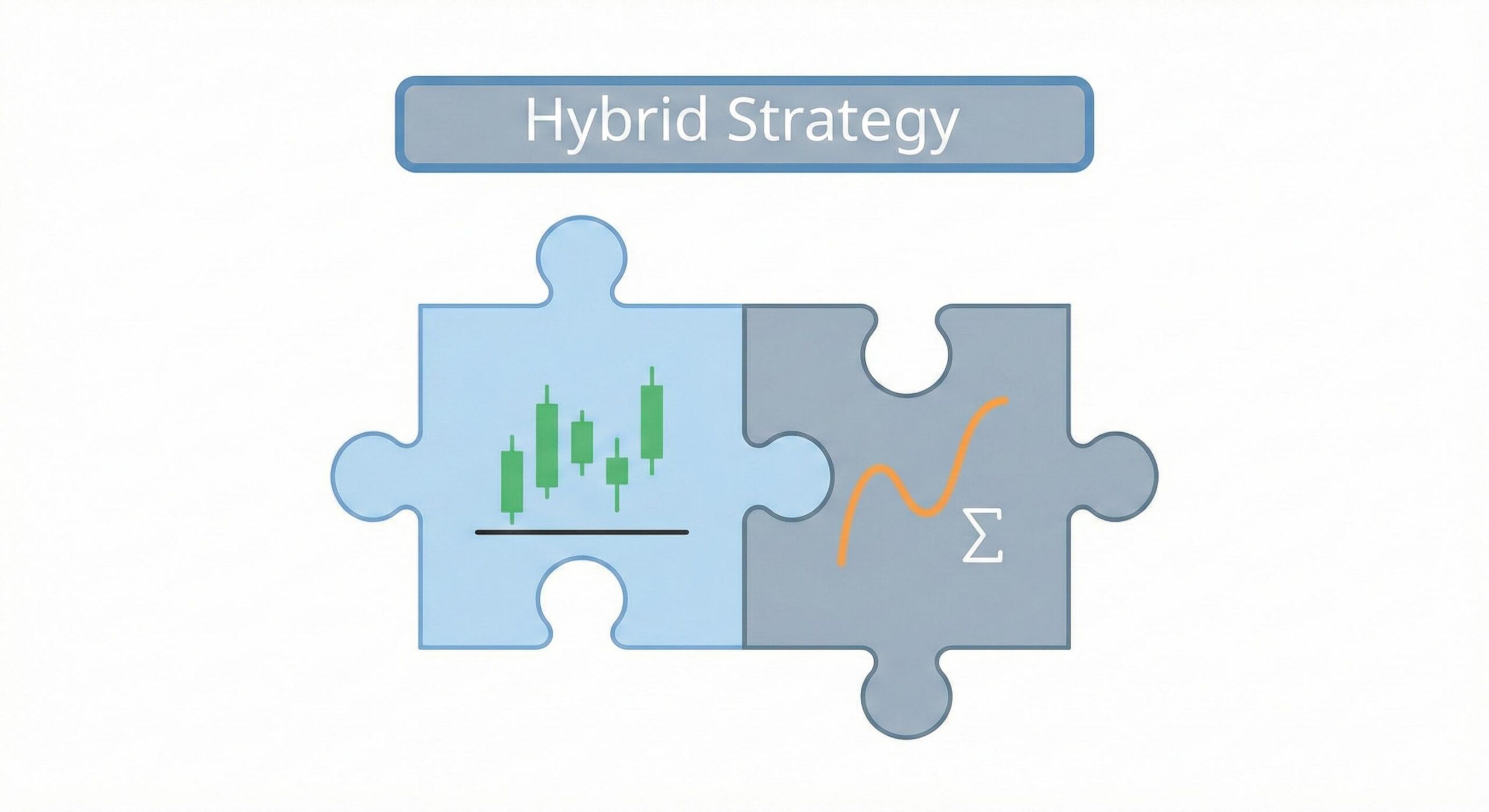
You should know that you don’t have to pick one method or the other. As you progress from beginner to intermediate level, you’ll see that many veteran traders employ a tactic called the hybrid approach.
An example of a hybrid trader would be someone who, at first, analyzes price action based on a certain market structure to identify logical zones of support and resistance. When the price hits one of those zones, instead of trying to predict what the price will do, that trader will analyze one technical indicator (such as, RSI, or MACD) to confirm its momentum. Say, for example, the price action at the level of resistance seems to be rejecting and the indicator shows that the market is overbought, that trader would have what is called a high probability “confluence” setup. This strategy is great at combining methods to use their strengths and filter out their weaknesses.
Critical Risk Awareness for Forex Beginners

Regardless of where you land on the spectrum of analytical methods, it is vital to understand the harsh, unvarnished realities of the foreign exchange market. Trading involves significant financial risk and should never be viewed as a quick way to make money or an easy way to replace your primary income in Nigeria.
The forex market is highly unpredictable and influenced by global geopolitical events that no candlestick pattern or mathematical indicator can perfectly foresee. There are absolutely no guarantees in trading, and there is no secret strategy that completely avoids losses. Both price action techniques and technical indicators will frequently produce false signals, resulting in losing trades.This is exactly why strict risk management—such as never risking more than 1% to 2% of your capital on a single trade and always using Stop Loss orders—is mandatory to survive in the market.
Supply and Demand Zone Trading in Nigeria: A Beginner’s Educational Guide (2026)
Conclusion
When it comes to Price Action trading vs Indicator trading, there is no magic formula. Price action teaches you to read raw, live market psychology through candlesticks and support levels, while indicators provide a structured, mathematical way to filter out market noise.
When starting out, it’s best to take a hybrid approach. Start learning to read a “naked” chart, meaning one free of indicators. You can then augment that analysis with one or two indicators. Always bear in mind that blinds you to indicators. You can then augment that analysis with one or two indicators. Always bear in mind that the forex market is extremely volatile, and you could lose a lot of money by trading. No strategy will work every time.
Take your time, prioritize your education, and practice strictly on a risk-free demo account before ever committing real funds. For more step-by-step, beginner-friendly trading guides, keep learning with us here at earnfx.ng.
Disclaimer: This content is provided strictly for educational purposes only and does not constitute professional financial advice. Always practice thoroughly on a risk-free demo account for several months before ever considering trading with real capital.
Humanize Text