
Introduction
The biggest financial market in the world is the global foreign exchange market. It processes trillions of dollars in sales each day. In the last few years, there has been new interest from people in Nigeria wanting to learn how the global foreign exchange market works. Nigeria has been focusing on acquiring digital skills, understanding local macroeconomics, and navigating local inflation. As a result, a lot of Nigerians are wanting to learn the basics of forex.
People wanting to trade foreign currencies actually have to learn a lot, and the market is highly dangerous and can be volatile. The risks are even greater for those who are new to the market. Considerable amounts of financial loss can be the result of a seemingly minor mistake. A thorough educational foundation is mandatory before anyone even considers interacting with a live market environment. For instance, one of the most critical concepts any beginner must master is understanding exactly what is leverage in forex trading, as this single mechanism drastically amplifies both market exposure and potential financial losses.
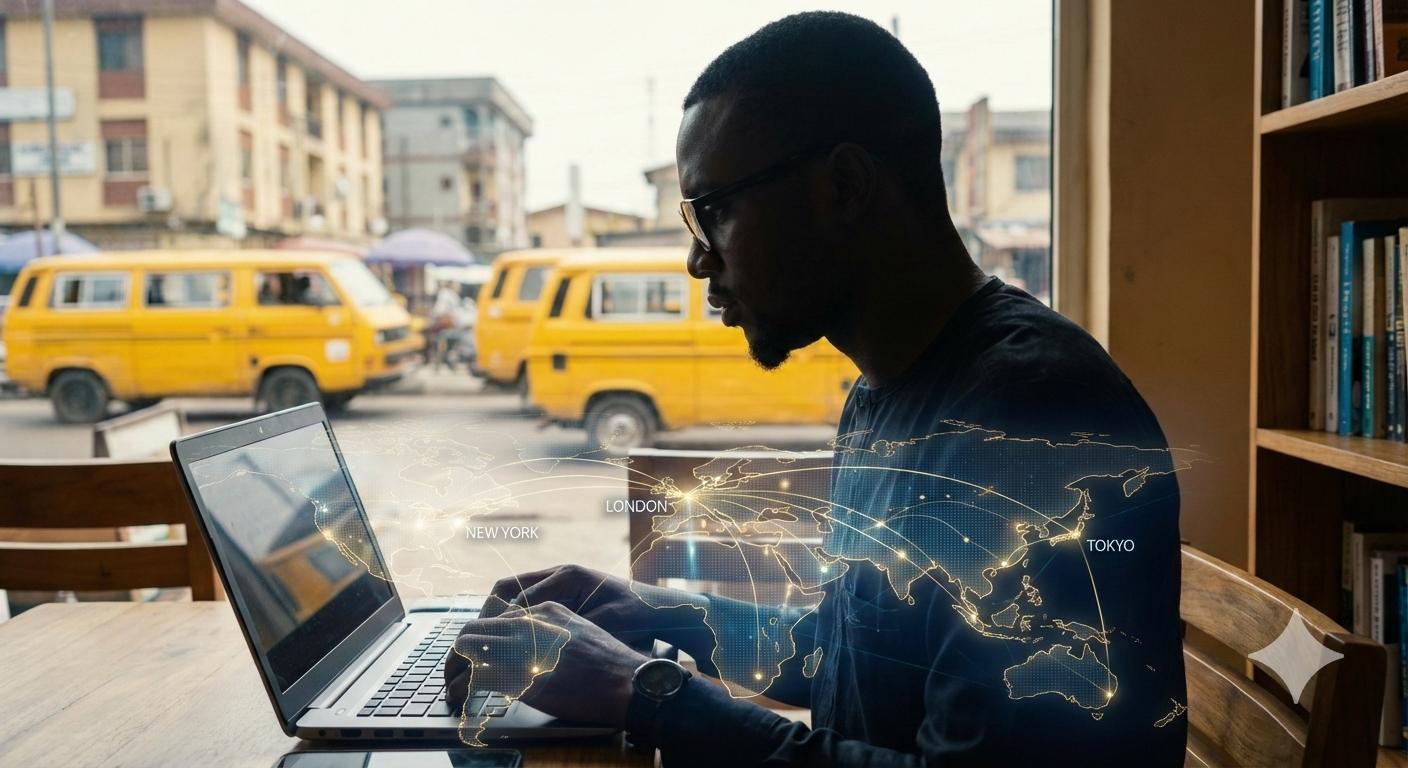
This comprehensive educational guide by earnfx.ng is carefully designed to provide Nigerian beginners with a realistic, neutral, and risk-aware introduction to the fundamentals of forex trading.We will take a look at how the market operates and the risks, and pitfalls that are commonplace and how to scam protect yourself against the educational scams that are growing in number on the internet.the digital space today.
Table of Contents
What Is Forex Trading?

Forex stands for foreign exchange, and it is a decentralised market for foreign currencies trading. Putting it simply, foreign exchange is a process that most people have done and may not even know it.
Take for example a flight from Lagos, Nigeria to London in the United Kingdom. When boarding the flight, you will not be able to use the Nigerian Naira (NGN) to buy a cup of coffee, or pay for a taxi in London. Instead, you will need to exchange your Naira for British Pounds (GBP) at the currently prevailing exchange rate. Now, let us say that your trip is canceled. You may decide to exchange those British Pounds back into Naira a week later. You will notice that the amount of Naira you receive may be different from what you initially spent.
This is as a result of the rise and fall of the exchange rate between the two currencies over that week.
In the digital forex trading market, people don’t really use the currencies they are trading, but rather use charts, economy and news data to predict the prices of different currencies at the moment. Data analysis is done by Global central banks, huge private commercial banks, big corporations, and small retail traders as well, with the aim of determining whether a currency is going to appreciate or depreciate compared to another currency. One of the focuses of forex market education is to grasp the overall global factors, such as the rate of inflation as well as political tensions and stability, that causes the high level of volatility in currency prices.
How Forex Trading Works
The first thing that you need to do in order to begin your financial education is to learn the fundamentals of the forex market. The forex market is different than the normal stock market.
Market Hours The global foreign exchange (forex) market is an example of a decentralized market, unlike an exchange like the Nigerian Stock Exchange, which has a fixed market schedule. Forex is open for trading 24 hours a day, 5 days a week. This is because the market ‘s decentralized nature allows it to spread across the major global financial centres, which are divided by time zones: Sydney, Tokyo, London, and New York. When one region’s main business day ends, another region’s main business day begins, keeping the market active.
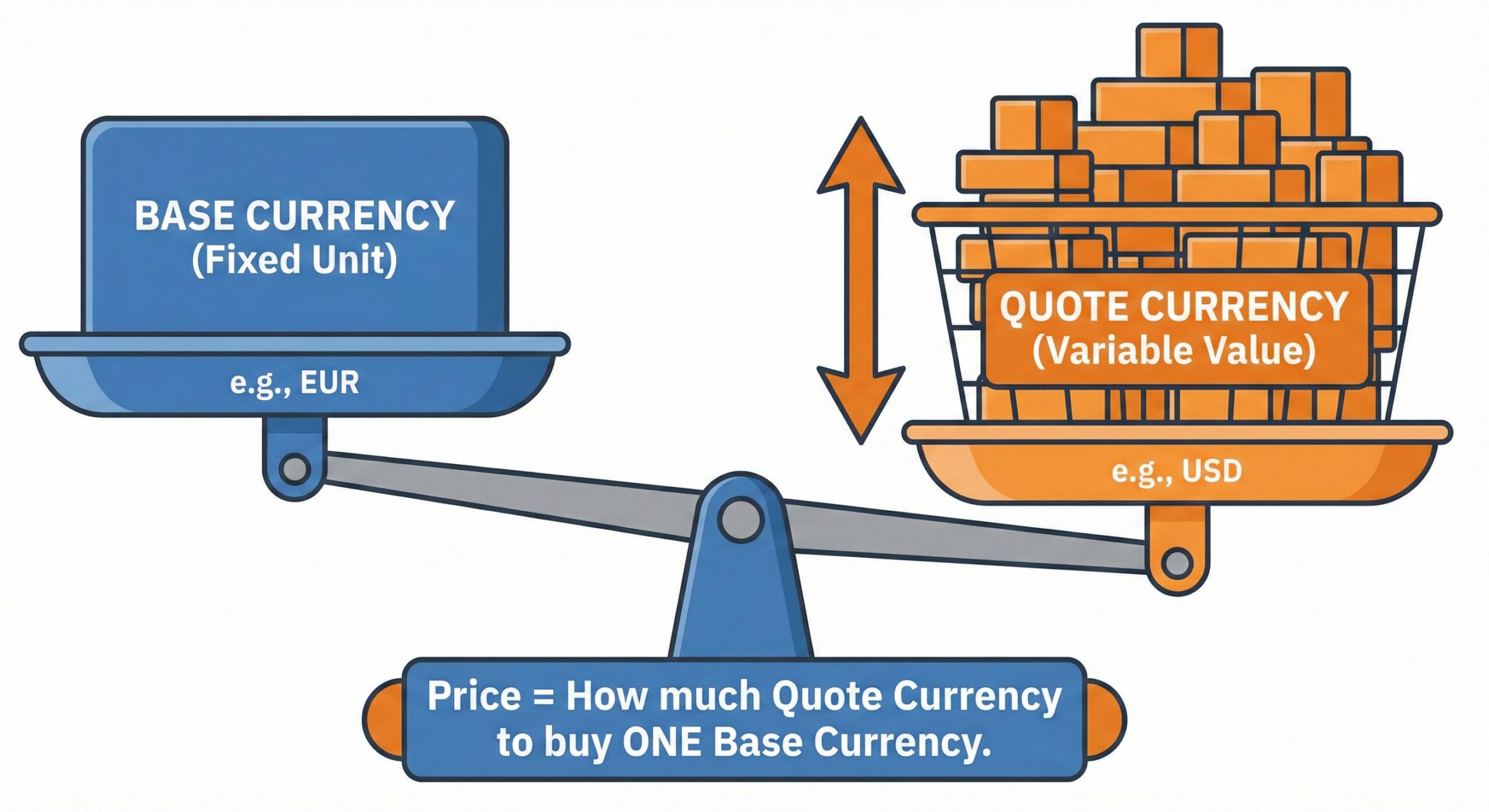
Currency Pairs In the Forex market, currencies trade and quote in pairs. This is due to the fact one must compare the value of one currency against the value of another. In trading you are at the same time buying and selling a currency. In a currency pair, the Base Currency is the first one listed and the Quote Currency is the second one listed. With the example of the most popular EUR/USD (Euro/US Dollar) currency pair, the base currency is the Euro, whereas the quote currency is the US Dollar.
This means that the amount quoted on the chart indicates how much of the quote currency (USD) is needed to get exactly one unit of the base currency (EUR).
Buyers and Sellers The entire forex market is driven by the fundamental economic principles of supply and demand. When major financial institutions release economic reports suggesting that a country’s economy is strengthening, the global demand for that country’s currency typically increases, driving its value up relative to other currencies. Conversely, negative economic data, political instability, or lowered interest rates can increase selling pressure, causing the currency’s value to drop rapidly.
Brokers Everyday retail individuals cannot access the global interbank forex market directly. They require the services of a forex broker. A broker is a financial services company that provides a digital trading platform. This platform acts as a bridge between the retail participant and the massive global market. The broker provides the real-time price quotes, charting software, and the infrastructure to execute the orders placed by the user.
Is Forex Trading Legal in Nigeria?
Are you wondering whether you can legally trade forex in Nigeria? To clear up any confusion, yes! Retail forex trading is legal in Nigeria, meaning the Nigerian Constitution has absolutely no law that protects the Constitution’s infringement by any Nigerian citizen concerning trading retail forex with his own money on any legal forex trading platform online. However, Nigeria’s legal and regulatory framework can be particularly tricky. For instance, the Central Bank of Nigeria (CBN) has an official monopoly on the regulation of official exchange rates, cross-border money transfers, commercial banks, and the overall monetary policy of the country. However, the retail forex brokerage business is unregulated in Nigeria.
Most Nigerian forex traders work with offshore retail brokers. This means they are subjected to high levels of regulation, sometimes in ways that could be detrimental to you. For example, a Nigerian trader may work with an offshore retail forex broker that is regulated by the Financial Conduct Authority (FCA) in the United Kingdom, the Australian Securities and Investments Commission (ASIC) in Australia, or the Cyprus Securities and Exchange Commission (SEC) in Cyprus, and the trader may choose to do so under the auspice of limited or no legal protection.
This means Nigerian forex traders may dip their toes in the retail forex trading industry, but they do so at their own risk. If you decide to go along with such a thing, you will be responsible for reducing the risk of all of the foreign offshore broker’s bad regulations.
Common Forex Trading Risks
Risk is an important aspect to thoroughly comprehend. This is particularly true of the Forex market, where potential customers could incur significant losses without the ability to earn money or gain returns.
Market Volatility As a result of unpredictable news, central banks shifting interest rates, geopolitical concerns, or even natural disasters, currencies may be subject to abrupt and violent price changes. This natural inconsistency will result in immediate loss of positions.
Feelings and Trading As emotions come and go, they play an important role in the decision-making process of beginner retail traders. Newer traders may find themselves at a loss and remain in an active trade, hoping that there is an uptick in the market, or they may place aggressive trades, out of excitement. It is evident that a tremendous amount of emotional strength and discipline is required.
Scams There are a lot of bad people that look to take advantage of newbies in the digital space. Many people bluff and pretend to be experts in the field and promise guaranteed returns. Without defensive education, Nigerians entering the digital space are extremely susceptible to these scams.
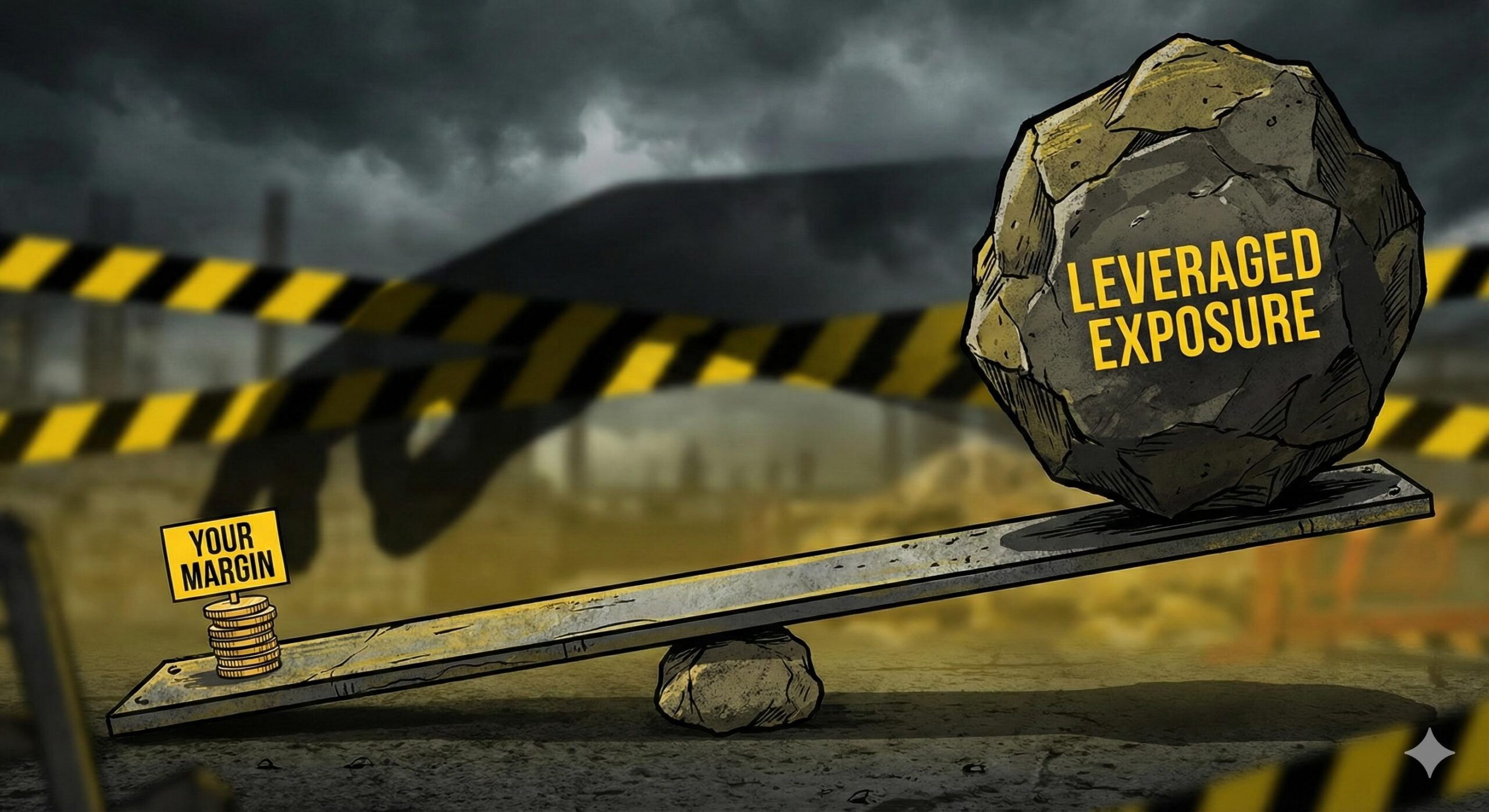
What Is Leverage in Forex Trading? To fully comprehend market risk, one must clearly understand what is leverage in forex trading. Leverage is essentially a mechanism of borrowed capital provided by the broker to artificially increase a participant’s market exposure. It allows an individual to control a very large position size in the market using only a relatively small amount of their own initial capital (which is known as margin).
For example, a leverage ratio of 1:100 means that for every $1 in the participant’s account, they can control $100 worth of currency in the market. While this concept might sound appealing conceptually to a beginner, it is inherently dangerous. Leverage amplifies losses in the exact same mathematical proportion that it amplifies market exposure. If the market moves against a highly leveraged position by even a tiny fraction of a percentage, it can result in the total, catastrophic loss of the participant’s entire account balance in an instant. Misunderstanding what is leverage in forex trading—and abusing it—is the primary reason the vast majority of beginners lose their capital rapidly.
Loss Possibility It is a statistical reality that a large majority of retail forex participants lose money. The market is highly competitive and zero-sum in many aspects, meaning one participant’s gain is generally another’s loss. Retail participants are competing directly against massive global financial institutions equipped with advanced high-frequency trading algorithms and infinitely deep financial resources.
Beginner Mistakes Nigerians Should Avoid
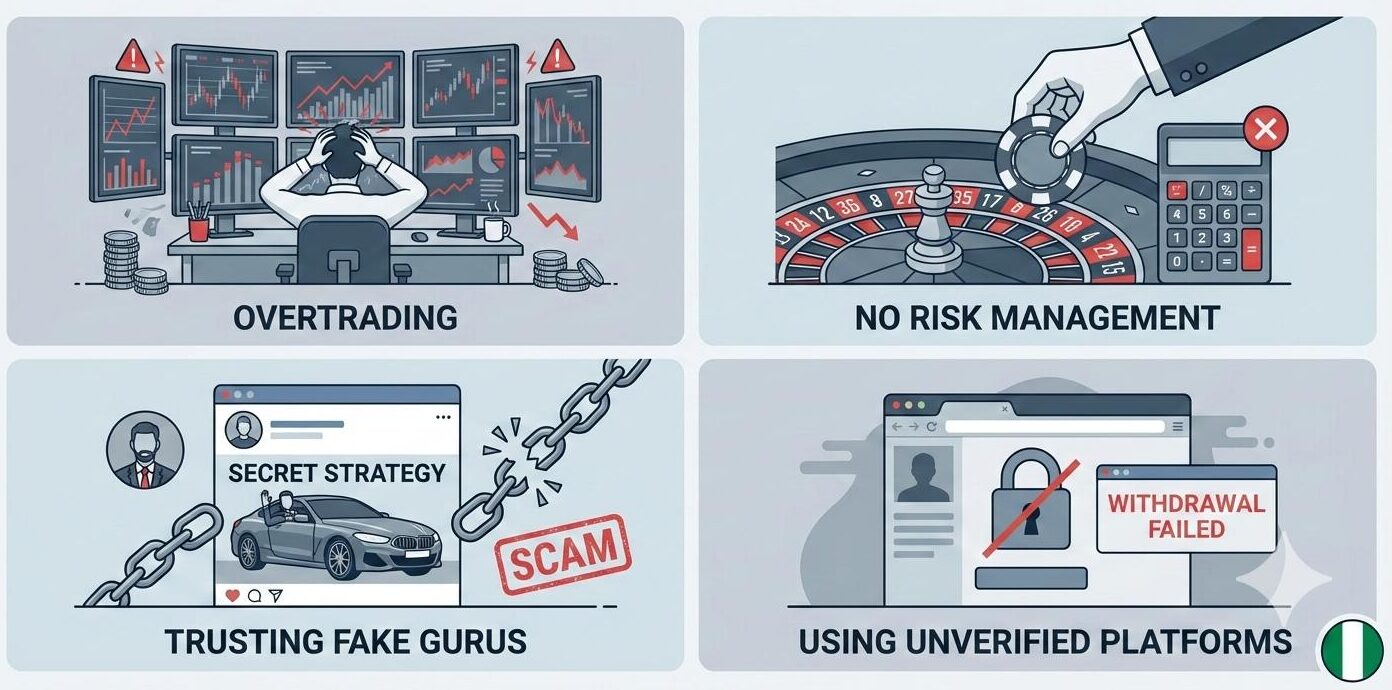
Through years of educational observation, several common pitfalls have been identified that frequently lead to the downfall and frustration of beginners.
Overtrading This phenomenon occurs when a beginner constantly enters and exits the market, taking far too many positions simultaneously or trading purely out of boredom. Overtrading is usually driven by a lack of patience and a misunderstanding of market structure. It results in paying excessively high transaction costs (such as spreads and commissions to the broker) and the rapid, unnecessary depletion of account capital.
No Risk Management Entering the market without a strict, mathematically sound risk management strategy is akin to gambling. Proper risk management involves calculating exact financial exposure before taking any position, strictly utilizing tools like Stop Loss orders (which automatically close a position to prevent further losses if the price reaches a certain negative level), and never exposing more than a tiny percentage of your total capital to a single market event.
Trusting Fake Gurus Many beginners mistakenly rely on individuals on social media (like Instagram or Twitter) who flaunt luxurious lifestyles, expensive cars, and claim to possess “secret” market strategies. These individuals often charge heavy fees for mentorship programs or “trading signals” that hold no real educational value. Real market professionals focus on risk, not lifestyle flexing.
Using Unverified Platforms Registering your details and funds with an unregulated, unknown, or offshore broker with a poor reputation is a severe mistake. Unverified platforms may manipulate internal price feeds, freeze user accounts without warning, or simply refuse to process withdrawal requests entirely.
Best Time to Trade Forex in Nigeria (GMT+1): A Beginner’s Guide (2026)
Learning Forex Trading the Right Way
A safe, responsible approach to the forex market is entirely dependent on adopting a strict, long-term, education-first mindset.
Education First Approach For weeks, a beginner must immerse themselves in vegetation before even thinking about interacting with the live market. The beginner must prioritize time in studying macroeconomic indicators, the art of reading candlestick price charts and the complex interrelated risk of the Global currency.
Demo Accounts A demo account is a practice trading environment almost every broker offers. It utilizes virtual, fake funds, allowing beginners to interact with real-time market data without carrying any financial risk whatsoever. Using a demo account for several months is absolutely mandatory for practicing platform navigation, testing educational theories, and understanding market volatility in a safe, stress-free environment.
Reading Market Basics If you want to get into the Forex market you have to understand the basic vocabulary of the foreign exchange market. This means learning the meaning of pips (percentage in point), lots (contract sizes), margin requirements, bid and ask prices and the distinctions of major, minor, and exotic currency pairs.
Awareness of Risks One of the most important things forex education teaches us is that we will never find a “perfect” strategy that will lead to consistent wins, because that doesn’t exist. The primary focus instead, should be learning how to handle and control risk. Someone who is properly educated and has experience understands that market outcomes are based on probabilities. Instead of trying to predict the next market direction, you should focus on protecting your existing capital through risk management.
How to Stay Safe From Forex Scams in Nigeria
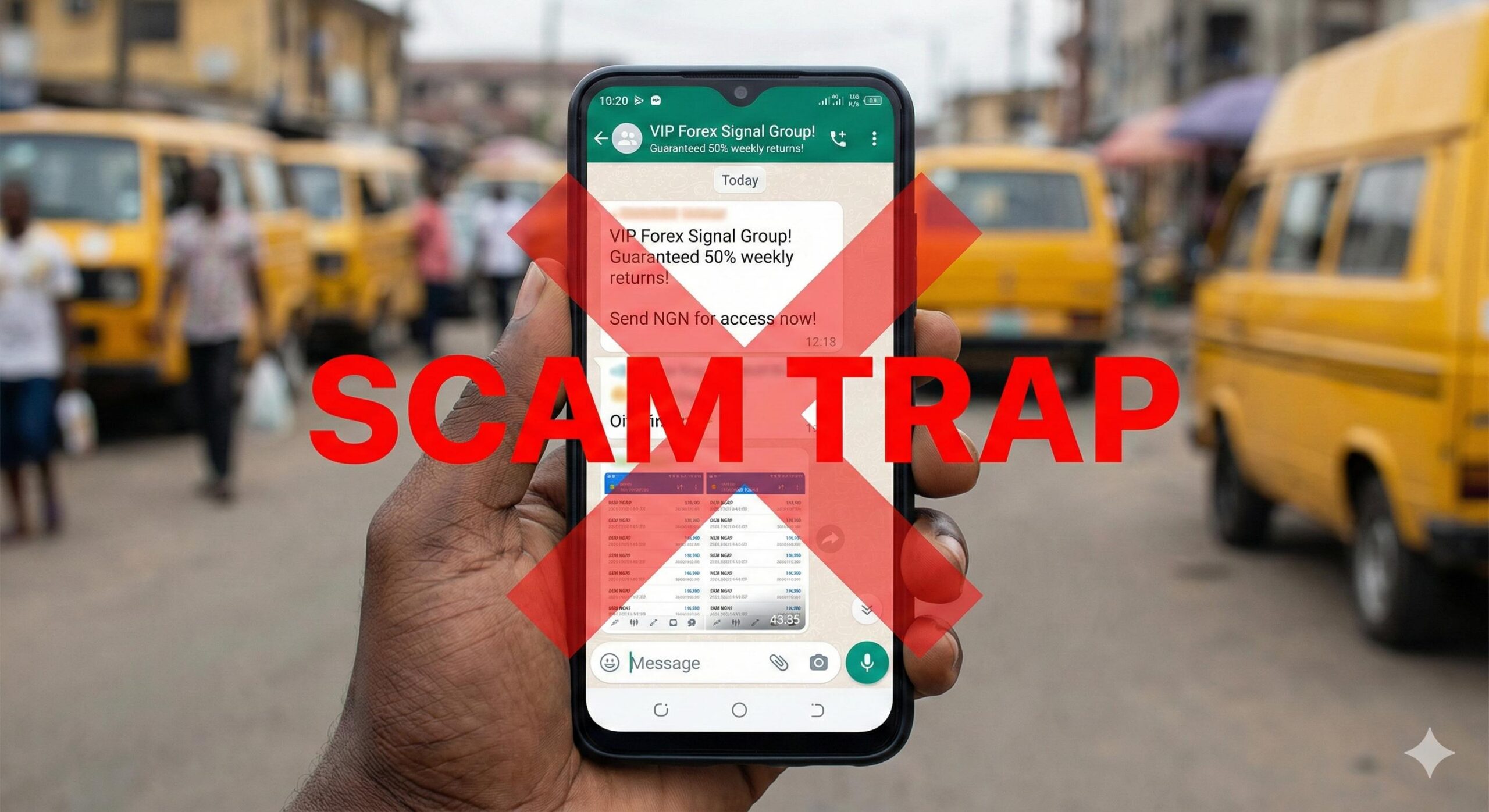
The rise of online scams in Nigeria has become a huge problem, particularly for people wanting to learn new skills in the digital space. In order to avoid being scammed, you have to be careful and be sure to protect yourself.
Scam Warning Signs One of the biggest warning signs of a scam is the promise of guaranteed returns. Each day, millions of trades happen across multiple financial markets. It is safe to say that nobody can predict the days winners and losers, and it is a lie if someone tells you they can guarantee a percentage of profit.
Educational scams For the genuine financial market education, it can take years of study, discipline and practice. If you are promised a quick financial success, easy job, or to quit your job, they are trying to push you into a scam. Avoid these scams by steering clear of anything that says “make money fast” or similar phrases.
Fake investment sites “account management” services ask you to send money to a third party’s bank account so an “expert” can do the trading for you. Most of the time, you will be the victim of a simple ponzi scheme, in which the money is never sent to the actual interbank market. The platform or trader will “disappear” with your money.
Scam warnings on WhatsApp/Telegram If you find yourself added to random WhatsApp or Telegram groups that are discussing forex, be very careful as the group may be run by a scammer. Scammers use forged profit screenshots and fake testimonials to gain the trust of the group. Once trust is formed, they will request that you send them cryptocurrency or a bank transfer in return for “VIP signals” or a scam “investment pool.”
Frequently Asked Questions (FAQ)
Is forex trading in Nigeria safe? No, trading forex in Nigeria is just as unsafe as trading forex in other parts of the world, if not more dangerous! Even though the global trade ecosystem is legitimate, trading forex without proper knowledge and understanding of the risks involved is unsafe. Beginners are easily scammed by unregulated platforms and local internet frauds.
Is it possible to learn forex for beginners? Yes, beginners can certainly learn the mechanics, terminologies, and analytical theories of the foreign exchange market. However, learning requires deep dedication, extensive time, and studying verified educational resources. It must be treated as a complex academic subject rather than a quick endeavor.
What is leverage in forex trading? Leverage is a high-risk facility provided by a broker that allows a participant to control a large market position using only a small amount of their own capital. It acts as a financial multiplier. While it increases market exposure, it proportionally and drastically increases the risk of severe financial loss.
How much money is needed to start learning? Learning the concepts of forex trading is entirely free. Beginners should strictly use free educational articles, video tutorials, and free demo accounts provided by brokers. You absolutely do not need to risk real money to learn how the market functions.
Are forex profits guaranteed? Absolutely not. There are zero guarantees in the foreign exchange market. Global price movements are unpredictable, and the statistical risk of losing your initial capital is very high.
Do I need a broker to interact with the forex market? Yes. Everyday retail participants cannot access the global interbank market directly. A brokerage platform is required to view live market prices and to execute simulated or real market orders on your behalf.
Conclusion
To start learning how to master the Forex Market, it takes patience, logical thinking, and a strong regard for the financial risks associated in this field. When it comes to Forex Trading, the risks involved greatly surpass the rewards. This is something Nigerian traders must consider. With the reality of the complexities involved in the financial markets, one must avoid the enticing hype of social media.
For a more thorough understanding of the Forex Market, one must take the time to get educated. With the solid understanding of the market’s flow and how it is impacted on a large scale, one will be able to be lightyears ahead of the rest. The whys and hows of risk management also happen to be a large critique factor and will allow smooth sailing for the rest. Understanding the complexities of the leverage involved in trading will allow one to steer clear of losing all one’s funds in one’s trading account very easily. Knowing and understanding the scams that Forex trading is more than a foreign concept for many.
One must always practice the preservation of one’s own capital in order to keep trading. One must not be hasty and make any rushed decisions. To not lose everything, one must engage in the advanced and ongoing education in the realms of finance. To master trading, one must dedicate a lot of time to Forex trading.
Disclaimer: Forex trading involves a significant level of risk and may not be suitable for all individuals. The possibility exists that you could sustain a loss of some or all of your initial capital. Therefore, you should not trade with money that you cannot afford to lose. This content is not financial advice, nor does it guarantee any profits. It is provided strictly for educational purposes only. This guide is written to help beginners understand forex market concepts, terminologies, and associated risks.