
Introduction
In the rapidly expanding world of online financial markets, Nigerian traders are increasingly looking for reliable platforms to access global currencies. From university students in Lagos seeking to understand global economics to professionals in Abuja looking for portfolio diversification, the interest in the foreign exchange market is undeniable. Amidst hundreds of brokers advertising on social media, one name that frequently appears in Nigerian trading circles is XM.
But is XM the right choice for a complete novice? More importantly, how does it function within the unique Nigerian financial ecosystem, especially regarding deposits and withdrawals in Naira?
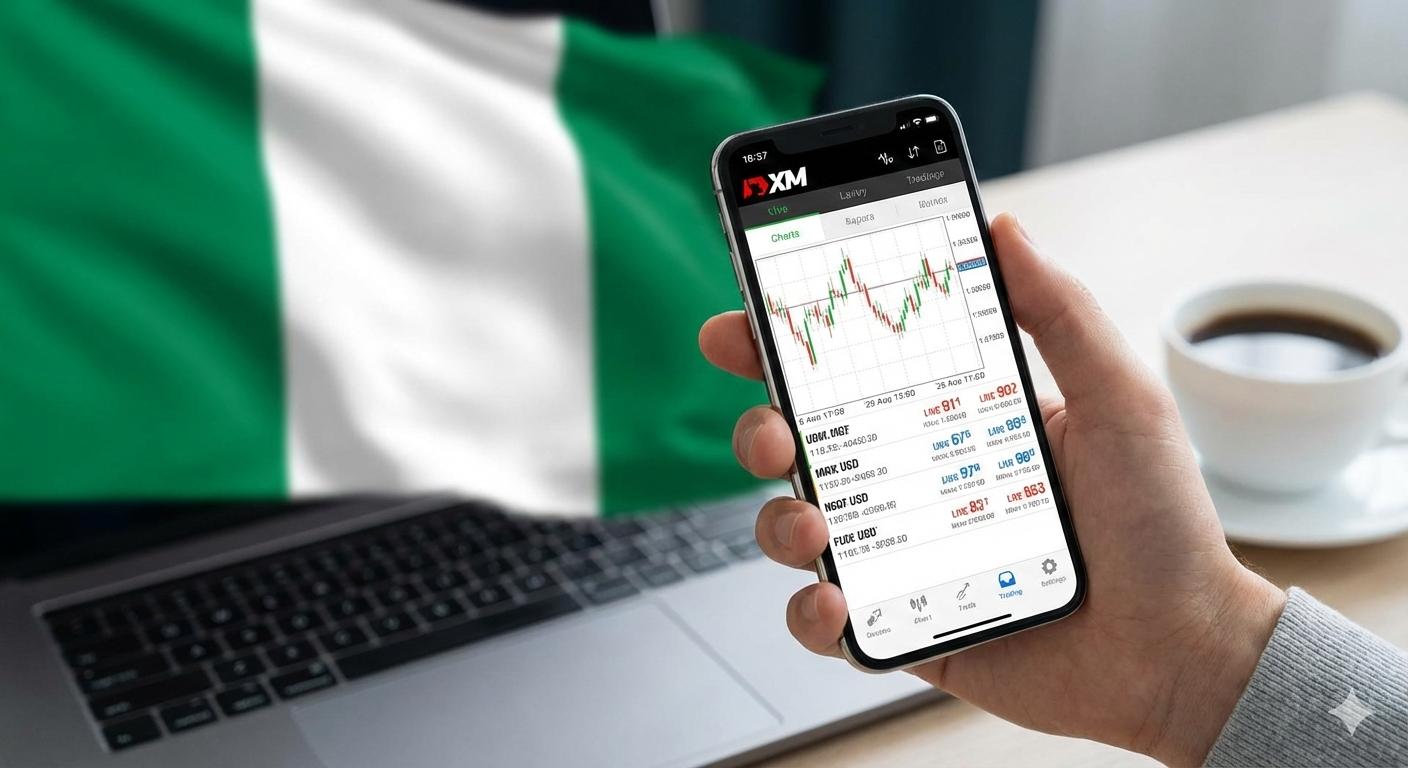
This comprehensive XM Forex Nigeria review is written for educational purposes to help you understand the technical features of this broker. We will analyze its suitability for beginners, explain its regulation status (safety), and break down its account types like Micro and Standard accounts with clear mathematical examples. We will also discuss the critical risks involved in trading and how to protect yourself from impersonation scams targeting Nigerian traders in 2026.
Table of Contents
What Is Forex Trading?
Foreign Exchange, or Forex, is the decentralized global marketplace where the world’s currencies are exchanged. It is the largest financial market globally, with daily trading volumes exceeding $6 trillion—dwarfing the New York Stock Exchange and the Nigerian Stock Exchange combined.
In simple terms, forex trading involves speculating on the fluctuating value of one currency relative to another.
- Real-World Example: Imagine you are a Nigerian business owner importing electronics from China. To pay your supplier, you must exchange your Naira (NGN) for US Dollars (USD). If the exchange rate is ₦1,500 to $1 today, you pay ₦1,500,000 for $1,000. If you wait a week and the rate changes to ₦1,600 to $1, you now have to pay ₦1,600,000 for the same $1,000. That difference of ₦100,000 is caused by the fluctuation in the forex market.
Retail Forex Trading: As an individual trader, you do not buy physical cash for business imports. Instead, you trade “Contracts for Difference” (CFDs). You are essentially entering a digital contract with a broker to exchange the difference in the value of a currency pair between the time you open the trade and the time you close it.
Key Concept: Forex is not a “money-doubling” scheme or a lottery. It is a high-risk profession that requires studying economic data (like inflation reports), analyzing charts, and understanding global news events.
How Forex Trading Works
To understand any broker review, you must first grasp the mechanics of how the market operates.
Currency Pairs
Currencies are always traded in pairs. You cannot just “buy Dollar.” You must buy the Dollar against another currency.
- Major Pairs: EUR/USD (Euro vs US Dollar), GBP/USD (British Pound vs US Dollar). These have the highest liquidity and lowest costs.
- Buying (Long): You believe the first currency (Base) will rise against the second (Quote).
- Selling (Short): You believe the first currency will fall against the second.
Market Hours
The forex market is open 24 hours a day, five days a week (Monday to Friday). This structure is perfect for Nigerians:
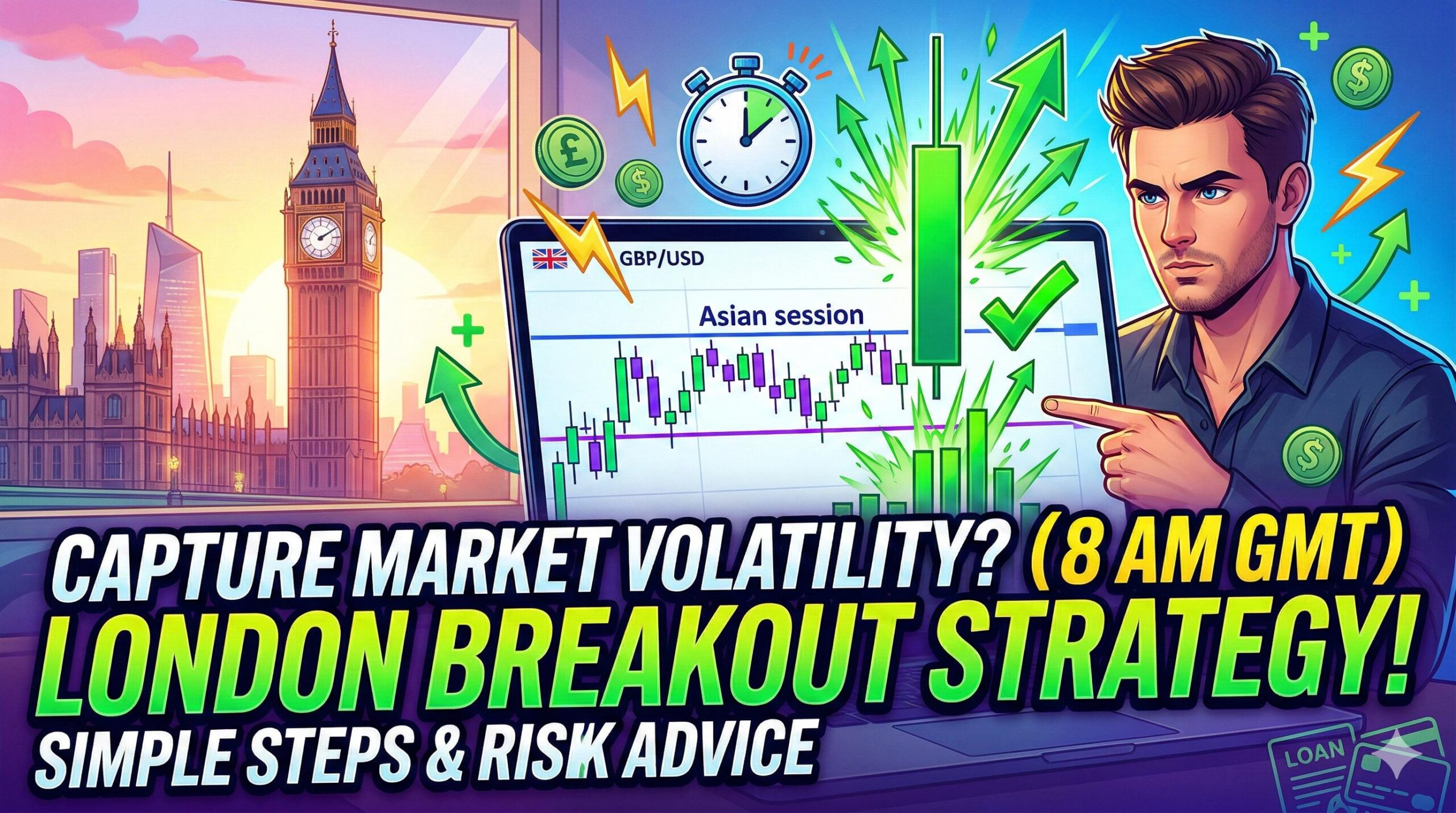
- London Session (8:00 AM – 4:00 PM WAT): This is the busiest time, with high volatility for EUR and GBP pairs.
- New York Session (1:00 PM – 9:00 PM WAT): This overlaps with the London session and sees heavy trading in USD pairs.
- Asian Session (Late Night): Generally quieter, suitable for specific strategies.
The Role of a Broker (Like XM)
You cannot walk into a commercial bank in Lagos to trade spot forex retail accounts. You need a Retail Broker. A broker provides the software (Trading Platform like MT4 or MT5) that connects you to the global market liquidity providers. They hold your deposit in a segregated account and execute your buy/sell orders.
Is Forex Trading Legal in Nigeria?
This is a critical question for beginners who want to ensure they are operating within the law.
The Short Answer: Yes, retail forex trading is generally legal for individuals in Nigeria. There is currently no law in the Nigerian constitution that criminalizes the act of an individual using their legitimate personal funds to speculate on international currency markets.
Regulatory Context:
- Central Bank of Nigeria (CBN): The CBN regulates the banking sector and manages the country’s foreign exchange reserves. While they have placed restrictions on using Naira debit cards for international transactions to protect the Naira from devaluation, they do not ban individuals from trading. This is why many traders use third-party payment methods.
- Securities and Exchange Commission (SEC): The SEC regulates investment schemes. They actively warn against unlicensed investment companies (Ponzi schemes) that collect money from the public to trade on their behalf without a license.
- Important Distinction: Trading yourself on a global broker like XM (where you control the trades) is different from giving your money to a “fund manager” on Telegram or WhatsApp. The latter is often illegal and fraudulent.
XM Nigeria Review: Key Features for Beginners
For a beginner in Nigeria, specific features matter more than advanced tools. Here is an educational breakdown of what XM offers specifically for the Nigerian market:
1. Minimum Deposit ($5)
XM is known for its accessibility, offering a low minimum deposit of just $5.
- Naira Equivalent: Depending on the exchange rate (e.g., if $1 = ₦1,500), this is approximately ₦7,500.
- Why this matters: This low barrier allows beginners to test the live market environment with money they can afford to lose (risk capital), rather than risking life savings or large amounts like $100 or $500 required by other brokers.
2. Local Funding Methods
One of the biggest hurdles for Nigerians is funding accounts due to CBN card restrictions. XM addresses this by supporting:
- Local Bank Transfers: You can transfer funds directly from your Nigerian bank account (GTBank, Zenith, Access, etc.) to the broker’s local partner banks. This avoids the need for dollar cards.
- E-Wallets: Services like Skrill and Neteller are supported.
- Debit Cards: Visa and Mastercard are accepted, though success rates vary depending on your bank’s international limit.
3. Regulation (Safety)
Safety is paramount. XM Group is regulated by multiple Tier-1 and Tier-2 authorities globally:
- ASIC (Australia): A Tier-1 regulator ensuring high standards.
- CySEC (Cyprus): Regulates operations within Europe.
- IFSC (Belize): Note: Most Nigerian accounts fall under the IFSC regulation. This allows the broker to offer higher leverage and bonuses, but it is technically an offshore regulation. While XM has a strong reputation for paying withdrawals, traders should understand this regulatory distinction.
4. Educational Resources
XM invests heavily in education. They provide:
- Daily Webinars: Live sessions where experts analyze the market.
- Local Seminars: Frequent physical seminars in major Nigerian cities like Lagos, Abuja, Port Harcourt, and Ibadan.
- Market Research: Daily technical analysis articles. For a beginner, these resources are often more valuable than the trading platform itself.
Best Forex Trading Platforms for Beginners NGN: 2026 Educational Guide
Understanding Account Types: Micro vs. Standard
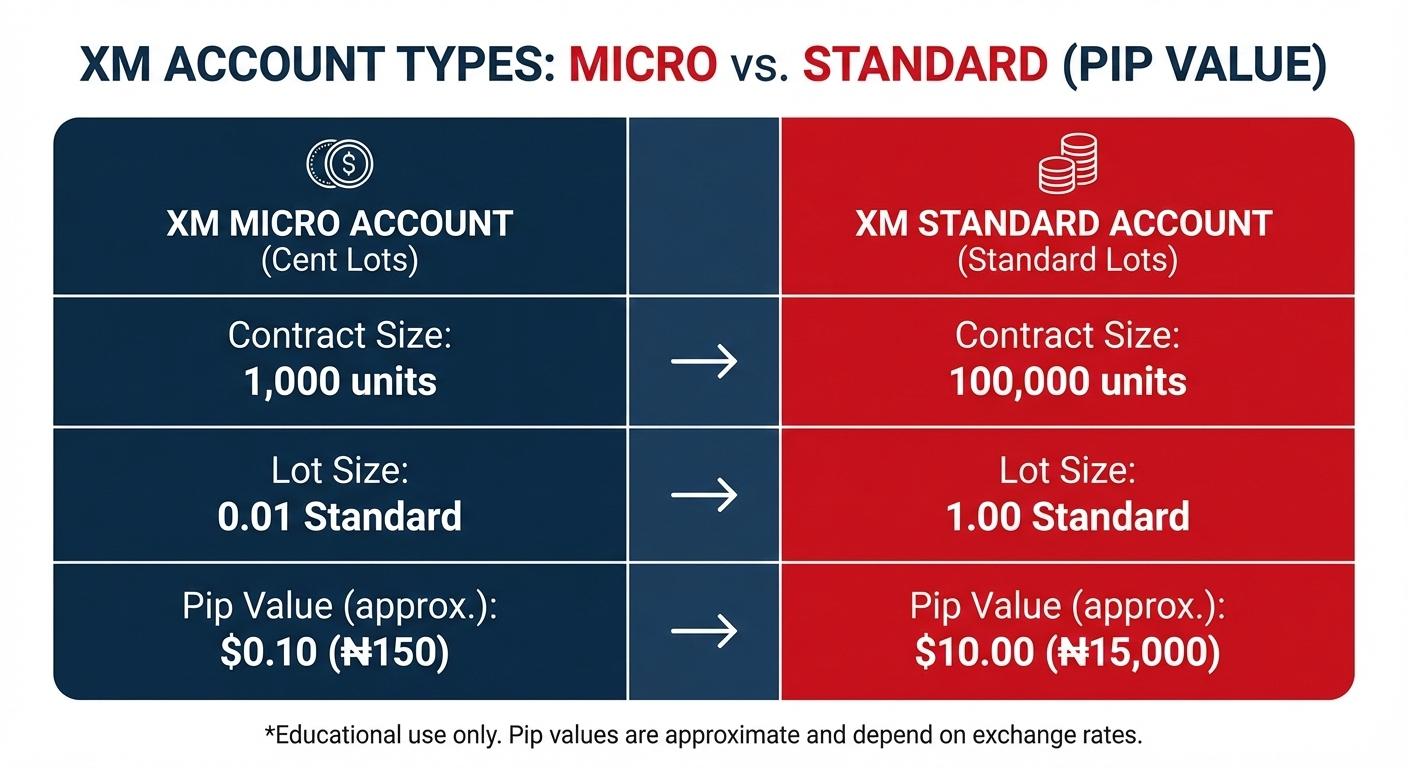
Choosing the wrong account type is a common mistake that leads to fast losses. You must understand the math behind the “Lot Size.”
Micro Account (Best for Beginners)
- Contract Size: 1 Lot = 1,000 units of currency.
- Pip Value: Trading 1 Micro Lot (0.01 standard) means a 1-pip movement equals approximately $0.10 (approx ₦150).
- Benefit: If the market moves 50 pips against you, you lose $5.00. This is manageable for small accounts. It allows you to practice risk management precisely.
Standard Account
- Contract Size: 1 Lot = 100,000 units of currency.
- Pip Value: Trading 1 Standard Lot means a 1-pip movement equals $10.00 (approx ₦15,000).
- Risk: If the market moves just 10 pips against you, you lose $100. If your account balance is small (e.g., $50), you would be wiped out instantly.
- Verdict: Beginners with less than $2,000 capital should strictly avoid Standard Accounts.
The Reality of Leverage (1:1000) – A Double-Edged Sword
You will often see “1:1000 Leverage” advertised as a benefit. It is vital to understand the math of leverage before using it.
- Definition: Leverage is a loan from the broker. With 1:1000 leverage, a $10 deposit can control $10,000 worth of currency in the market.
- The Attraction: It sounds great—you can make profits on $10,000 even if you only have $10.
- The Danger: Leverage magnifies losses just as much as profits.
- Mathematical Example:
- You open a trade with high leverage.
- The market moves against you by just 0.1% (a tiny fluctuation).
- Because you are leveraged 1000 times, that 0.1% loss becomes a 100% loss of your equity.
- Result: Your $10 is gone in seconds. This is called a “Margin Call” or “Stop Out.”
- Educational Advice: Beginners should stick to lower leverage (e.g., 1:50 or 1:100) to protect their capital from volatility.
Common Forex Trading Risks (IMPORTANT)
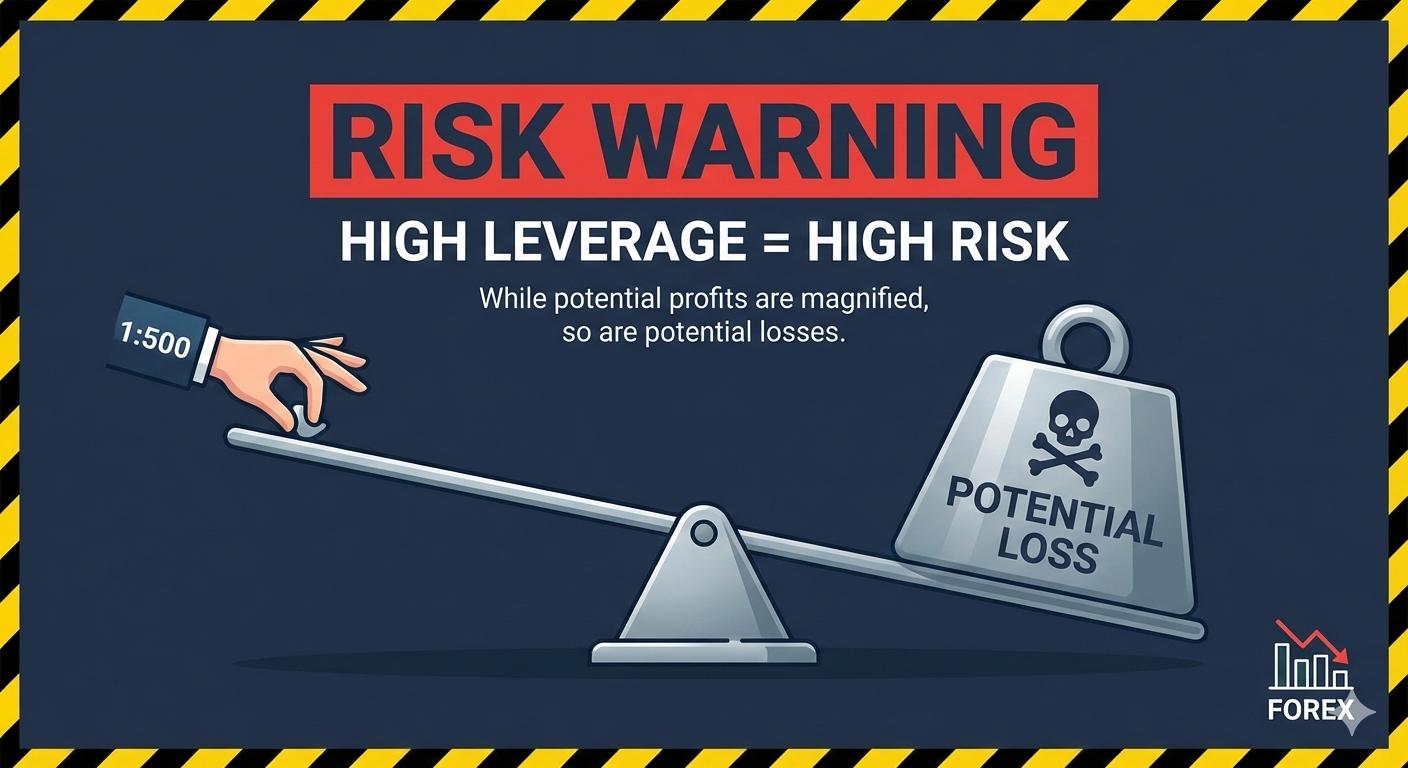
Trading is not a path to guaranteed wealth. The risks are substantial and real.
Market Volatility
The forex market is driven by global news. Events like US inflation data, interest rate decisions by the Federal Reserve, or geopolitical tensions can cause prices to spike unexpectedly.
- Slippage: In fast markets, you might try to close a trade at a specific price, but the market moves so fast that your trade closes at a worse price than you intended.
Emotional Trading
The biggest risk is you.
- FOMO (Fear Of Missing Out): Entering a trade just because you see a green candle rising.
- Revenge Trading: Trying to “win back” money immediately after a loss. This usually leads to bigger losses.
- Greed: Refusing to take profit because you hope the price will go higher.
Capital Loss
Statistics show that a significant percentage of retail traders lose money (often cited as 70-90%). Never trade with money you need for rent, school fees, medical bills, or food. Only trade with “disposable income.”
Beginner Mistakes Nigerians Should Avoid
- Chasing Bonuses: XM and other brokers offer “Deposit Bonuses” (e.g., $30 No Deposit Bonus or 50% Deposit Bonus). Do not view this as free withdrawable money. It is “trading credit” meant to support your margin. You can withdraw profits, but usually not the bonus itself.
- Using “Signals”: Relying on WhatsApp or Telegram groups for buy/sell signals prevents you from learning. If the signal provider disappears, your trading career ends.
- Ignoring Stop Losses: A “Stop Loss” is an automatic safety order that closes your trade if it loses a certain amount (e.g., $2). Refusing to use one exposes your account to total ruin during a market crash.
- Over-Trading: Opening 10 or 20 trades a day (“scalping”) without a plan. This racks up transaction costs (spreads) and increases exposure to risk.
How to Stay Safe From Forex Scams in Nigeria
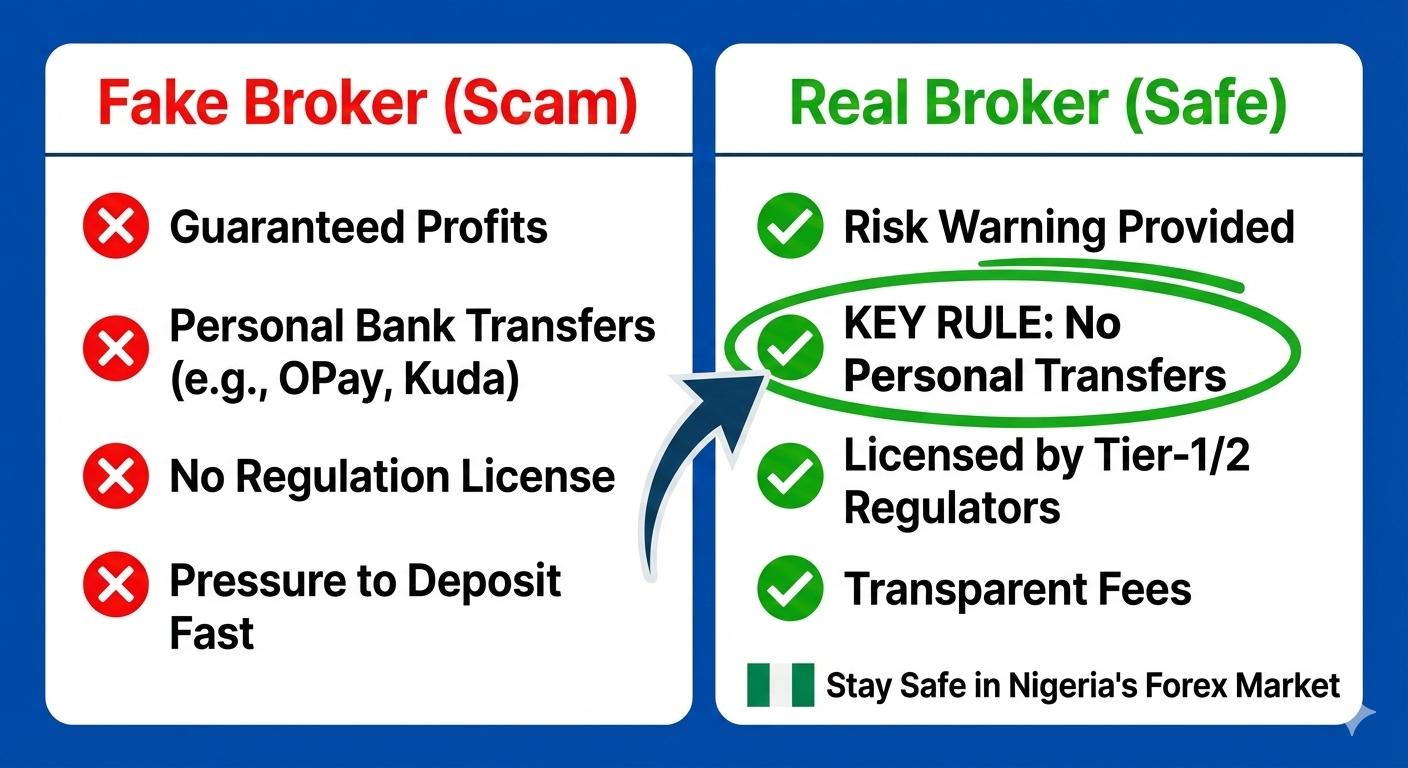
Scammers often impersonate legitimate brokers like XM to steal money from unsuspecting Nigerians.
Red Flags to Watch For:
- “XM Investment Packages”: XM is a platform for you to trade. If someone on Telegram says, “Send money to this XM Manager account and get 200% returns in 24 hours,” it is a SCAM. XM does not manage funds for you; they only provide the platform.
- Personal Bank Accounts: Legitimate brokers never ask you to send money to a personal OPay, PalmPay, Kuda, or Moniepoint account. You should only deposit via the official website or app using their secure payment gateway.
- Guaranteed Profits: Real trading involves loss. Anyone guaranteeing a profit is lying.
- “Account Management”: Never give your trading password to anyone claiming they will trade for you. They will likely steal your funds or blow the account.
Frequently Asked Questions (FAQ)
Q1: Is XM a legit broker in Nigeria? A: Yes, XM is a legitimate international broker that accepts Nigerian clients. However, they are regulated internationally (e.g., IFSC, ASIC), not specifically by the SEC Nigeria for retail forex. They have a strong track record of paying withdrawals.
Q2: What is the minimum deposit for XM in Naira? A: The minimum is $5. The Naira amount depends on the current exchange rate. If the rate is ₦1,500, the minimum is ₦7,500. If the rate is ₦1,000, it is ₦5,000.
Q3: Can I withdraw my profits to a Nigerian bank account? A: Yes. XM supports withdrawals to local Nigerian bank accounts. Crucial Rule: The name on your bank account MUST match the name on your trading account exactly. You cannot withdraw to a friend’s account.
Q4: Does XM offer a demo account? A: Yes. You can open a free demo account with virtual money (e.g., $10,000 virtual funds) to practice strategies without risk. This is highly recommended for at least 3 months before depositing real money.
Q5: Is trading with XM tax-free? A: The broker does not deduct tax. However, you are responsible for declaring your personal income to the relevant tax authorities in Nigeria (FIRS) according to local laws.
Q6: Can I lose more than I deposited? A: XM offers “Negative Balance Protection,” which means you typically cannot lose more than you deposited. If a market crash sends your balance to -$50, the broker will reset it to $0, so you do not owe them money.
Conclusion
To summarize this XM Forex Nigeria review: XM is a robust, beginner-friendly option for Nigerian traders. Its key strengths lie in its low deposit requirement ($5), support for local bank transfers, and extensive educational resources (webinars/seminars).
However, the tool is only as good as the user. A good broker cannot save you from bad trading decisions or lack of knowledge. The high leverage available (1:1000) is a risk factor that requires strict discipline to manage effectively.
We encourage you to prioritize education. Start with the free demo account, attend their webinars, and read as much as possible before risking a single Kobo of your hard-earned money. Treat forex trading as a business, not a gamble.
Disclaimer: This content is for educational purposes only and does not constitute financial advice. Trading foreign exchange on margin carries a high level of risk and may not be suitable for all investors. You should consider whether you understand how CFDs work and whether you can afford to take the high risk of losing your money. Past performance is not indicative of future results.