
Introduction
The foreign exchange market, commonly known as forex, is the largest financial market globally, with a daily trading volume exceeding $6 trillion. For many Nigerians, the concept of exchanging currencies is familiar due to the need to convert Naira (NGN) for travel, business importation, or online payments. However, moving from physical currency exchange to online trading requires a deeper level of knowledge. At the heart of this market lies the concept of the “currency pair.”
Understanding currency pairs for beginners is the absolute first step in forex education. You cannot trade forex without understanding that currencies are always valued relative to one another. There is no single price for the US Dollar; there is only a price for the US Dollar in relation to the Euro, the British Pound, or the Nigerian Naira.
This guide is written for educational purposes to help beginners understand forex trading concepts. We will break down the mechanics of currency pairs, explain the difference between major, minor, and exotic pairs, and highlight the significant risks involved in trading.
Disclaimer: Forex trading involves significant risk of loss and is not suitable for all investors. You should not invest money that you cannot afford to lose. This content is for informational purposes only and does not constitute financial advice.
Table of Contents
What Is Forex Trading?
Foreign Exchange (Forex or FX) is the decentralized global marketplace where all the world’s currencies are traded. Unlike the stock market, where you might buy a share of a specific company like Dangote Cement or First Bank, in forex, you are effectively buying one country’s currency while simultaneously selling another.
To explain this simply, imagine you are a Nigerian business owner importing goods from the United States. You possess Nigerian Naira (NGN), but your supplier in New York requires US Dollars (USD). You must go to a bank or a licensed bureau de change to exchange your Naira for Dollars.
If the exchange rate is ₦1,500 to $1, you give the cashier ₦1,500,000 to receive $1,000.
In this transaction, you have participated in the forex market. You have “sold” Naira and “bought” Dollars. Online forex trading works on the same principle, but instead of physical cash, traders speculate on whether the value of a currency will rise or fall relative to another using digital platforms.
How Forex Trading Works: The Mechanics of Currency Pairs
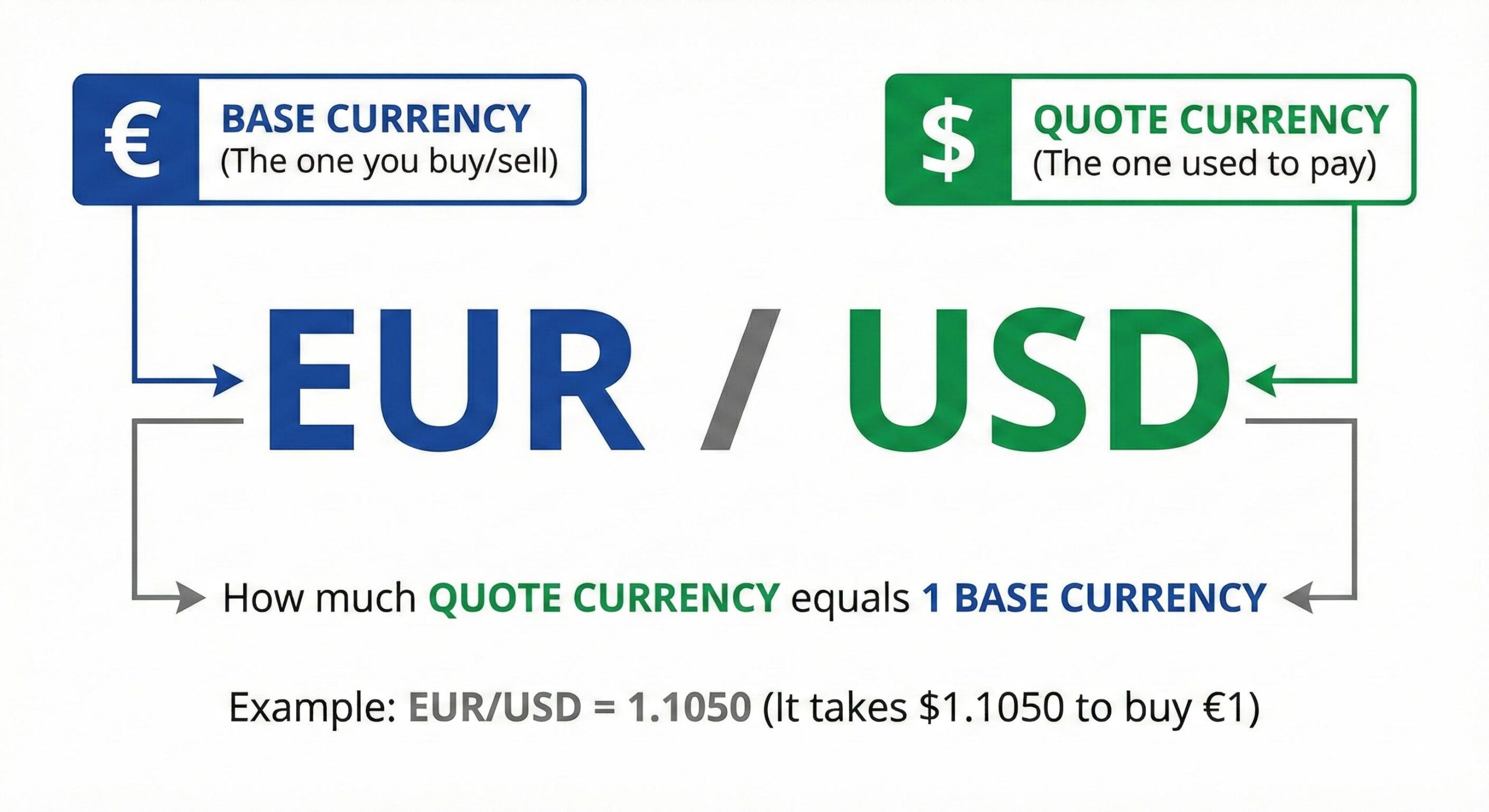
This section is critical for understanding currency pairs for beginners. In the forex market, currencies are never listed alone. They are always listed in pairs, such as EUR/USD or GBP/USD.
Base Currency vs. Quote Currency
Every currency pair consists of two parts:
- The Base Currency: The first currency listed in the pair.
- The Quote Currency: The second currency listed in the pair.
Example: EUR/USD = 1.1050
- Base Currency: Euro (EUR)
- Quote Currency: US Dollar (USD)
What does the price mean? The price tells you how much of the Quote Currency is needed to buy one unit of the Base Currency. In this example, it takes $1.1050 US Dollars to purchase 1 Euro.
Buying and Selling (Long vs. Short)
- Going Long (Buying): You buy the pair if you believe the Base Currency will appreciate (rise in value) against the Quote Currency.
- Going Short (Selling): You sell the pair if you believe the Base Currency will depreciate (fall in value) against the Quote Currency.
The Three Main Categories of Currency Pairs
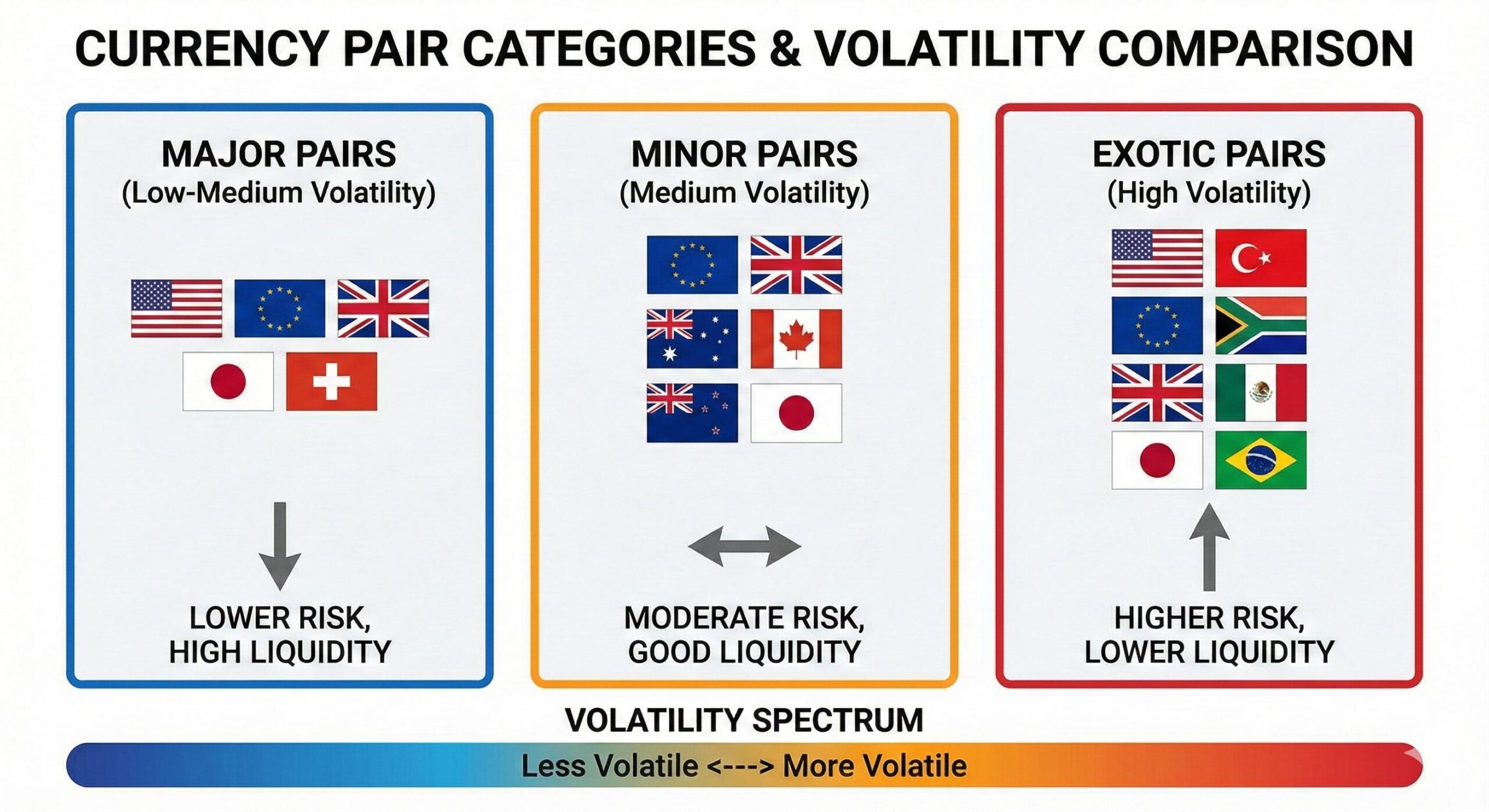
Not all currency pairs are equal. They are categorized based on their trading volume and liquidity (how easily they can be bought or sold).
1. Major Currency Pairs (The Majors)
These are the most traded pairs in the world. They always include the US Dollar (USD) on one side. Because they are so heavily traded, they typically have the lowest “spreads” (transaction costs) and are the most stable.
Examples:
- EUR/USD (Euro vs. US Dollar)
- GBP/USD (British Pound vs. US Dollar)
- USD/JPY (US Dollar vs. Japanese Yen)
- USD/CHF (US Dollar vs. Swiss Franc)
For Nigerian beginners, education often focuses on these pairs first because information about the US, UK, and European economies is widely available.
2. Minor Currency Pairs (The Crosses)
These pairs contain major currencies (like the Euro, Yen, or Pound) but do not include the US Dollar.
Examples:
- EUR/GBP (Euro vs. British Pound)
- EUR/JPY (Euro vs. Japanese Yen)
- GBP/JPY (British Pound vs. Japanese Yen)
These pairs can be slightly more volatile than majors and may have slightly higher transaction costs.
3. Exotic Currency Pairs
Exotic pairs consist of one major currency and one currency from a developing or emerging economy. These pairs are known for high volatility and very high transaction costs (spreads).
Examples:
- USD/NGN (US Dollar vs. Nigerian Naira)
- USD/ZAR (US Dollar vs. South African Rand)
- USD/TRY (US Dollar vs. Turkish Lira)
Note: While USD/NGN is the pair most relevant to Nigerians fundamentally, it is rarely traded on standard international retail forex platforms due to liquidity issues and capital controls. Most Nigerian retail traders focus on Major pairs like EUR/USD.
Is Forex Trading Legal in Nigeria?
Before engaging in any market activity, it is vital to understand the legal framework.
Yes, Forex Trading is Legal Individual Nigerians are legally permitted to trade foreign currencies online using their personal funds. There is no law in the Nigerian Constitution that criminalizes retail forex trading for personal investment.
Regulatory Context
- Central Bank of Nigeria (CBN): The CBN regulates the traditional banking sector and the official foreign exchange windows. They have strict policies regarding the sourcing of FX for imports. However, these policies generally apply to Authorized Dealers (Banks), not individual retail traders speculating on international platforms.
- Broker Safety: Currently, there is no specific licensing framework for online retail forex brokers within Nigeria. This means most Nigerian traders use international brokers. To be safe, beginners should strictly stick to brokers regulated by Tier-1 international authorities like the Financial Conduct Authority (FCA) in the UK.
Common Forex Trading Risks (IMPORTANT)
Understanding market mechanics is useless if you do not understand the risks involved. The forex market is unforgiving, and losses are a normal part of the business.
Market Volatility
Volatility refers to the speed and magnitude of price changes. While volatility is necessary for price movement, it also creates risk. A major news event—like a change in US interest rates—can cause currency prices to move aggressively against your position in seconds.
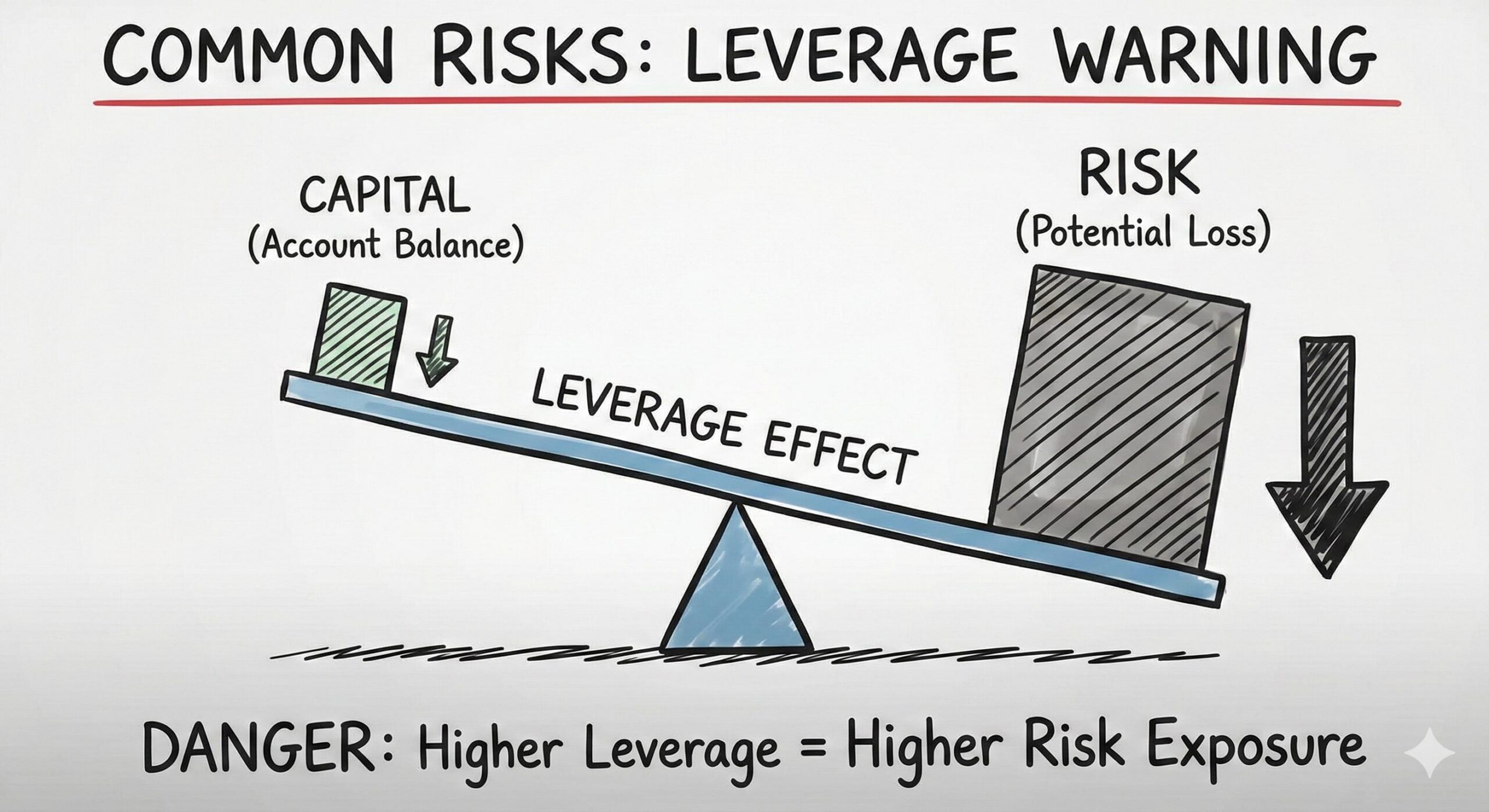
Leverage Risk
Leverage allows traders to control large positions with small capital. For example, a 1:100 leverage ratio means $10 can control $1,000.
- The Danger: While leverage amplifies potential exposure, it also amplifies losses. A small market move against you can result in the total loss of your deposit. High leverage is the primary reason beginners lose funds.
The Spread
The spread is the difference between the Buy price and the Sell price. This is the cost of the trade. In illiquid markets (like Exotics), spreads can be very wide, meaning you start the trade with a significant loss that must be recovered before you break even.
Beginner Mistakes Nigerians Should Avoid
1. Trading Exotic Pairs Without Knowledge
Many beginners try to trade pairs they don’t understand. Exotic pairs like the Mexican Peso or Turkish Lira can have wild price swings that wipe out small accounts instantly. Stick to studying Major pairs initially.
2. Overtrading
Many beginners trade too frequently, believing that more trades equal more success. In reality, overtrading increases your transaction costs and exposure to risk.
3. Lack of Risk Management
Trading without a “Stop Loss” (an automatic order to close a trade if it hits a certain loss level) is akin to driving a car without brakes. Every trade should have a pre-defined exit point to limit losses.
4. Trusting “Fake Gurus”
Social media in Nigeria is full of influencers flaunting wealth and claiming to have “secret strategies.” These are often scams designed to sell courses. Real trading requires study, patience, and discipline, not secrets.
Learning Forex Trading the Right Way

Success in forex requires treating it as a profession, not a hobby.
Education-First Approach
Before opening a live account, invest time in free education.
- Read about Economic Indicators (GDP, Inflation).
- Understand Technical Analysis (Support and Resistance).
- Study Risk Management formulas.
The Importance of Demo Accounts
Every reputable broker offers a free Demo Account. This allows you to trade with virtual “fake” money in real market conditions.
- Educational Step: Open a demo account. Practice identifying Base and Quote currencies. Place test trades to see how spreads work.
- The Rule: Do not deposit real money until you are consistently profitable on a demo account for several months.
How to Stay Safe From Forex Scams in Nigeria
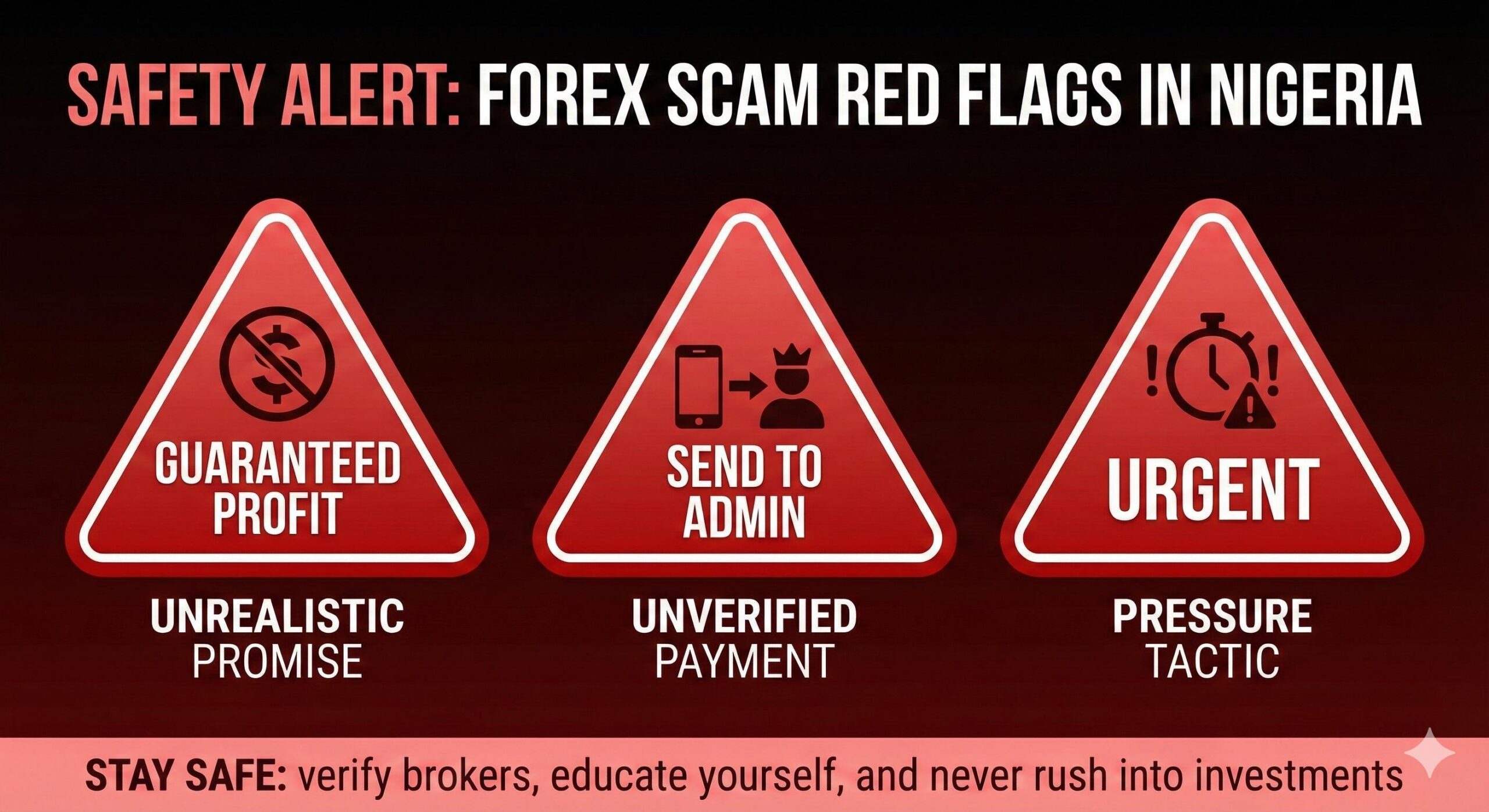
The search for financial knowledge often leads beginners to scammers.
Red Flags to Watch For
- “Guaranteed Profits”: No one knows what the market will do. Anyone guaranteeing a profit is lying.
- “Investment Pools”: Be extremely wary of schemes asking you to send money to a personal bank account (Opay, Palmpay, Kuda) for someone else to trade for you. Legitimate trading involves you depositing directly with a regulated broker.
- WhatsApp/Telegram Investment Groups: Scammers often add people to groups where “bots” claim to make thousands of dollars daily. These are almost always fraudulent.
Can I Trade Forex with 10,000 Naira in Nigeria? A Beginner’s Guide (2026)
Frequently Asked Questions (FAQ)
Q1: What is the best currency pair for beginners? Most educators recommend starting with EUR/USD. It is the most traded pair, offers the lowest spreads, and moves in a relatively stable manner compared to exotics.
Q2: What is a “pip” in forex? A “pip” stands for “percentage in point.” It is the smallest standard unit of price change in a currency pair. For most pairs, it is the fourth decimal place (e.g., if EUR/USD moves from 1.1050 to 1.1051, that is 1 pip).
Q3: Can I trade Naira (NGN) on forex platforms? Most international retail brokers do not offer USD/NGN trading due to liquidity constraints. The official exchange rate is managed by the CBN, making it difficult to trade freely on global retail platforms.
Q4: How much money do I need to start learning? You need zero Naira to start learning. You can open a Demo Account for free. When moving to a live account, minimum deposits vary by broker, but it is recommended to have sufficient capital to manage risk properly.
Q5: Is forex trading gambling? If you trade without knowledge or risk management, it is gambling. However, professional trading involves analysis, probability, and risk control, which distinguishes it from gambling.
Q6: What happens if the currency I bought goes down? If the Base Currency falls in value against the Quote Currency while you are holding a “Buy” position, your trade will be in a loss. If it hits your Stop Loss level, the trade will close automatically to prevent further loss.
Conclusion
Understanding currency pairs for beginners is the foundation upon which all other trading knowledge is built. Whether you are looking at the EUR/USD or the GBP/JPY, knowing which currency is the Base and which is the Quote allows you to interpret price movements correctly.
Forex trading offers opportunities for those who are willing to learn, but it punishes those who seek easy money. As a beginner in Nigeria, your priority should be education and capital preservation. Do not rush. Use demo accounts to practice identifying pairs, calculating pips, and managing risk.
The market will always be there. Take your time to build a solid foundation of knowledge before you ever risk your hard-earned capital.