
Introduction
In the rapidly growing Nigerian financial community, from the bustling markets of Lagos to the administrative hubs of Abuja, the interest in online global markets is surging. With the Naira’s fluctuation and the desire for financial literacy, many are turning to the internet to learn new skills. While many beginners start their journey by asking about brokers or potential profits, the most successful learners ask about strategy and market structure. Among the many tools available to a trader, one concept stands out as the absolute foundation of technical analysis: Support and Resistance trading for Nigerians.
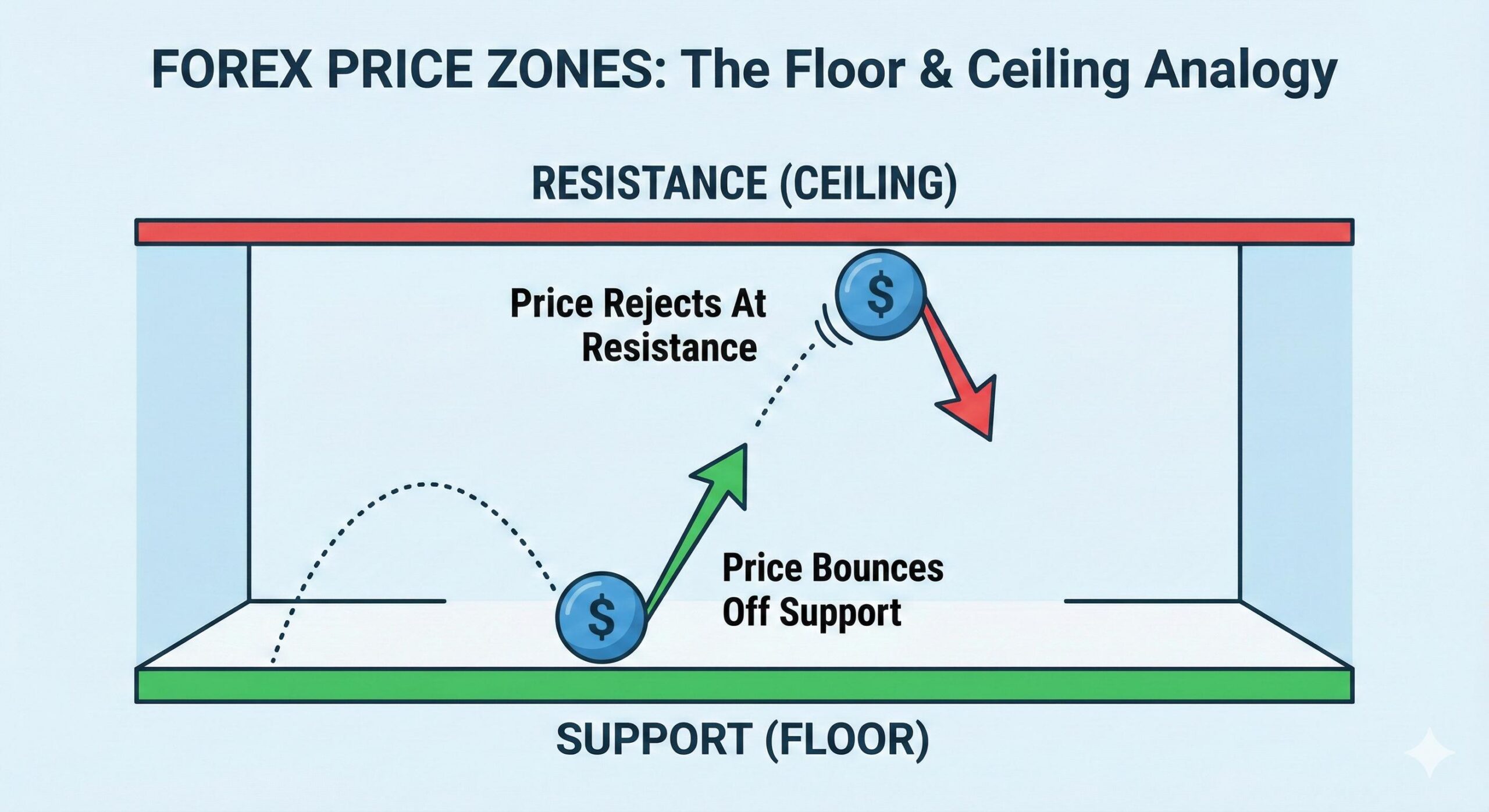
Understanding Support and Resistance is akin to understanding the “floor” and “ceiling” of a room. Without these boundaries, price movement seems chaotic and random. However, once you learn to identify these levels, you begin to see a map. You understand where price is likely to pause, where it might turn around, and where it might break through. For a beginner in Nigeria, mastering these levels is often the critical first step toward moving from gambling-style guessing to professional, structured market analysis.
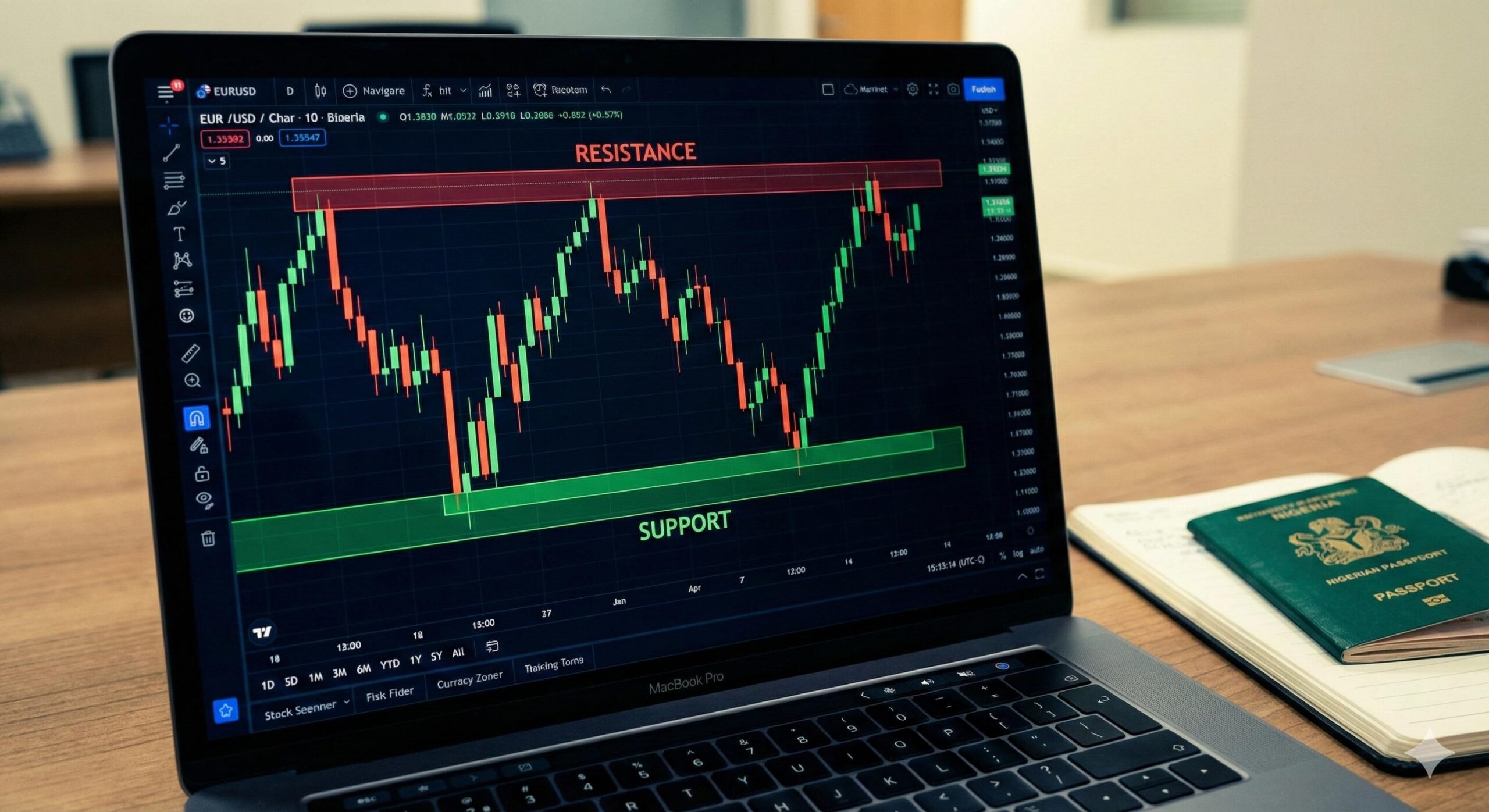
This guide is written for educational purposes to help you understand what forex trading is, how the market moves between these critical levels, and how to approach technical analysis safely. We will explore the deep definitions, the market psychology behind why these levels exist (greed and fear), and the critical importance of risk management. Whether you are analyzing charts on a mobile phone in Lagos traffic or on a laptop in Port Harcourt, these concepts remain the universal language of the market.
Table of Contents
Foreign Exchange, commonly known as Forex or FX, is the decentralized global marketplace where the world’s currencies are exchanged. It is the largest financial market in the world, with daily trading volumes exceeding $6 trillion—far larger than the Nigerian Stock Exchange or even the New York Stock Exchange.
In its simplest form, forex trading is the act of exchanging one currency for another to facilitate trade or tourism.
- Real-World Example: Consider a Nigerian electronics importer in Alaba International Market. If he intends to import laptops from the United States, he cannot pay the manufacturer in Naira (NGN). He must exchange his Naira for US Dollars (USD). This transaction happens in the forex market. If the exchange rate changes from ₦1,500 to ₦1,600 per Dollar, it affects his business cost.
For retail traders (individuals trading from personal devices), the goal is not to buy physical goods, but to analyze the price movements of these currencies. Traders look at digital charts to determine if the value of a currency pair, like EUR/USD or GBP/USD, is strengthening or weakening. This analysis is where concepts like Support and Resistance become vital. You are not buying physical cash to put in your wallet; you are speculating on the exchange rate’s future value based on economic data and chart patterns.
Key Concept: Forex is not a scheme to get rich quickly or a solution to immediate financial problems. It is a serious analytical profession that requires studying market behavior, global economics, and rigorous risk control.
How Forex Trading Works
To accurately apply Support and Resistance trading for Nigerians, you must first understand the mechanics of how the market operates and the forces that drive price movement.
The Mechanics of Price Movement (Bulls vs. Bears)
Forex prices do not move in a straight line. They move in waves—zig-zagging up and down. This movement is the result of a constant battle between supply and demand.
- Buyers (The Bulls): When buyers are aggressive and believe the price is cheap, they buy. This demand pushes prices up.
- Sellers (The Bears): When sellers are aggressive and believe the price is expensive, they sell. This supply pushes prices down.
Support and Resistance levels are simply the “battlefields” where these two forces clash and one side eventually takes control.
Currency Pairs
Currencies are always traded in pairs because you are always swapping one for another.
- Support Level: If the price of GBP/USD falls and hits a “Support” level, it means there is a concentration of buyers at that specific price. They believe the Pound is “cheap” enough to buy, stopping the price from falling further.
- Resistance Level: If the price rises and hits a “Resistance” level, it means there is a concentration of sellers. They believe the Pound is “too expensive,” so they sell, stopping the price from rising higher.
Market Participants
The market is composed of various players, and understanding them helps you realize why these levels work:
- Central Banks: They manage national money supply and interest rates.
- Institutional Banks: JP Morgan, Deutsche Bank, etc., move billions of dollars. Their buying and selling create the massive Support and Resistance zones we see on charts.
- Retail Traders: Individuals like you who access the market via Brokers. Your broker provides the platform (like MetaTrader 4 or 5) where you draw lines to visualize where the “Big Players” might be acting.
Is Forex Trading Legal in Nigeria?
Before diving deeper into technical analysis strategies, it is crucial to address the legal framework to ensure you are operating within the law.
The Short Answer: Yes, retail forex trading is generally legal in Nigeria. There is currently no law in the Nigerian constitution that prohibits a citizen from using their legitimate personal funds to trade on international currency markets.
The Regulatory Context:
- Central Bank of Nigeria (CBN): The CBN is responsible for the monetary policy of the country and protecting the Naira. While they often adjust policies regarding the use of Naira debit cards for international payments (crypto bans, card limits) to manage FX reserves, they do not criminalize the act of individual trading. This is why many traders use Domiciliary accounts or P2P methods.
- Securities and Exchange Commission (SEC): The SEC monitors the investment space to protect citizens. They strictly warn against unlicensed investment schemes.
- Legal: You sitting at your computer, analyzing Support and Resistance charts, and trading your own capital through a regulated broker.
- Illegal: You collecting money from your church members, colleagues, or Facebook friends, pooling it together, and trading on their behalf without an Asset Management License.
Safety Note: Always ensure you are trading with your own funds. Avoid any scheme that asks you to “invest” for a fixed monthly return, as these are often Ponzi schemes masquerading as forex trading.
Read More: Is Forex Trading Legal in Nigeria? A Comprehensive 2026 Educational Guide
Common Forex Trading Risks (IMPORTANT)
Technical analysis tools like Support and Resistance are incredibly useful, but they do not eliminate risk. Understanding the dangers is vital for every Nigerian beginner.
Market Volatility
Volatility refers to the speed and magnitude of price changes.
- The Risk: A Support level (floor) might look strong, but during high volatility events—such as news releases about US inflation, Federal Reserve interest rates, or Nigerian economic policy changes—prices can move aggressively. In these moments, price can crash right through your Support level like a hot knife through butter, leading to rapid losses.
Leverage Risk (The Double-Edged Sword)
Brokers offer “leverage,” which allows you to control a large position with a small deposit.
- Example: With 1:500 leverage, a $100 deposit allows you to trade $50,000 worth of currency.
- The Danger: While leverage can magnify potential gains, it equally magnifies losses. If you buy at a Support level using high leverage, and the price drops just a few pips below that level, your entire account balance could be wiped out in seconds. This is the #1 reason beginners fail.
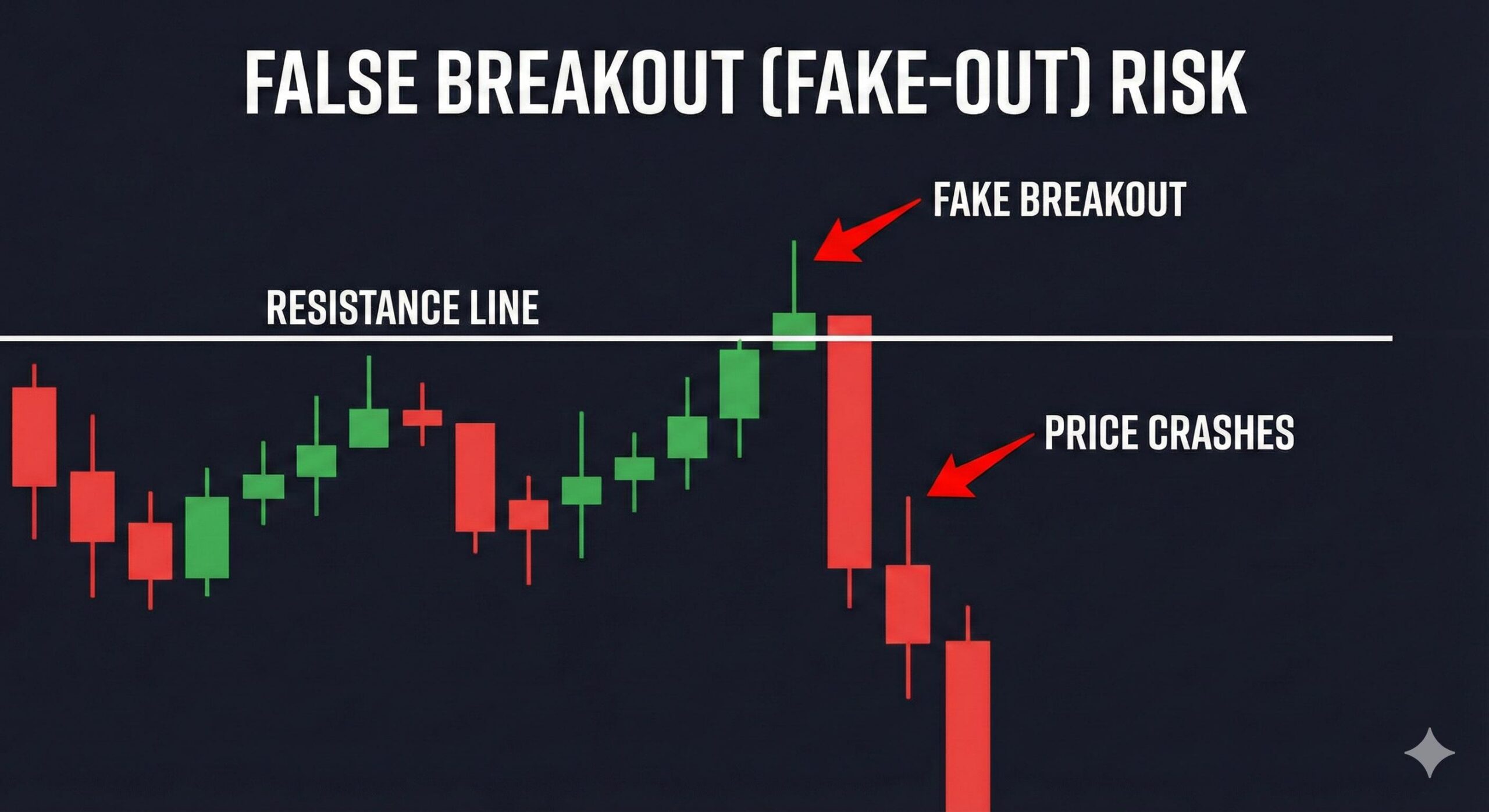
False Breakouts (The “Fake-Out”)
Support and Resistance are not concrete walls; they are flexible zones.
- The Scenario: Sometimes, the price will push slightly past a Resistance level, tricking traders into thinking the price is “breaking out” to the upside. Buyers jump in. Suddenly, the price reverses and crashes back down hard. This is called a “False Breakout” or a “Fake-out,” and it traps many inexperienced traders who enter too early without waiting for confirmation.
Beginner Mistakes Nigerians Should Avoid
When learning Support and Resistance trading for Nigerians, beginners often fall into specific psychological and technical traps:
- Treating Lines as Exact Numbers: Support is a “zone” or “area,” not a specific single number (e.g., 1.5000). Beginners often lose money by setting their orders strictly at one price point. If the price turns 2 pips before your line, you miss the trade. If it goes 2 pips past it, you might panic.
- Overtrading: Thinking every small pause in price is a Support level. Not every bump in the chart is significant. You should focus on major levels that are clearly visible on higher timeframes.
- Ignoring the Trend: Buying at Support when the overall market trend is crashing down violently. As the saying goes, “The trend is your friend.” Buying a falling knife just because it hit a minor Support line is dangerous.
- Trading Without a Stop Loss: Entering a trade at a Support level without a safety net. If the Support breaks, you must have a Stop Loss order to get you out of the trade before you lose your entire capital.
- Revenge Trading: After a Support level breaks and you lose money, immediately entering a new trade to “win it back” without analysis. This is gambling.
Learning Forex Trading the Right Way
This section is the core of understanding our primary keyword. To learn forex properly, you must master the art of technical analysis and chart reading.
Understanding Support (The Floor)
Support is a price level where a downtrend tends to pause or reverse due to a concentration of demand (buying interest).
- Visual: Imagine a ball falling and hitting the floor. It bounces up. That floor is Support.
- Psychology: As the price gets cheaper, sellers become less aggressive because they don’t want to sell at a low price. Simultaneously, buyers see “value” and believe the price is a bargain, so they step in to buy. This influx of buying pressure stops the drop and pushes the price back up.
Understanding Resistance (The Ceiling)
Resistance is a price level where an uptrend tends to pause or reverse due to a concentration of supply (selling interest).
- Visual: Imagine throwing a ball up at the ceiling. It hits the concrete and falls back down. That ceiling is Resistance.
- Psychology: As the price gets expensive, buyers become hesitant to buy at the top. Simultaneously, sellers step in to take profits from previous trades or initiate new sell positions. This selling pressure stops the rise.
How to Draw Levels Correctly
- Zoom Out (Top-Down Analysis): Do not start on the 1-minute chart. Look at the “Big Picture” on a Daily (D1) or 4-Hour (H4) chart. Levels found here are much stronger than levels found on small timeframes.
- Touch Points: Look for horizontal areas where the price has touched and reversed multiple times (at least two or three times). The more times price rejects a level, the stronger that level is considered.
- Use Zones, Not Lines: Instead of drawing a single thin line, draw a rectangle or a box. This covers the “wicks” of the candlesticks and accounts for market noise. Price rarely turns at an exact digit; it turns within a zone.
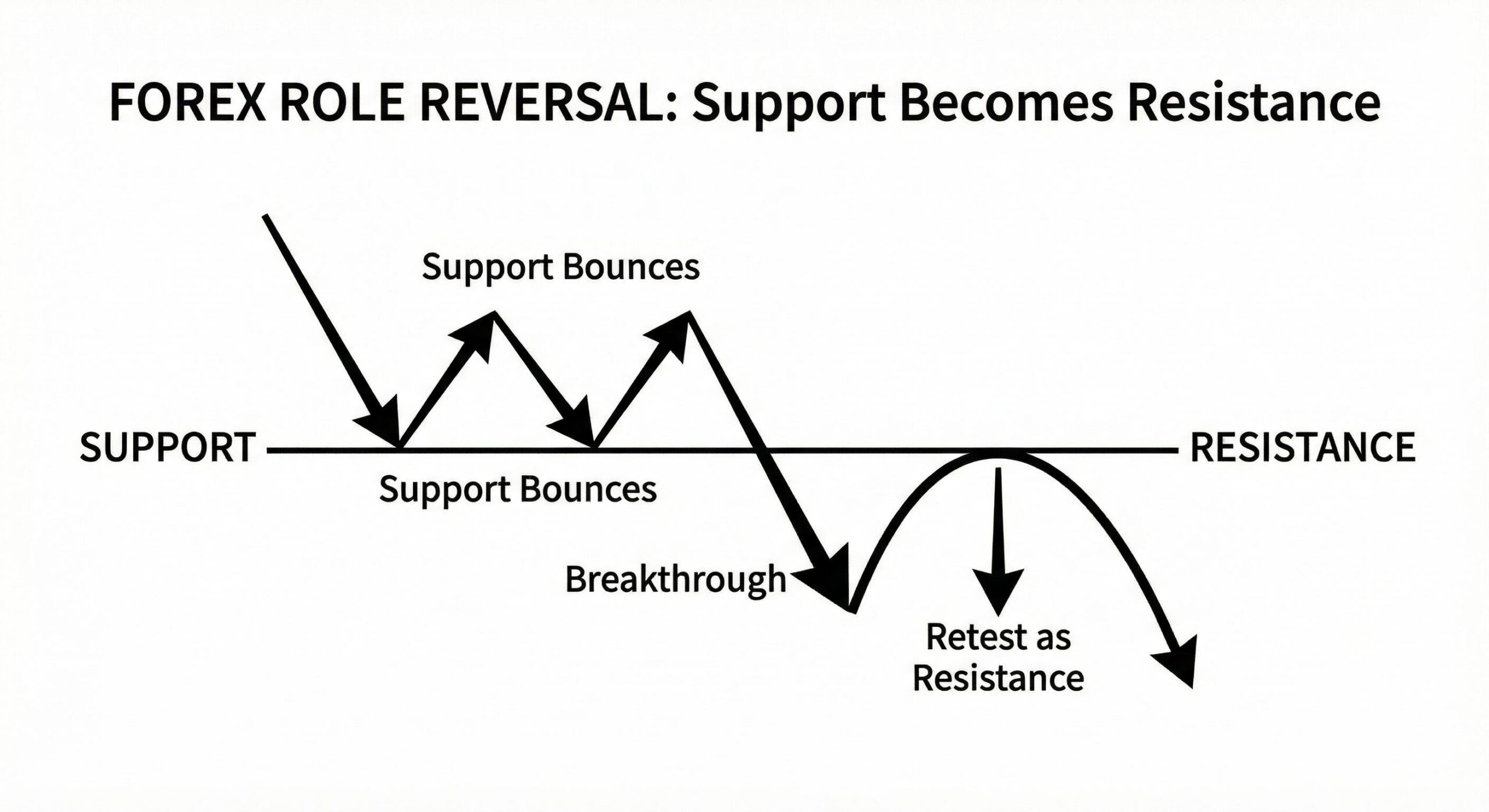
The Phenomenon of “Role Reversal”
One of the most powerful concepts is when a level changes its job.
- Support Becomes Resistance: If the price crashes through a Support floor, that floor often acts as a Resistance ceiling if the price tries to climb back up later.
- Resistance Becomes Support: If the price smashes through a Resistance ceiling, that ceiling often becomes a Support floor for the future.
The Education-First Approach
Do not rush to trade these levels with real money.
- Read & Study: Look at historical charts from last year. Draw lines and see how price reacted.
- Demo Account: Open a free demo account with a reputable broker. Practice drawing these zones and watching how price reacts in real-time. Do this until you are profitable on paper before risking a single Kobo.
How to Stay Safe From Forex Scams in Nigeria
As you search for information on “Support and Resistance trading,” you will inevitably encounter scammers claiming to have “magic indicators” or “secret strategies.”
Red Flags to Watch For:
- “Never Loss” Systems: Scammers will sell indicators claiming they perfectly predict every bounce at Support. This is impossible. No strategy has a 100% win rate. Professional traders lose trades often; they just manage their risk better.
- Guaranteed Profits: Any WhatsApp or Telegram group promising you will double your money in 24 hours because they have “special” Resistance levels is a scam.
- Account Management: Strangers on social media asking for your trading login details or money to trade “Support and Resistance strategies” for you. Never share your password or send investment funds to personal bank accounts.
- Fake Brokers: Unregulated platforms that manipulate the charts so your Support levels always fail, forcing you to lose money. Always use regulated brokers with a verified track record.
Frequently Asked Questions (FAQ)
Q1: What is the best timeframe for Support and Resistance trading for Nigerians? A: For beginners, higher timeframes like the Daily (D1) or 4-Hour (H4) charts are highly recommended. They filter out the “noise” and random movements of smaller timeframes (like the 1-minute or 5-minute charts), making the Support and Resistance levels more reliable and easier to identify.
Q2: Can Support become Resistance? A: Yes, absolutely. This is called “Role Reversal” or “Polarity Change.” If the price breaks down through a Support floor, that floor often becomes the new Resistance ceiling when price tries to rally back up.
Q3: Is forex trading safe for beginners? A: Forex trading carries high risk. It is “safe” only in the sense that legitimate brokers exist. However, your capital is never safe from loss. You should only trade if you use a regulated broker, practice proper risk management (Stop Losses), and treat it as an educational journey, not a gambling scheme.
Q4: Do I need a laptop to draw Support and Resistance? A: While you can use mobile apps like MetaTrader 4 or 5 on a smartphone to trade, a laptop or desktop is highly recommended for analysis. It allows you to see the full chart history, zoom out effectively, and draw precise zones that are difficult to manage on a small phone screen.
Q5: How much money do I need to start? A: You need $0 to start learning on a Demo Account. For live trading, beginners are advised to start with an amount they can strictly afford to lose (risk capital). While some brokers accept $10, it is often recommended to start with $100-$200 to allow enough room for proper risk management practices.
Q6: Are profits guaranteed with Support and Resistance strategies? A: No. Support and Resistance are tools of probability, not certainty. A level can break at any time due to news or market volume. There is no guarantee that price will bounce.
Conclusion
Mastering Support and Resistance trading for Nigerians is a journey that shifts your perspective from gambling to analyzing. It provides a structured, logical way to look at the chaotic movement of currency prices, helping you identify high-probability areas where the market might pause or reverse.
However, it is vital to remember that these lines on your chart are not magic concrete barriers. They are psychological zones representing human greed and fear. They can—and often do—break. The difference between a successful professional trader and a struggling beginner is not just in knowing how to draw the lines, but in knowing how to manage risk when the market doesn’t do what you expected. Prioritize your education, practice diligently on demo accounts, and always protect your capital.
Disclaimer: This article is for educational purposes only. EarnFX.ng is an independent educational platform. Trading foreign exchange (Forex) involves a high level of risk and may not be suitable for all investors. The high degree of leverage can work against you as well as for you. Before deciding to trade foreign exchange, you should carefully consider your investment objectives, level of experience, and risk appetite. Past performance is not indicative of future results. You should not risk more than you are prepared to lose.