
Introduction
The global foreign exchange market is unique in the financial world because it operates 24 hours a day, five days a week. From the moment the market opens in Sydney on Monday morning to the closing bell in New York on Friday evening, currencies are constantly fluctuating. For a beginner in Lagos, Abuja, or Port Harcourt, this non-stop action can be overwhelming. A common question arises among new traders: When should I actually look at the charts?
Finding the Best time to trade forex in Nigeria (GMT+1) is not about finding a “magic hour” where profits are guaranteed. Instead, it is about understanding when market liquidity (volume) and volatility (movement) are suitable for your specific experience level. Trading at the wrong time—such as during low-liquidity periods or highly volatile news releases—can expose beginners to unnecessary risks like widened spreads, slippage, and sudden price spikes.
In Nigeria, we operate on West Africa Time (WAT), which is GMT+1. This places Nigerian traders in a very advantageous geographical position. Our time zone aligns closely with the major European financial centers, allowing us to participate in the busiest market sessions during our standard daylight hours without needing to stay awake all night.
This guide is written strictly for educational purposes to help beginners understand forex trading concepts. We will break down the four major global trading sessions converted to Nigerian time, analyze the risks associated with different times of the day, and explain why “more trading” does not equal “better trading.”
Disclaimer: Forex trading involves significant risk of loss and is not suitable for all investors. You should not invest money that you cannot afford to lose. This content is for informational purposes only and does not constitute financial advice.
Table of Contents
What Is Forex Trading?
Foreign Exchange, commonly known as Forex or FX, is the decentralized global marketplace where all the world’s currencies are traded. It is the largest financial market in the world, dwarfing the stock market in terms of daily trading volume.
To explain this simply, imagine you are planning a trip from Nigeria to the United Kingdom. You cannot spend Nigerian Naira (NGN) in London shops. You must visit a bank or a Bureau De Change (BDC) to exchange your Naira for British Pounds (GBP). If the exchange rate is roughly N2,000 to £1, you give the cashier N2,000 and receive £1.
Now, imagine you cancel your trip and hold onto that £1 for a week. In that time, the exchange rate changes to N2,100 to £1 because the Naira has weakened or the Pound has strengthened. If you convert it back, you now have N2,100. You have made a surplus of N100 simply because the value of the Pound increased relative to the Naira. That small profit is the essence of forex trading.
Online Retail Trading vs. Physical Exchange
In the context of online trading, individuals do not buy physical cash to store in a safe. Instead, they use platforms provided by brokers to speculate on these price movements digitally. Traders analyze economic data, news, and charts to forecast whether a currency pair (like EUR/USD) will rise or fall. If their analysis is correct, they may realize a profit; if incorrect, they will incur a loss.
How Forex Trading Works
Unlike the Nigerian Stock Exchange (NGX), which has a physical location in Lagos and set opening and closing hours, the forex market is a global network of banks, corporations, and individuals connected electronically. It has no central headquarters.
The Concept of Currency Pairs
Currencies are always traded in pairs. You are always buying one currency and selling another simultaneously. A price quote tells you how much of the “Quote Currency” is needed to buy one unit of the “Base Currency.”
- Major Pairs: These include the US Dollar (e.g., EUR/USD, GBP/USD, USD/JPY). They generally have the highest trading volume and the lowest costs (spreads) because they are the most traded.
- Minor Pairs (Crosses): These do not include the US Dollar (e.g., EUR/GBP, AUD/JPY). They can be more volatile than majors.
- Exotic Pairs: These involve a major currency and a currency from a developing economy (e.g., USD/ZAR, USD/NGN). Beginners should be cautious with exotics as transaction costs are high and price movements can be erratic.
Market Participants
The market is open 24/5 because as one part of the world goes to sleep, another wakes up. The major participants operate in different financial hubs:
- Interbank Market: The top-tier banks trading billions of dollars.
- Central Banks: Institutions like the CBN or the US Federal Reserve that manage national monetary policy.
- Retail Traders: Individuals like you, who access the market via brokers to speculate on price changes.
The Four Major Forex Sessions in Nigeria Time (GMT+1)
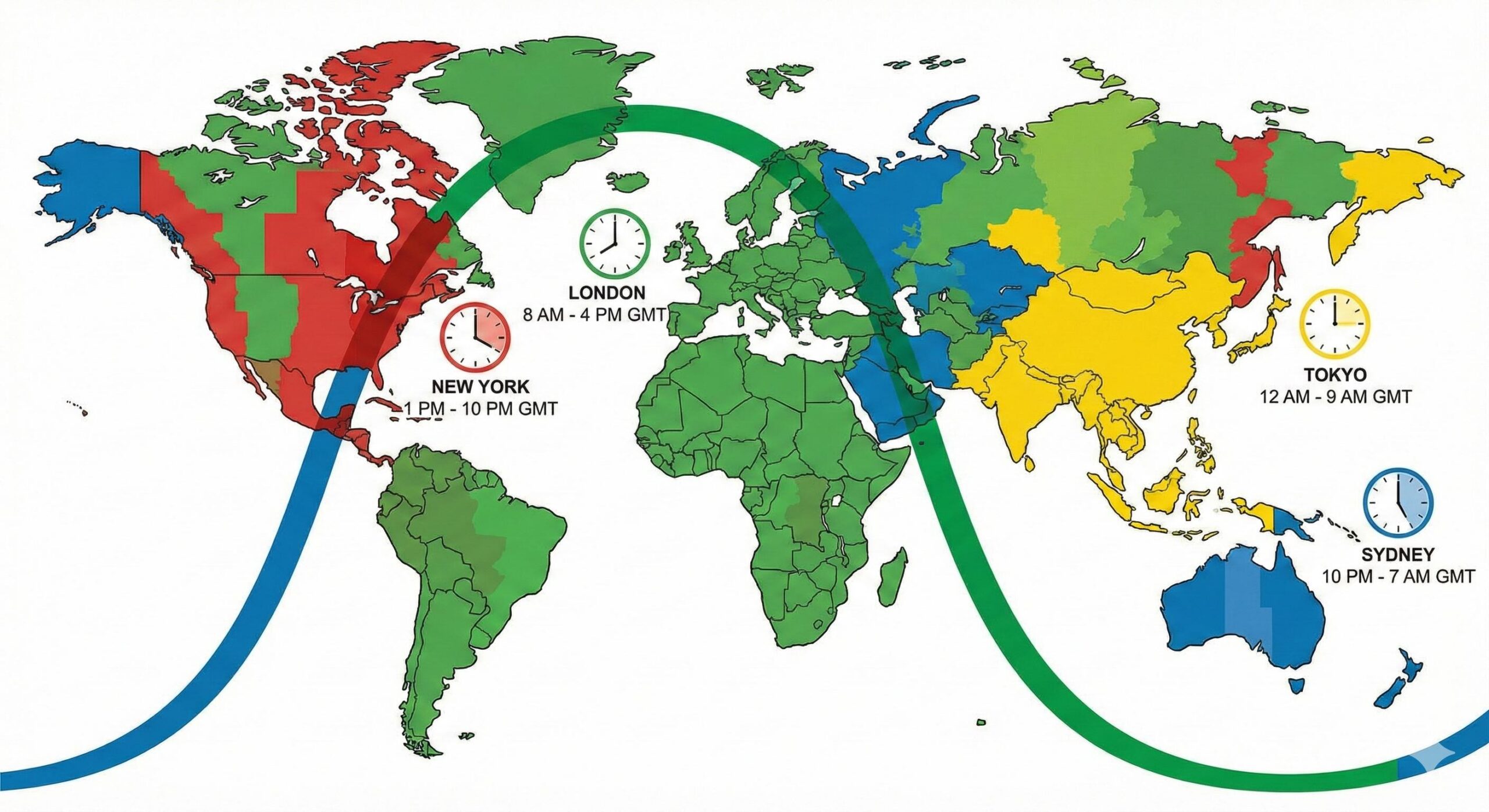
To determine the Best time to trade forex in Nigeria, you must know when the major financial centers are open. Below is a detailed table converting global market hours to Nigerian time.
Forex Market Hours Table (Nigeria Time GMT+1)
| Market Session | Region | Opens (Nigeria Time) | Closes (Nigeria Time) | Characteristics |
| Sydney | Pacific | 10:00 PM (Sunday) | 7:00 AM | Low Volatility, Market Open |
| Tokyo | Asian | 12:00 AM (Midnight) | 9:00 AM | Moderate Volatility (JPY focus) |
| London | European | 8:00 AM | 4:00 PM | High Volatility, Major Trends |
| New York | North American | 1:00 PM | 10:00 PM | High Volatility, News Events |
Note: These times can shift by one hour depending on Daylight Saving Time (DST) changes in the US and Europe.
1. The Sydney Session (Pacific)
- Time: 10:00 PM – 7:00 AM
- What Happens: This is when the market “opens” for the week on Sunday night in Nigeria. It is usually the quietest time. Price movement is often slow and range-bound.
- Best For: Analyzing the weekly opening price, but generally not ideal for high-frequency trading.
2. The Tokyo Session (Asian)
- Time: 12:00 AM – 9:00 AM
- What Happens: Japan is the third-largest forex trading center. Activity picks up slightly, especially in pairs containing the Japanese Yen (JPY).
- Best For: Traders who prefer slower markets or “Range Trading” strategies. However, staying up all night in Nigeria to trade this session can lead to fatigue and poor decision-making.
3. The London Session (European) – Critical for Nigeria
- Time: 8:00 AM – 4:00 PM
- What Happens: This is the heavyweight session. London is the financial capital of the forex world. Approximately 43% of all forex transactions happen here. Major trends often begin during this session.
- Best For: Nigerian traders, as this aligns perfectly with our morning and early afternoon. Volatility is high, providing opportunities, but risks are also elevated.
4. The New York Session (North American)
- Time: 1:00 PM – 10:00 PM
- What Happens: The US Dollar is involved in 90% of all trades. When New York opens, huge volume hits the market. This session is known for aggressive moves, especially when US economic news is released.
The “Overlap”: Understanding High Liquidity
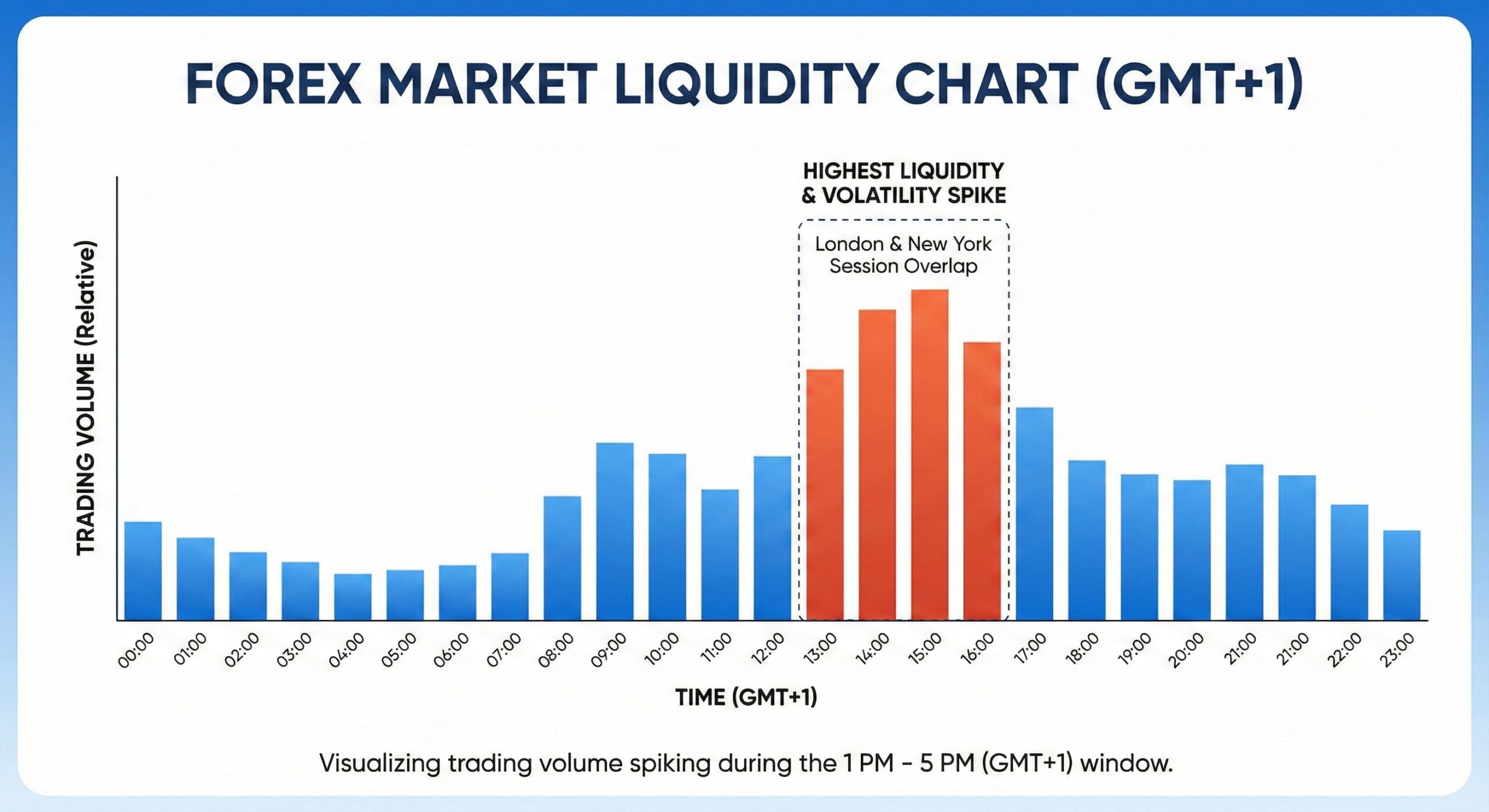
For many educational experts, the “Best” time is when the market has the most volume. High volume usually means tighter spreads (lower costs) and more significant price movement.
The London-New York Overlap
- Time in Nigeria: 1:00 PM to 4:00 PM (GMT+1)
- Why it matters: During this 3-4 hour window, the European banks are finishing their day while the American banks are just starting. The two largest financial centers in the world are open simultaneously.
- What to expect: This period often sees the highest volatility and liquidity of the entire day.
- Pros: Spreads are usually at their lowest. Price moves are genuine and often sustained.
- Cons: The market can move very fast. If you are on the wrong side of a trade without a Stop Loss, you can lose money quickly.
Is “Best” the Same for Everyone?
No.
- Scalpers (Short-term): Prefer the Overlap (1 PM – 4 PM) for quick price moves.
- Swing Traders (Long-term): May prefer to analyze charts at the daily close (10:00 PM Nigerian time) when the market is quiet to plan for the next day.
- Beginners: It is often safer to avoid the first 15 minutes of the New York opening (1:00 PM – 1:15 PM) due to chaotic price spikes and “whipsaws.”
Is Forex Trading Legal in Nigeria?
Before engaging in any market activity, it is vital to understand the legal framework to ensure you are operating safely.
Legality for Individuals
Yes, Forex Trading is Legal. Individual Nigerians are legally permitted to trade foreign currencies online using their personal funds. There is no law in the Nigerian Constitution that criminalizes retail forex trading for personal investment.
The Role of Regulation
- The CBN: The Central Bank of Nigeria (CBN) regulates the traditional banking sector and the official foreign exchange windows. They have strict policies regarding the sourcing of FX for imports. However, these policies generally apply to Authorized Dealers (Banks) and Bureau De Change operators, not individual retail traders speculating on price differences via international brokers.
- Broker Regulation: Currently, there is no specific licensing framework for online retail forex brokers within Nigeria. This means most Nigerian traders use international brokers.
- Safety Tip: Because there is no local protection, beginners must strictly stick to brokers regulated by Tier-1 international authorities like the FCA (UK), ASIC (Australia), or FSCA (South Africa). Using an unregulated broker puts your capital at severe risk of fraud.
Common Forex Trading Risks (IMPORTANT)
Understanding when to trade is useless if you do not understand the risks involved. The forex market is unforgiving, and losses are a normal, unavoidable part of the business.
Market Volatility Risk
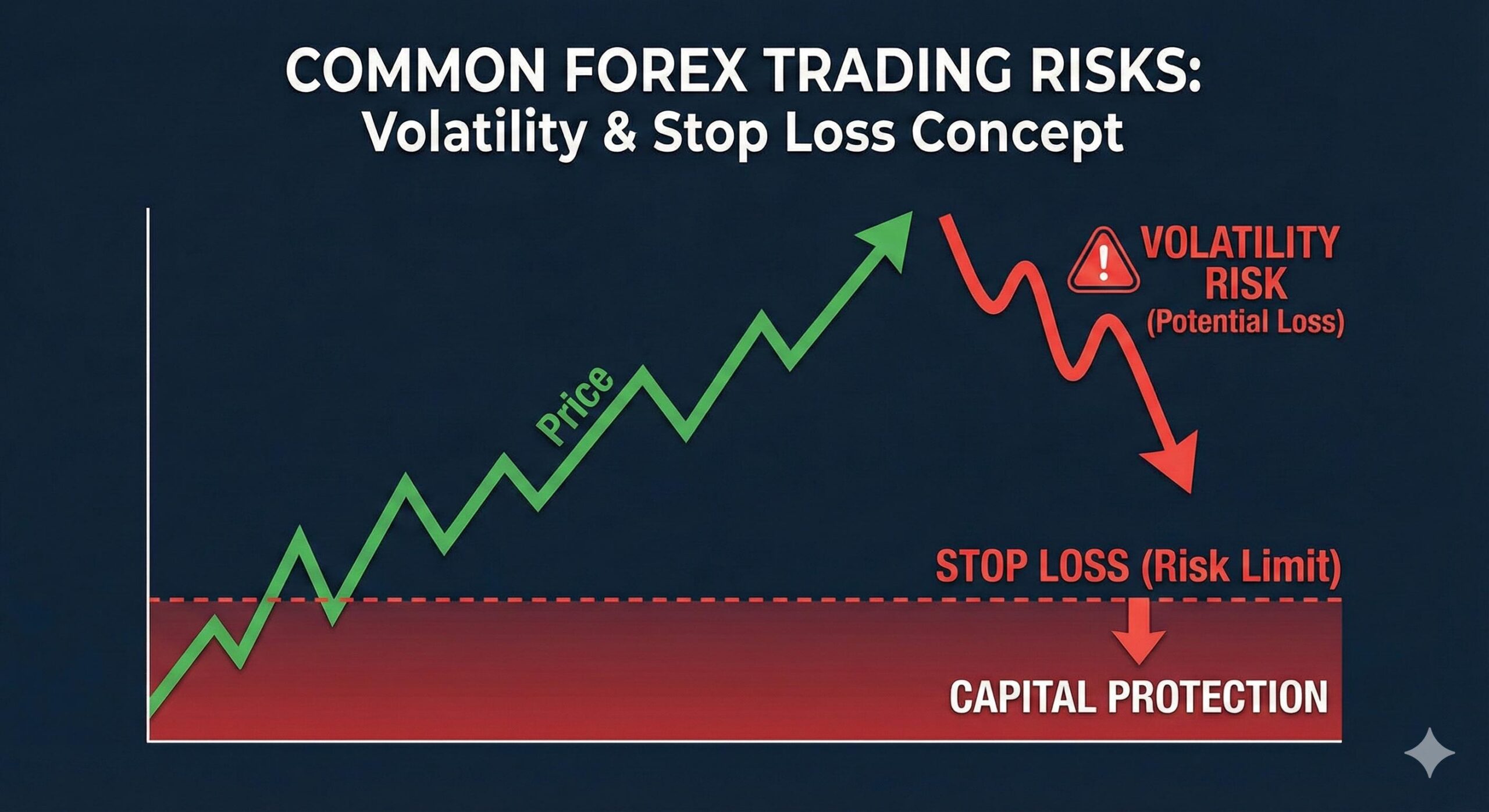
While volatility (price movement) is necessary to make a profit, it is also what causes losses. During major news events—like the US Non-Farm Payroll (NFP) or CBN interest rate decisions—volatility can be extreme. Prices can jump dozens of pips in seconds, potentially skipping over your Stop Loss order.
The “Spread” Risk
The spread is the fee you pay to the broker (the difference between the Buy and Sell price).
- During “Best” Times: Spreads are usually low (tight), meaning it costs less to open a trade.
- During “Worst” Times: During the late Asian session (early morning in Nigeria) or just before the market closes on Friday, spreads can widen significantly. Trading during these times puts you at a mathematical disadvantage.
Leverage Risk
Leverage allows traders to control large positions with small capital (e.g., using $10 to control $1,000).
- The Danger: Leverage amplifies losses just as much as gains. A small market move against you can wipe out your entire account balance if high leverage is used without proper risk management.
Beginner Mistakes Nigerians Should Avoid
In the quest to find the best time to trade, many beginners in Nigeria fall into specific traps that lead to blown accounts.
Trading During High-Impact News
Many beginners try to “gamble” on news releases (like US Inflation data at 1:30 PM Nigerian time).
- The Mistake: Placing trades minutes before the news drops, hoping to catch a big move.
- The Consequence: “Slippage” (where the trade opens at a worse price than expected) often occurs. The price can move up and down violently in the same second, hitting your Stop Loss and taking your money before moving in your direction.
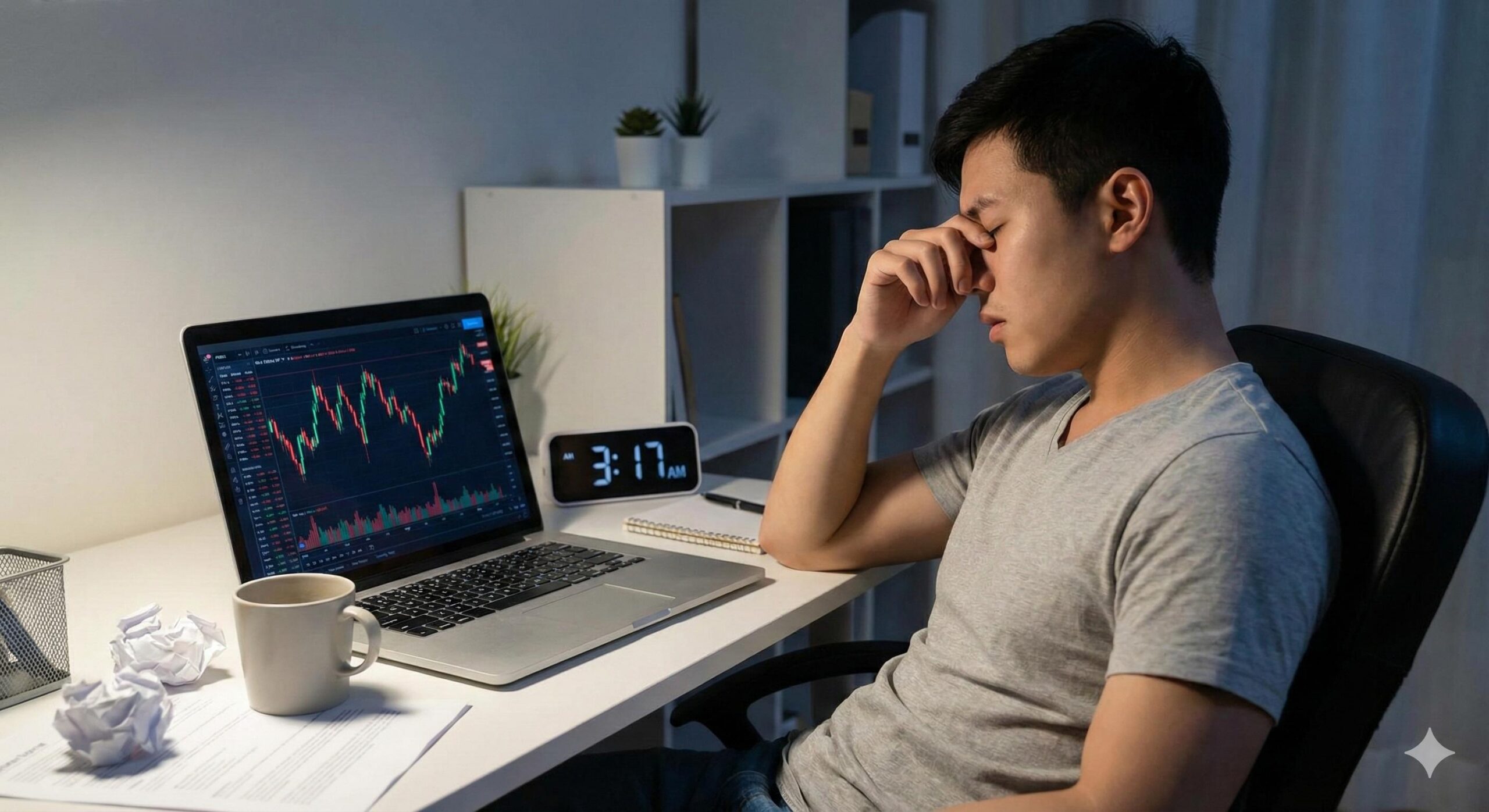
Trading When Tired
Because the market is open 24 hours, some beginners stay up all night trying to trade the Asian session.
- The Mistake: Trading with fatigue.
- The Reality: The Asian session is often slow. It is better to trade during the London session (morning/afternoon in Nigeria) when you are alert and liquidity is high.
Holding Trades Over the Weekend
The market closes on Friday night and opens Sunday night.
- The Risk: If a major geopolitical event (like a war or election) happens on Saturday, the market might “Gap” on Sunday night. This means the price opens significantly higher or lower than where it closed, bypassing your Stop Loss. For beginners, it is safer to close all trades on Friday evening.
Can I Trade Forex with 10,000 Naira in Nigeria? A Beginner’s Guide (2026)
Learning Forex Trading the Right Way
Success in forex is not about owning the most expensive laptop or having the fastest internet in Lagos. It is about education, patience, and discipline.
Education-First Approach
Do not rush to deposit money. Spend weeks or months studying.
- Market Structure: Learn how to identify if the market is trending up or down.
- Japanese Candlesticks: Learn to read the price action on the chart.
- Risk Management: This is the most important skill. Learn how to calculate lot sizes so you never risk more than 1-2% of your account on a single trade.
The Importance of Demo Accounts
Every reputable broker offers a free Demo Account. This allows you to trade with virtual “fake” money in real market conditions.
- Educational Step: Use a demo account to test different trading times. Try trading during the London session and then the Asian session. Compare the results.
- The Rule: Do not deposit real money until you are consistently profitable on a demo account for at least 3 months.
How to Stay Safe From Forex Scams in Nigeria
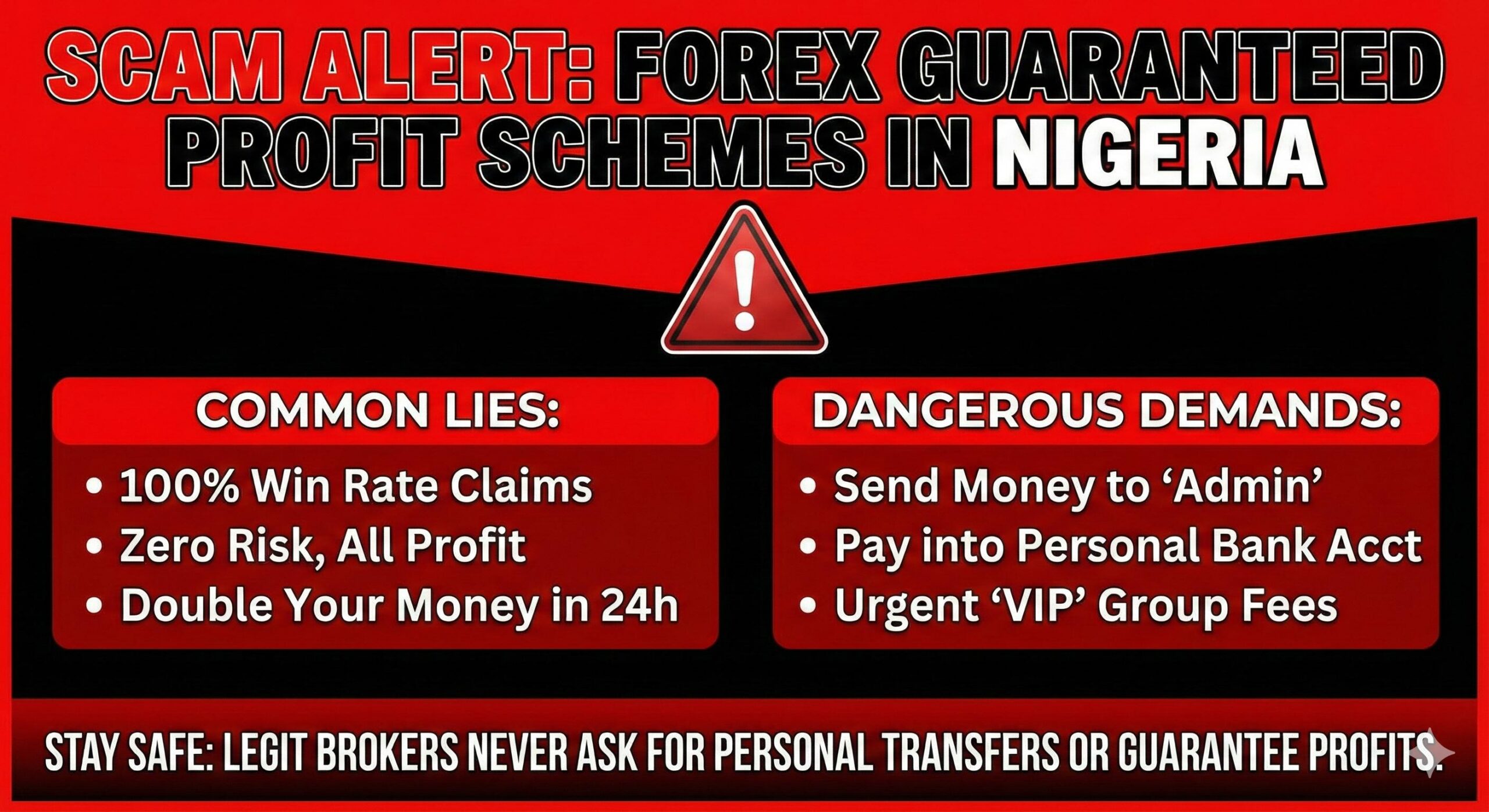
The search for the “Best time to trade” often leads beginners to scammers who promise they have the “secret timing” or “special software.”
Red Flags to Watch For
- “Guaranteed Profits”: No one knows what the market will do. The market is uncertain. Anyone guaranteeing you a profit is lying.
- “Insider Secrets”: Scammers claim they know the exact time the market will move. This is false. The market is driven by global macroeconomics, not secrets.
- Investment Schemes: Be extremely wary of anyone asking you to send money to their personal bank account (Opay, Palmpay, Kuda) so they can “trade for you.” Legitimate trading involves YOU depositing directly with a regulated broker’s business account.
WhatsApp and Telegram Groups
Be extremely cautious of “VIP Signal Groups” on Telegram. Many of these groups manipulate demo account screenshots to look like real profits. They prey on beginners’ desire for quick success to sell expensive subscriptions or steal funds.
Frequently Asked Questions (FAQ)
Q1: What is the best time to trade forex in Nigeria (GMT+1)?
Generally, the London session (8:00 AM – 4:00 PM) and specifically the London/New York overlap (1:00 PM – 4:00 PM) offer the highest liquidity and volume for Nigerian traders.
Q2: Can I trade forex at night in Nigeria?
Yes, you can trade the Asian session (Late night/Early morning). However, volatility is usually lower, and spreads may be higher for European currency pairs like EUR/USD or GBP/USD.
Q3: Is forex trading safe for beginners?
Forex trading carries high risk. It is “safe” only if you use a regulated broker, practice on a demo account first, and strictly manage your risk. Losing capital is a very real possibility.
Q4: How much money do I need to start trading?
You can start learning with Zero Naira using a demo account. When ready to go live, many brokers accept small deposits ($10-$50), but it is recommended to have adequate capital to manage risk properly.
Q5: Does the CBN regulate forex trading?
The CBN regulates banks and the official FX market. They do not currently license online retail forex brokers. This is why due diligence in choosing an internationally regulated broker is essential.
Q6: What happens if I trade on public holidays?
If it is a public holiday in Nigeria but not in the UK or USA, the market is open. If it is a holiday in London or New York, liquidity will be very thin, and it is usually better to avoid trading.
Conclusion
Finding the Best time to trade forex in Nigeria (GMT+1) is a significant step in a beginner’s journey, but it is only one piece of the puzzle. While the overlap between the London and New York sessions (1:00 PM – 4:00 PM WAT) offers the most activity, it also carries the risk of higher volatility.
Successful trading is not just about being awake at the right time; it is about having a solid trading plan, managing your risk on every single trade, and maintaining emotional discipline. The market will always be there. There is no need to rush. Take your time to learn the mechanics of the sessions using a demo account before you ever risk your hard-earned capital.