
Introduction
In the fast-paced, high-stakes world of the global financial markets, a Nigerian trader’s greatest adversary is often not the market volatility itself, but their own internet connection. Imagine the scenario: You have analyzed the charts for hours, identified a perfect entry point on the GBP/USD pair, and clicked “Buy.” Suddenly, a “Reconnecting…” wheel spins on your screen. By the time the connection restores ten seconds later, the price has moved against you, turning a potential win into an immediate loss. In the world of forex trading, speed is not just a luxury—it is currency.
For beginners residing in Lagos, Abuja, Port Harcourt, and other bustling Nigerian cities, finding the best internet service for forex in Nigeria is just as critical as choosing a regulated broker. A poor connection leads to “slippage” (entering a trade at a different price than intended), missed opportunities, and the psychological stress of disconnects during major news events like the US Non-Farm Payrolls (NFP).
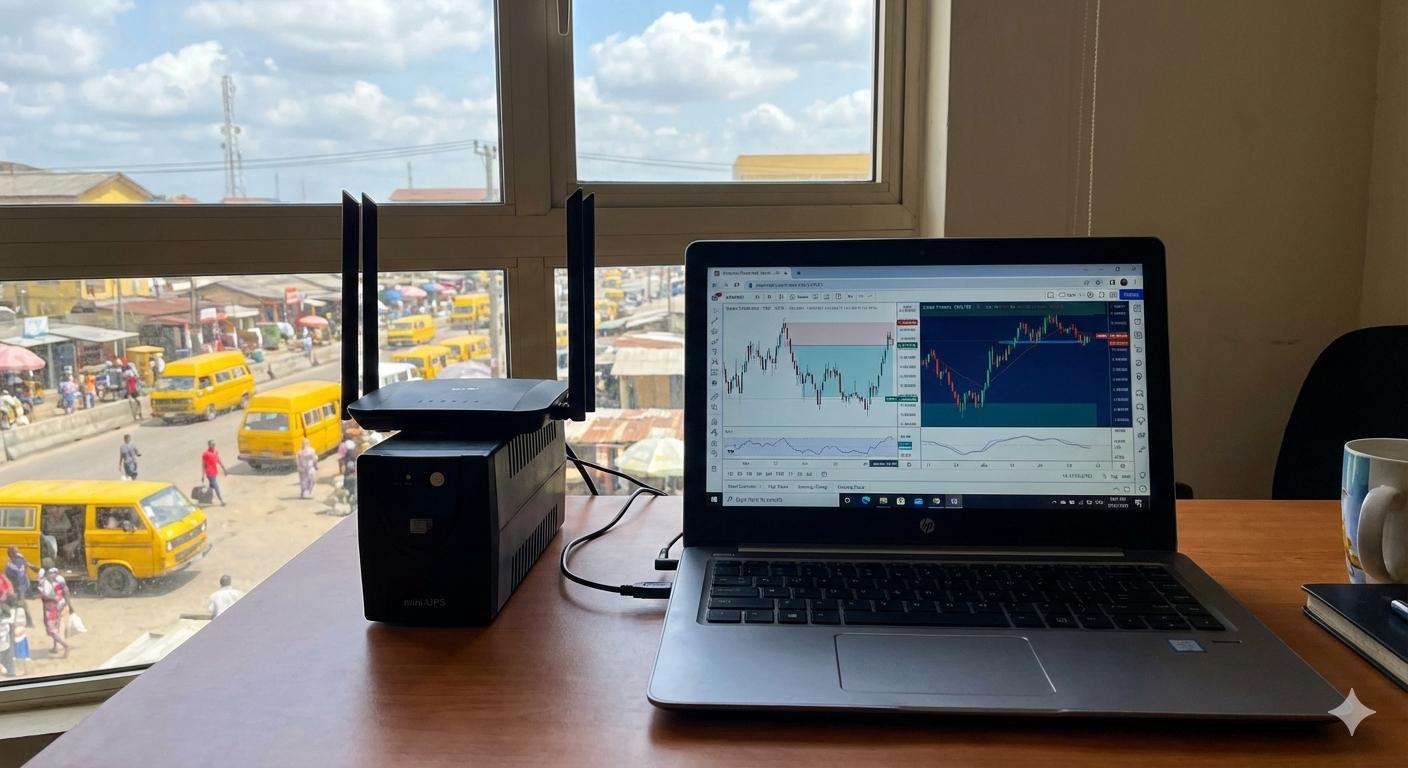
This guide is written for educational purposes to help you understand the technical requirements of a professional trading setup. We will move beyond the marketing hype of “download speeds” to discuss what really matters for trading: latency (ping), jitter, and reliability. We will also provide a detailed comparison of the top options available in Nigeria in 2026—from Fiber Optics and 5G to Low-Earth Orbit satellites like Starlink—to help you build a resilient, professional trading desk.
Table of Contents
What Is Forex Trading?
Foreign Exchange, commonly referred to as Forex or FX, is the decentralized global marketplace where the world’s currencies are exchanged. It is the largest and most liquid financial market in the world, with daily trading volumes exceeding $6 trillion—dwarfing the New York Stock Exchange.
In its simplest form, forex trading involves exchanging one currency for another.
- Real-World Example: If a Nigerian electronics importer needs to purchase inventory from Japan, they cannot pay in Naira (NGN). They must exchange their Naira (or US Dollars) for Japanese Yen (JPY). This commercial demand drives the price of the Yen up or down.
For retail traders (individuals trading from home), the goal is not to buy physical cash for travel or business, but to speculate on these price movements using “Contracts for Difference” (CFDs). You are essentially making a prediction: “I think the Euro will become stronger than the Dollar today.”
Key Concept: Forex trading is a high-risk financial profession. It requires patience, extensive education, and stable infrastructure. It is absolutely not a “get rich quick” scheme or a solution to immediate financial problems.
How Forex Trading Works
To understand why your internet connection is the backbone of your trading business, you must first understand the journey of a single “click.”
The Journey of a Trade Execution
When you click “Buy” on your laptop in Ikeja or Maitama, a complex digital relay race begins:
- Signal Sent: Your “Buy” request travels from your computer/phone to your Internet Service Provider (ISP) via your router or mast.
- The Hop: The signal travels through undersea fiber optic cables (like the MainOne or Glo-1 cables) all the way to a server in London or New York, where most major brokers and liquidity providers host their data centers.
- Execution: The broker’s server receives your order, matches it with a seller, and executes the trade.
- Confirmation: The confirmation message travels all the way back through the cables to your screen in Nigeria.
This entire round trip is measured in milliseconds (ms). If your internet has high “latency” (delay), the price of the currency pair might change during those few milliseconds your signal is traveling. This phenomenon is called Slippage.
- Example: You click Buy at 1.2050. Because of slow internet, the order arrives late, and you actually get filled at 1.2055. You have started the trade with a 5-pip disadvantage simply because of your connection.
Is Forex Trading Legal in Nigeria?
This is a common concern given the strict financial regulations often discussed in Nigerian news.
The Short Answer: Yes, retail forex trading is generally legal in Nigeria. There is currently no law in the Nigerian constitution that prohibits a citizen from using their legitimate personal funds to speculate on international currency markets.
The Regulatory Context:
- Central Bank of Nigeria (CBN): The CBN’s primary mandate is to manage the country’s foreign exchange reserves and stabilize the Naira. Their restrictions usually focus on banking channels (e.g., stopping the use of Naira debit cards for international transactions to prevent capital flight). They do not criminalize the act of individual trading itself.
- Securities and Exchange Commission (SEC): The SEC regulates the investment space. They actively warn against unregistered investment schemes (Ponzi schemes) that claim to trade forex on your behalf.
- Your Responsibility: As a trader, you are responsible for declaring your income for tax purposes and ensuring you are not participating in illegal money laundering activities.
Best Forex Trading Platforms for Beginners NGN: 2026 Educational Guide
Why Internet Speed Matters: Latency vs. Bandwidth
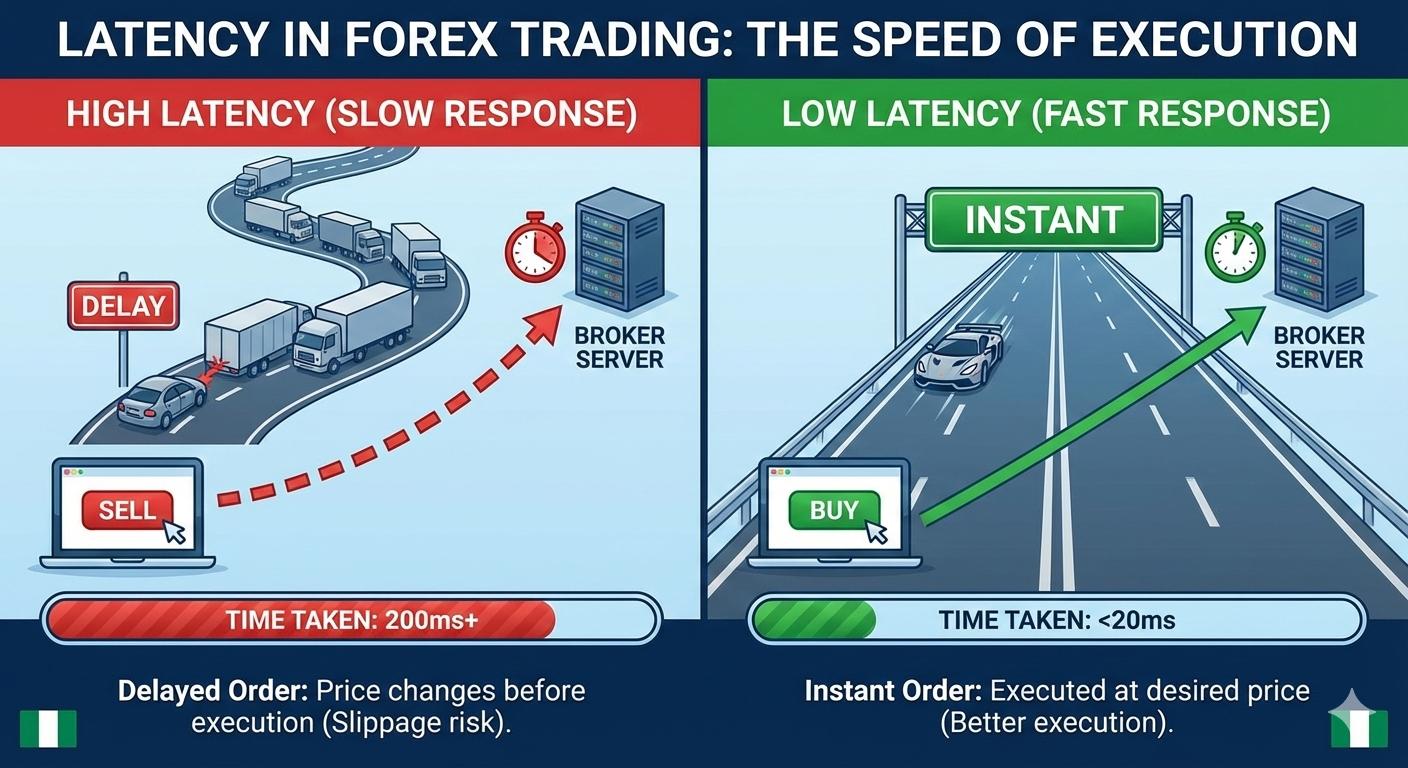
Most Nigerian ISPs market their services based on “Download Speed” (e.g., 50 Mbps or 100 Mbps). For a forex trader, this number is almost irrelevant. You are sending tiny bits of text data (buy/sell orders), not downloading 4K movies.
1. Latency (Ping)
- Definition: The time it takes for a packet of data to travel from your computer to the broker’s server and back. It is measured in milliseconds (ms).
- Ideal for Trading:
- < 50ms: Excellent (Professional grade).
- 50ms – 100ms: Good (Standard for Nigeria).
- > 200ms: Dangerous (High risk of slippage).
- Why it matters: High latency means you are seeing “old” prices. The market has already moved by the time you see the candle close.
2. Jitter
- Definition: The instability or variance of your ping. If your ping jumps from 50ms to 500ms and back to 50ms every few seconds, you have high jitter.
- Why it matters: Jitter causes charts to “freeze” or “lag.” A stable, slower connection is often better for trading than a fast connection that spikes unpredictably.
3. Reliability (Uptime)
- Definition: How often the internet disconnects completely.
- Why it matters: Imagine you have an open trade without a Stop Loss, and the market starts crashing. You try to close the trade, but your internet cuts out. By the time you reconnect 5 minutes later, your account could be blown. Reliability is non-negotiable.
Top Internet Options for Nigerian Traders (2026)
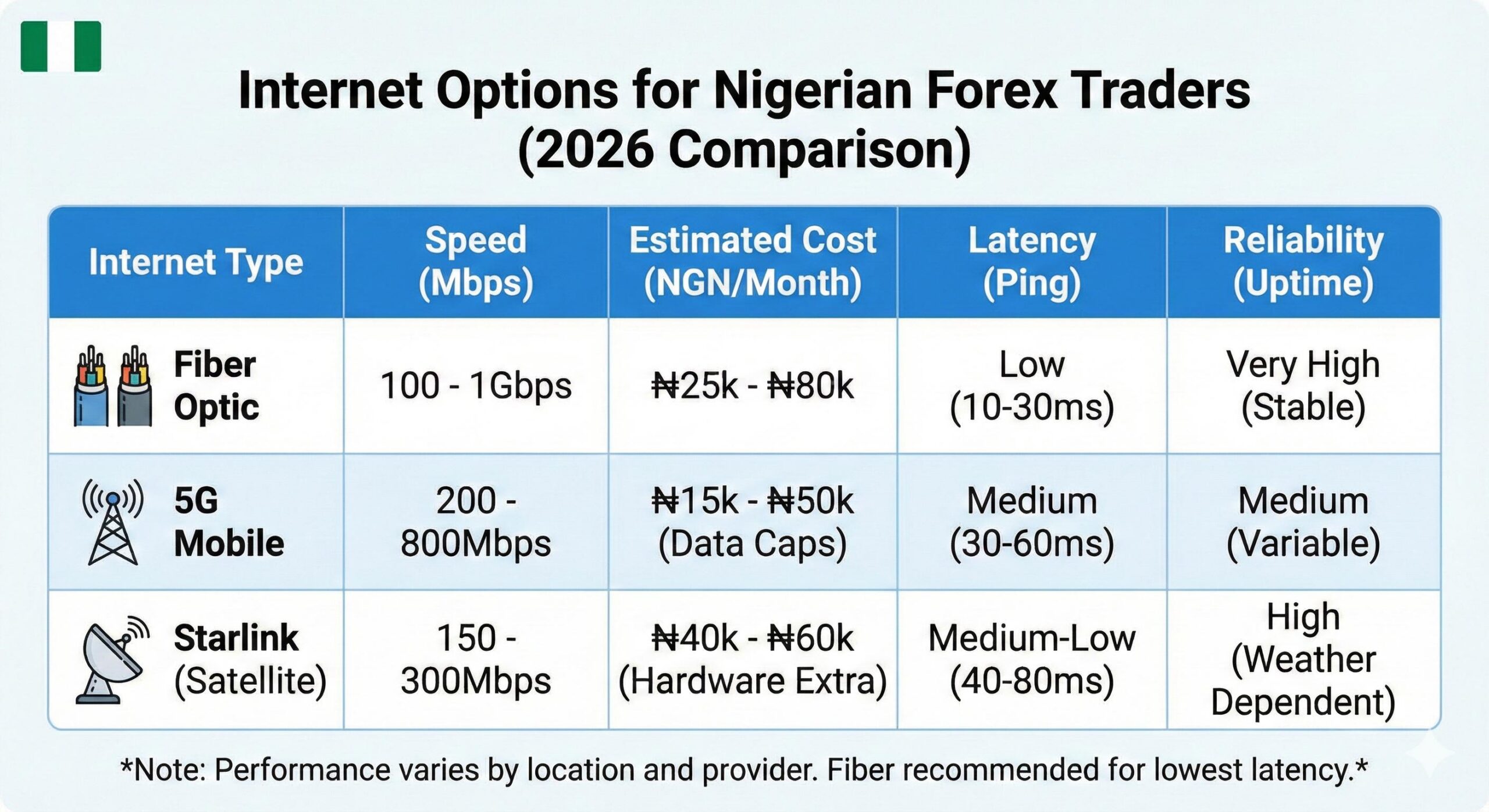
Thanks to significant infrastructure upgrades in 2026, Nigerian traders now have access to world-class internet options. Here is a detailed breakdown of the best categories.
1. Fiber Optic (The Gold Standard)
Fiber optic cables deliver the lowest latency because they use light to transmit data, which is faster than copper cables or radio waves.
- Top Providers: ipNX, FiberOne, Coollink, MainOne (for business).
- Pros: Extremely low ping (often 10-20ms to local servers, stable to London), consistent speeds, unlimited data plans (no “fair usage” caps on premium plans).
- Cons: Geographic limitation. Only available in major cities (Lagos, Abuja, PH) and specific high-end estates. High installation cost (cabling into your home).
- Verdict: If you live in a coverage area, Fiber is the #1 choice for a serious trader. It offers the stability required for scalping and day trading.
2. 5G Networks (The Flexible Alternative)
With the aggressive rollout of 5G by major telecoms, mobile internet has become a viable primary option for many traders.
- Top Providers: MTN 5G, Airtel 5G, Mafab.
- Pros: Portable (you can trade from anywhere), lower setup cost than fiber (just buy a 5G router), speeds can be comparable to fiber in uncongested areas.
- Cons: Congestion. Speeds often drop drastically in the evenings (7 PM – 10 PM) when everyone is streaming video. Higher latency than fiber due to wireless transmission. Data caps can be expensive for heavy users.
- Verdict: Excellent as a primary connection for swing traders or a backup for professionals.
3. Low-Earth Orbit Satellite (Starlink)
Starlink has revolutionized internet access in remote Nigeria. Unlike old VSATs that were slow, Starlink satellites are close to Earth, offering decent latency.
- Pros: Works anywhere in Nigeria (villages, remote towns, offshore). Decent latency (40-100ms), high download speeds.
- Cons: Very high hardware cost (hundreds of thousands of Naira). Susceptible to “Rain Fade”—the signal can degrade or cut out completely during the heavy tropical rainstorms common in Southern Nigeria.
- Verdict: The best option if you live outside major cities where Fiber/5G is unavailable.
The “Nigerian Factor”: Power Supply and Backups
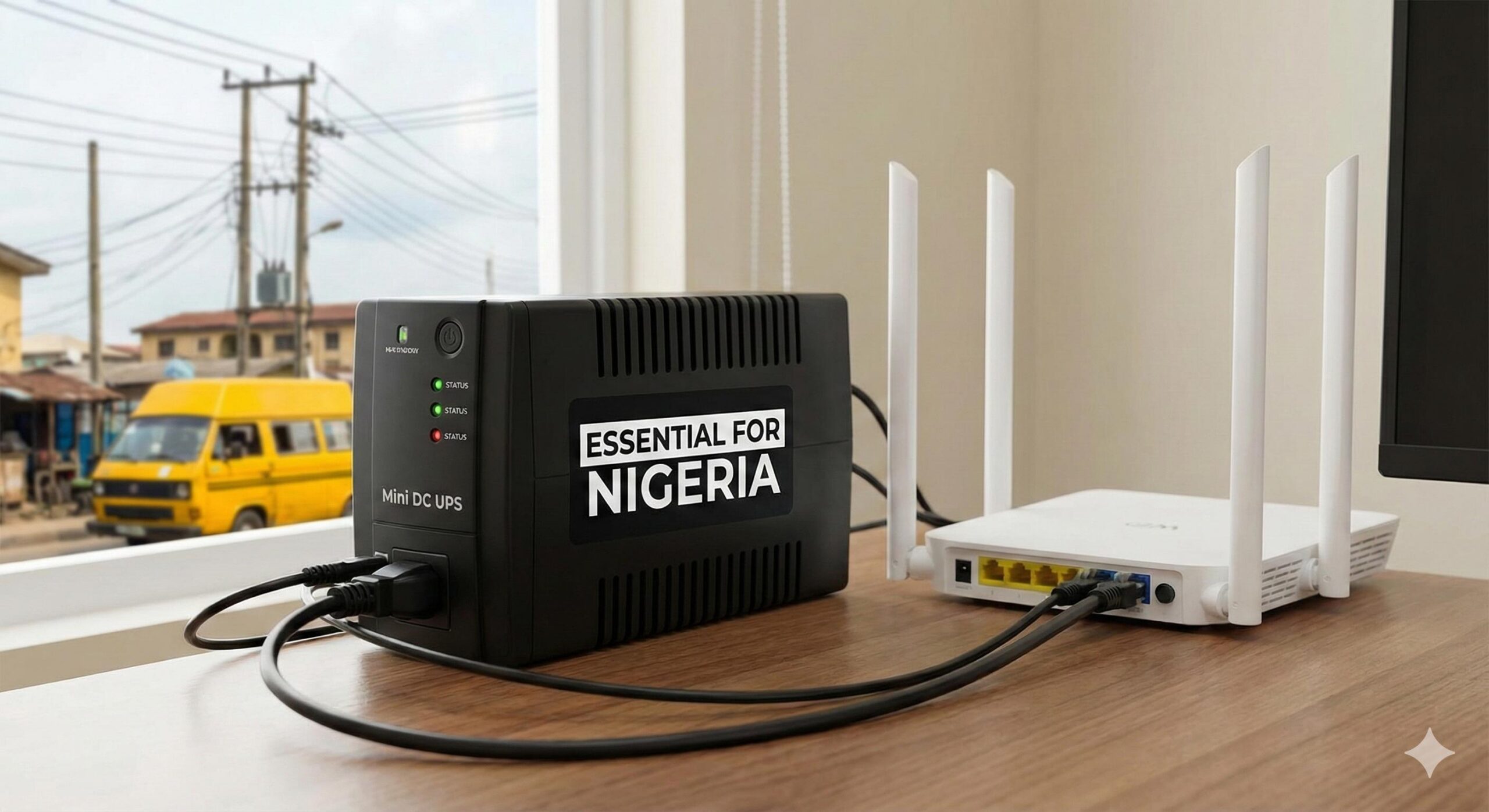
In Nigeria, having the fastest internet in the world is useless if your modem turns off when NEPA/PHCN takes the light.
Powering Your Internet
- Fiber/5G Routers: Most routers run on 12V DC power. You can purchase a Mini DC UPS (uninterruptible power supply) for roughly ₦15,000 – ₦35,000 in Computer Village or online. This small device sits between the wall socket and your router. When the power cuts, it keeps your internet running for 4-8 hours seamlessly.
- Starlink: Requires significantly more power (often 50W-100W). You will need a standard Inverter setup or a generator; a simple mini UPS is usually insufficient.
The Rule of Redundancy
Never trade with only one internet source.
- Primary: Fiber or Starlink.
- Backup: A fully charged smartphone with a 5G/4G data plan from a different network provider. (e.g., If your main fiber uses the MTN backbone, have an Airtel MiFi ready).
- Scenario: If your fiber line gets cut or the service goes down, you can instantly switch your laptop’s Wi-Fi to your phone’s hotspot and manage your trades.
Advanced Tip: Using a VPS to Solve Internet Issues
A Virtual Private Server (VPS) is essentially a computer that runs in the cloud, typically located in a data center in London or New York, right next to your broker’s servers.
How it helps Nigerian Traders:
- You rent a VPS (monthly fee).
- You install your trading platform (MT4/MT5) onto the VPS.
- You connect to the VPS from your Nigerian laptop using “Remote Desktop.”
- The Magic: The trading platform runs on the VPS, which has a 1ms ping to the broker and 24/7 power/internet.
- Benefit: Even if your Nigerian internet disconnects or your laptop battery dies, the VPS keeps running. If you are using an automated robot (Expert Advisor) or a Trailing Stop, it continues to work perfectly.
Common Forex Trading Risks (IMPORTANT)
Even with the fastest internet connection, forex trading remains a high-risk activity.
Market Volatility
Prices can move hundreds of pips in seconds during economic announcements. Fast internet helps you react, but it does not predict the future or prevent the market from moving against you.
Emotional Trading
“Revenge trading” (trying to win back losses immediately) causes more financial damage than slow internet ever could. A fast connection just helps you lose money faster if you lack discipline and a trading plan.
Leverage Risk
Leverage allows you to trade with borrowed funds. While it increases potential profit, it equally increases potential loss. High leverage combined with high volatility can lead to rapid account liquidation, regardless of your internet speed.
Beginner Mistakes Nigerians Should Avoid
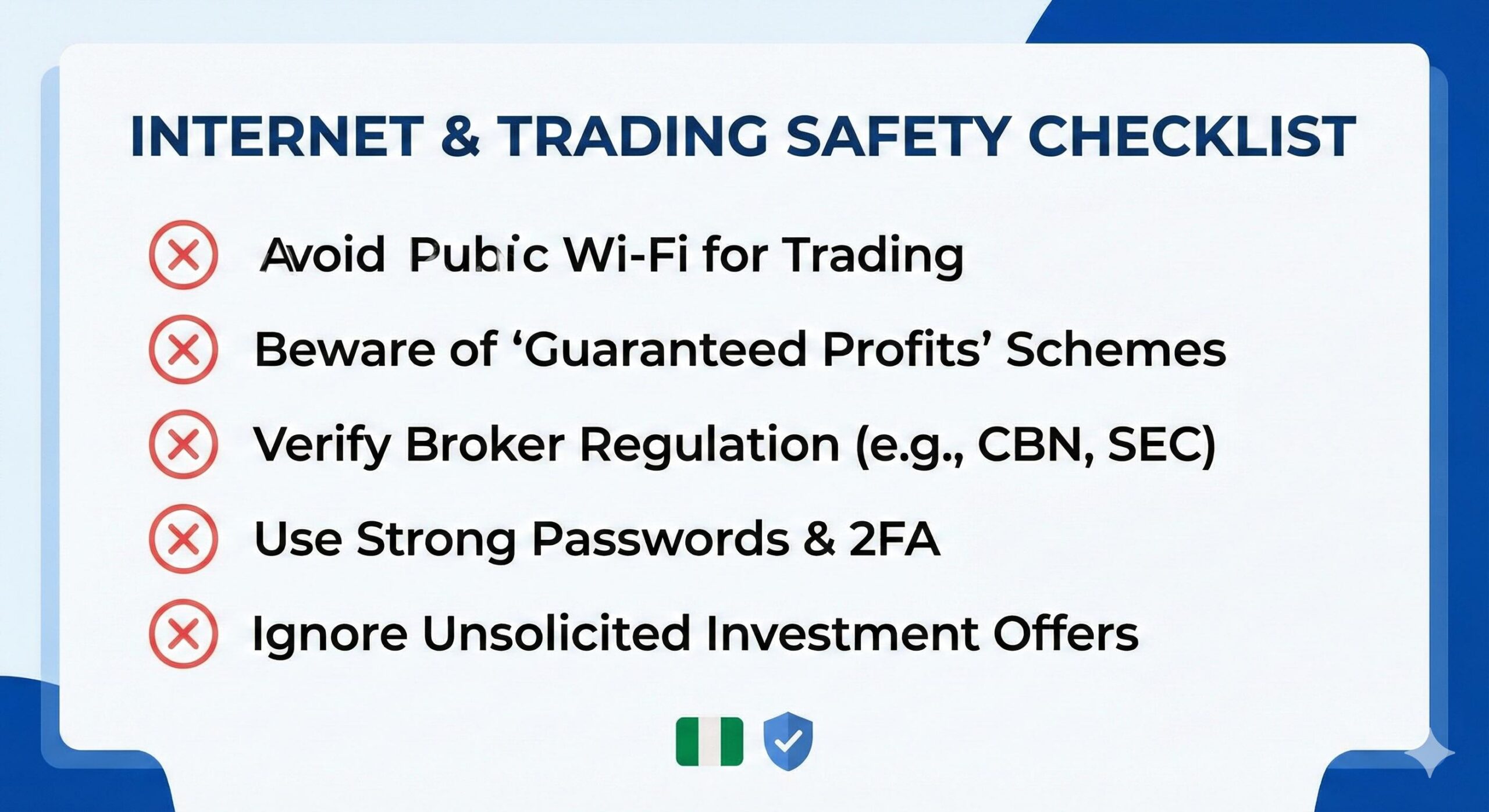
- Trading on Public Wi-Fi: Never use free Wi-Fi at eateries, airports, or hotels for trading. These networks are often insecure (prone to hacking) and unstable (prone to disconnects).
- Ignoring Weather Conditions: If you use 4G, 5G, or Starlink, be cautious during heavy thunderstorms. The signal will degrade. Do not open new “scalping” trades during a storm; wait for the weather to clear.
- Being Cheap on Hardware: Using a 10-year-old laptop that freezes or lags will hurt you just as much as slow internet. Ensure your trading device has enough RAM (at least 8GB) to run charting software smoothly.
- Trusting “Free Data” VPNs: Free VPNs often slow down your connection, increase latency, and sell your data. Avoid them for trading activities.
How to Stay Safe From Forex Scams in Nigeria
Scammers often target beginners searching for “forex investment” or “best internet for trading.”
Red Flags to Watch For:
- “Forex Investment Platforms”: Websites that ask you to deposit money for a “fixed monthly return” (e.g., 30% monthly). These are Ponzi schemes, not trading platforms. Real trading has no guarantees.
- Fake ISP Agents: People on Facebook or Telegram claiming to sell Starlink kits or Fiber installation for “half price.” Only buy hardware from official websites or verified physical offices.
- Guaranteed Profits: Any “mentor” who guarantees you will make money because they have a “special server” or “bot” is lying to you.
Frequently Asked Questions (FAQ)
Q1: What is the best internet speed for forex trading in Nigeria? A: Stability is more important than raw speed. A stable 10 Mbps connection with low ping (latency) is far better for trading than a 100 Mbps connection that disconnects every 10 minutes.
Q2: Is Starlink good for forex trading in Nigeria? A: Yes, it is a very good option, especially for those living in areas without Fiber coverage. However, its latency (40-100ms) is slightly higher than Fiber (10-20ms), and it can be affected by heavy rain.
Q3: Can I trade forex on mobile data (MTN/Airtel/Glo)? A: Yes, modern 4G/5G mobile data is sufficient for swing trading or long-term investing. However, for “Scalping” (very short-term trades lasting seconds or minutes), mobile data can be risky due to sudden signal fluctuations.
Q4: Do I need a VPS for manual trading? A: It is not mandatory for manual trading, but it is highly recommended if your local power or internet is unreliable. It acts as an insurance policy for your active trades.
Q5: Which network has the best ping in Nigeria? A: Generally, Fiber Optic providers (like ipNX or FiberOne) offer the best and most consistent ping. Among mobile networks, 5G networks currently offer better latency than older 4G LTE networks.
Q6: Are forex profits guaranteed if I get fast internet? A: Absolutely not. Fast internet only ensures your orders are delivered quickly and accurately. Your profitability depends entirely on your trading strategy, risk management, and market analysis skills.
Conclusion
Choosing the best internet service for forex in Nigeria is a critical business decision, not just a lifestyle choice. It is the bridge between you and the global markets.
For most traders in Lagos, Abuja, or Port Harcourt, Fiber Optic remains the gold standard for speed and reliability. For those in remote locations or with unstable infrastructure, Starlink offers a powerful alternative. And for everyone, a reliable 5G mobile backup and a DC UPS for power are non-negotiable essentials.
Remember, the market does not care if your data ran out or your light went off. It is your responsibility to build a resilient trading desk. Prioritize infrastructure over leverage, and education over speculation.
Disclaimer: This content is for educational purposes only and does not constitute financial or technical advice. Service quality of ISPs can vary by location. Trading forex involves high risk and you may lose your capital. Past performance is not indicative of future results.